

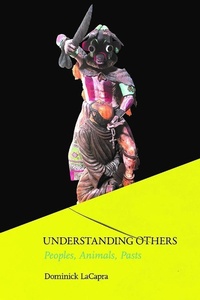
Understanding Others
Description

To what extent do we and can we understand others-other peoples, species, times, and places? What is the role of others within ourselves, epitomized in the notion of unconscious forces? Can we come to terms with our internalized others in ways that foster mutual understanding and counteract the tendency to scapegoat, project, victimize, and indulge in prejudicial and narcissistic impulses? How do various fields or disciplines address or avoid such questions? And have these questions become particularly pressing and not in the least confined to other peoples, times, and places?
Making selective and critical use of the thought of such important figures as Sigmund Freud, Jacques Derrida, and Mikhail Bakhtin, in Understanding Others Dominick LaCapra investigates a series of crucial topics from the current state of deconstruction, trauma studies, and the humanities to newer fields such as animal studies and posthumanist scholarship. LaCapra adroitly brings critical historical thought into a provocative engagement with politics and our current political climate. This is LaCapra at his best, critically rethinking major currents and exploring the old and the new in combination, often suggesting what this means in the age of Trump.
More details
Other editions
Additional editions
Person
Dominick LaCapra is Professor Emeritus of History and Comparative Literature and Bowmar Professor Emeritus of Humanistic Studies at Cornell University. He is the author of many books, including History, Literature, Critical Theory; History and Its Limits: Human, Animal, Violence; and History in Transit: Experience, Identity, Critical Theory.
Content
Introduction
1. History, Deconstruction, and Working through the Past
2. Humans, Other Animals, and the Humanities
3. Trauma, History, Memory, Identity: What Remains?
4. Frank Hamilton Cushing and His "Adventures" at Zuni
5. What is History? What is Literature?
6. What Use Are the Humanities?
Index
