

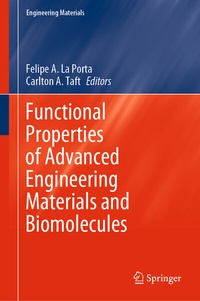
Functional Properties of Advanced Engineering Materials and Biomolecules
Description

This book shows how a small toolbox of experimental techniques, physical chemistry concepts as well as quantum/classical mechanics and statistical methods can be used to understand, explain and even predict extraordinary applications of these advanced engineering materials and biomolecules. It highlights how improving the material foresight by design, including the fundamental understanding of their physical and chemical properties, can provide new technological levels in the future.
More details
Other editions
Additional editions
Persons
Felipe A. La Porta (was born October 1988, in São Paulo, Brazil) received his undergraduate degree in Chemistry 2010 from the Federal University of Lavras (UFLA) and his Ph.D. in Chemistry in 2014 from the São Paulo State University (UNESP) in Araraquara, Brazil. Since 2015, he is currently an Adjunct Professor of chemistry and materials science at the Federal Technological University of Paraná (UTFPR). His research interests are in the field of the materials synthesis, spectroscopic and applications of novel advanced materials - from a combination of experimental and theoretical approaches.
Professor Dr. Carlton A. Taft earned the Master of Science (Physics), University of Illinois (USA) in 1969, and the Ph.D. in Physics at the Centro Brasileiro de Pesquisas Físicas in 1975 and did postdoctoral work as a Senior Visitor to the Chemistry Department, University of California (USA), in the 1980s. He was hired at CBPF in 1976 and worked his way up through the decades from Assistant, Associate to Full Professor. He has published 237 international papers in indexed scientific journals, ~250 communications in conferences and 25 book chapters and served as Editor for 7 books, Guest Editor for 6 Special Issues and referee for ~ 50 indexed scientific journals. He works in multidisciplinary areas with focus on theoretical-computational physical/chemical/biological/engineering applications in molecular and material sciences.