

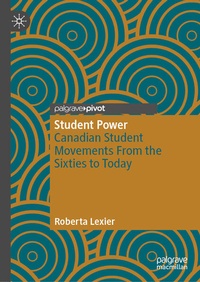
Student Power
Description

As global campus protests attract academic and public attention, interest in student movements continues to grow; however, very little is known about the Canadian context. Lexier's monograph offers the first detailed history of on-campus activism in Canada. Each chapter draws upon archival documents, media reports, and oral interviews to chronicle major upheavals in, respectively, the Sixties, 1974-2000, and 2000-2020. Grounded in the larger historical, political, economic, social/cultural, and institutional context of the period, each analyzes the various demands and tactics, the internal and external responses, and perceivable outcomes. Together, they demonstrate that student movements regularly anticipate broader social and political developments and, despite ongoing resistance to their confrontational strategies, effectively advance democracy and social justice both on- and off-campus.
The conclusion brings the story to the present moment, using news coverage, survey data, and interviews to examine recent pro-Palestinian encampments at Canadian universities. It encourages scholars, activists, and the general public to take student movements seriously, positing that they are viewed as dangerous, not because they interfere with university operations or public safety, but because they often herald real, transformative change.
More details
Other editions
Additional editions
Person
Roberta Lexier is Professor in the Departments of General Education and Humanities at Mount Royal University. She is the coeditor of Party of Conscience: The CCF, the NDP, and Social Democracy in Canada (2018).
Content
Chapter 1 - Canadian Student Movements: An Introduction.- Chapter 2 - The "Radical" Sixties: 1964-1974.- Chapter 3 - The End of History: 1975-2000.- Chapter 4 - The Neoliberal University: 2001-2020.- Chapter 5 - Conclusion: Some Final Lessons.
