

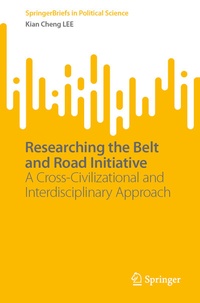
Researching the Belt and Road Initiative
Description

This book offers a cross-civilizational and interdisciplinary approach to the Belt and Road Initiative (BRI) research to mitigate the problematiques of extant literature. Instead of employing conventional lenses of geo-political, geo-economic and geo-strategic analyses that are predominant, this book offers fresh perspectives that venture into other civilizational and disciplinary territories while critically seeking integration without falling into romanticizing or essentializing any notions. Due to epistemic inadequacies and other conceptual limitations of existing approaches, this book argues that a heuristic framework drawing from the negotiation between Western and Chinese perspectives as well as integration of anthropological-international relations conceptualizations can provide greater potency in unravelling the intricacies of BRI studies. This book is a timely contribution to the ameliorating of the rising tensions between US and China over the recent years. An interdisciplinary toolkit for researchers in BRI-related research, as well as those in government organizations, policy-making bodies, think-tanks, trade and industry sectors, the book presents a paradigmatic shift from a predominantly hegemonic Western thinking about the BRI and its role in the region, and within academic dialogue.
More details
Other editions
Additional editions
Person
Kian Cheng LEE holds a Ph.D. (Social Sciences), M.A. (Southeast Asian Studies), M.Th. (Asian Christianity), M.Div., M.A. (Biblical Studies) and B.Sc. (Physics). He is Assistant Professor in the Faculty of Political Science and Public Administration while being affiliated with the School of Public Policy and Faculty of Social Sciences at Chiang Mai University. He is also a member of the board of the Asian Pastoral Institute Ltd. in Singapore. Kian Cheng's research interests concern Chinese capital interaction and business practices, transnational entrepreneurship, multi-dimensional (cultural, smart city and citizen) diplomacy, religion studies, and other emerging cross civilizational and interdisciplinary fields. Kian Cheng has published nine research-based articles in esteemed journals including Scopus-indexed journals such as Journal of Chinese Overseas, International Journal of China Studies, Journal of Current Chinese Affairs and Identities. In addition, he has published six research-based book chapters with Springer, Palgrave Macmillan and Edward Elgar Publishing, Inc.
Content
Introduction.- Problematizing Existing Approaches to BRI Studies.- Cross-Civilizational Negotiation between Western and Chinese Epistemic Perspectives in BRI Research.- Interdisciplinary Contributions from Anthropological Perspectives in BRI Research.- Toward a Heuristic Framework Integrating Cross-Civilizational and Interdisciplinary Perspectives in BRI Research.- Conclusion.
