

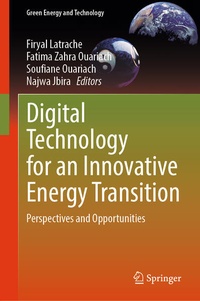
Digital Technology for an Innovative Energy Transition
Description

This book gives an insight into the laws, regulations and ethics involved in adopting digital technologies to promote the energy transition. The current global development requires a deep understanding and a well-adopted strategy. The energy transition is an essential lever for global development, whether in terms of energy consumption or the protection of biodiversity in order to combat climate change, which is threatening living beings. Climate change is not only threatening living beings, it is also threatening natural resources and, in particular, causing water stress, which is currently a major issue. The energy transition is therefore the key to solving these challenges by adopting purely renewable consumption to reduce the impact of fossil fuels. But how is energy transition contributing to development? Clearly, digitalisation is the current trend. So the idea is to use digital tools to achieve what we call an innovative energy transition. This edited book aims to present how digital technologies contribute to the energy transition. It discusses the approaches, challenges and opportunities of applying digitalisation in the energy sector to ensure an innovative energy transition. This digitisation can then be used to optimise energy efficiency using intelligent energy technologies. To ensure an innovative energy transition, the book encourages readers to discover artificial intelligence and energy simulation programmes. Finally, the book presents the concept of the digital enterprise in the energy sector and the emerging trends in smart energy professions up to 2050.
More details
Other editions
Additional editions
Persons
Firyal Latrache works as a temporary Professor at Mohammed First University in Oujda, Morocco. She has a PhD in mechanical and energy engineering. She works in solar thermal and thermodynamic energies, green hydrogen and smart cities. Her research focuses on the mathematical modeling of solar thermal energy applications, as well as the dimensioning and study of the technical feasibility of thermodynamic solar power plants. Firyal is a major player in the energy transition and sustainable development, and in achieving decarbonisation by 2050. She uses the electrical energy generated in thermodynamic solar power plants to generate green hydrogen. Its research focuses on developing mathematical and numerical models for heat exchangers and solar concentrators and on analyzing the thermomechanical behavior of materials to predict their industrial maintenance for Industry 4.0. She is currently working on books on the energy transition and smart cities. Firyal has reviewed numerous articles in international journals and conferences (Springer and Scientific.net). She is an Arabic-language poet, portraitist, and painter of abstract art.
Content
1 Introduction to the Digital and Energy Transition.- 2 The challenges and opportunities of digitalisation in the energy sector.- 3 Approaches of digital technologies in the transformation of the energy sector.- 4 Digital regulations and strategies for the energy transition.- 5 Using virtual reality as a digital lever to accelerate the energy transition.- 6 Tools and software for simulating energy systems.- 7 The design of intelligent systems to contribute to the development of the energy transition.- 8 Optimising energy efficiency through intelligent energy technologies.- 9 Using artificial intelligence to promote a sustainable energy transition.- 10 Ethical considerations in the adoption of digitalisation for the energy transition.- 11 Implementing the digital enterprise in the energy sector.- 12 Anticipating trends and the emerging new professions in smart energy by 2050.
