

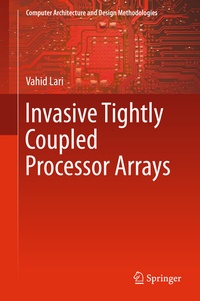
Invasive Tightly Coupled Processor Arrays
1st Edition
Published on 8. July 2016
XXIII, 149 pages
978-981-10-1058-3 (ISBN)
Description

This book introduces new massively parallel computer (MPSoC) architectures called invasive tightly coupled processor arrays. It proposes strategies, architecture designs, and programming interfaces for invasive TCPAs that allow invading and subsequently executing loop programs with strict requirements or guarantees of non-functional execution qualities such as performance, power consumption, and reliability. For the first time, such a configurable processor array architecture consisting of locally interconnected VLIW processing elements can be claimed by programs, either in full or in part, using the principle of invasive computing. Invasive TCPAs provide unprecedented energy efficiency for the parallel execution of nested loop programs by avoiding any global memory access such as GPUs and may even support loops with complex dependencies such as loop-carried dependencies that are not amenable to parallel execution on GPUs. For this purpose, the book proposes different invasion strategies for claiming a desired number of processing elements (PEs) or region within a TCPA exclusively for an application according to performance requirements. It not only presents models for implementing invasion strategies in hardware, but also proposes two distinct design flavors for dedicated hardware components to support invasion control on TCPAs.
More details
Series
Language
English
Place of publication
Singapore
Singapore
Publishing group
Springer Singapore
Target group
Professional and scholarly
Product notice
Reflowable
Illustrations
XXIII, 149 p. 52 illus., 49 illus. in color.
File size
8,01 MB
ISBN-13
978-981-10-1058-3 (9789811010583)
DOI
10.1007/978-981-10-1058-3
Schweitzer Classification
Other editions
Additional editions
VAHID LARI
Invasive Tightly Coupled Processor Arrays
Book
07/2016
Springer
€106.99
Shipment within 15-20 days
Person
Vahid Lari is a researcher at the Department of Computer Science, Friedrich-Alexander University Erlangen-Nürnberg (FAU), since 2008. He defended his PhD degree on the topic of "Invasive Tightly Coupled Processor Arrays" in November 2015. He received his bachelor degree in computer engineering in 2005 from University of Isfahan, Iran, and master degree in computer architectures in 2007 from Sharif University of Technology, Iran. His main research interests include fault tolerance, programmable hardware accelerators, the design of massively parallel architectures and system level performance evaluation.
Content
Introduction.- Invasive Tightly Coupled Processor Arrays.- Self-adaptive Power and Energy Management for TCPAs.- On-Demand Fault Tolerance on Massively Parallel Processor Arrays.- Conclusions and Future Work.
