

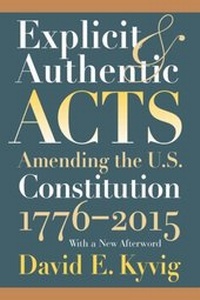
Explicit and Authentic Acts
Description

Winner: Bancroft Prize
Winner: Henry Adams Prize
Winner: Ohio History Association Book Prize
In time for the 225th anniversary of the Bill of Rights, David Kyvig completed an Afterword to his landmark study of the process of amending the US Constitution. The Afterword discusses the many amendments, such those requiring a balanced federal budget or limiting the terms of members of Congress, that have been proposed since the book was originally published and why they failed of passage. At a time when prominent scholars and other public figures have called for a constitutional convention to write a new constitution, arguing that our current system of governance is unsustainable Kyvig reminds us of the high hurdles the founders created to amending the constitution and how they have served the country well, preventing the amendment process from being used by one faction to serve the passions of the moment.
In his farewell address, President Washington reminded his audience that the Constitution, ?till changed by an explicit and authentic act of the whole people, is sacredly obligatory upon all.? He regarded the Constitution as a binding document worthy of devout allegiance, but also believed that it contains a clear and appropriate procedure for its own reform. David Kyvig's illuminating study provides the most complete and insightful history of that amendment process and its fundamental importance for American political life
Over the course of the past two centuries, more than 10,000 amendments have been proposed by the method stipulated in Article V of the Constitution. Amazingly, only 33 have garnered the required two-thirds approval from both houses of Congress, and only 27 were ultimately ratified into law by the states. Despite their small number, those amendments have revolutionized American government while simultaneously legitimizing and preserving its continued existence. Indeed, they have dramatically altered the relationship between state and federal authority, as well as between government and private citizens.
Kyvig reexamines the creation and operation of Article V, illuminating the process and substance of each major successful and failed effort to change the formal structure, duties, and limits of the federal government. He analyzes in detail the Founders' intentions; the periods of great amendment activity during the 1790s, 1860s, 1910s, and 1960s; and the considerable consequences of amendment failure involving slavery, alcohol prohibition, child labor, New Deal programs, school prayer, equal rights for women, abortion, balanced budgets, term limits, and flag desecration.
All prices
More details
Other editions
Additional editions
Person
David E. Kyvig was professor of history at the University of Akron.
Content
Preface
Acknowledgments 2016
Preface 1996
Acknowledgments 1996
1. ?Here Shall Be Thy Bounds?
The Rise of Constitutionalism
2. ?To Rectify the Errors That Will Creep In?
The Emergence of the Amending Corollary
3. ?A Peacable Process of Cure?
Devising the American Amending System
4. ?A Remedy in the System Itself?
Amending and the Adoption of the Constitution
5. ?The Most Satisfactory Provisions for All Essential Rights?
Immediate Amendment as the Constitution's Price and Proof
6. ?Too Ticklish to be Unnecessarily Multiplied?
Amendments and the Judicial Review Alternative
7. ?In Pursuit of an Impracticable Theory?
States' Rights and Constitutional Amendment
8. ?Consummated Amid Fiery Passions?
The Second American Constitutional Revolution
9. ?No Force Less Than the Force of Revolution?
Resurrecting the Amending Remedy
10. ?Just as Far as Public Sentiment Would Justify?
As Era of Constitutional Activity and Faith
11. ?Like the Ratchet on a Cog Wheel?
Second Thoughts About Amendment
12. ?Where the People Themselves Express Their Will?
Altering Established Constitutional Provisions and Practices
13. ?The Danger of Tinkering?
Forgoing Amendment in the Third American Constitutional Revolution
14. ?The Sharp Anger of a Moment?
Attempted Counterrevolution by Amendment
15. ?Not Perfect, But Better Than No Solution?
Amendments to Solve Immediate Problems
16. ?To Set Out on a Vast Uncharted Sea?
Failed Quests to Alter Original Agreements
17. ?They Thought that Just Being Right Would Be Enough?
Amendments as Test of National Consensus
18. ?To Manipulate the Symbol of National Purpose?
Amendment Politics in a Conservative Era
19. ?The Offspring of Our Own Choice?
Amendments in Constitutional Thought and Practice
Afterword
Notes
Bibliography
Index
