

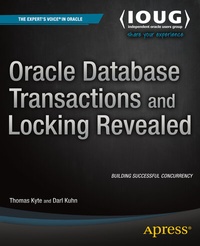
Oracle Database Transactions and Locking Revealed
Description

Oracle Database Transactions and Locking Revealed provides much-needed information for building scalable, high-concurrency applications and deploy them against the Oracle Database. Read this short, 150-page book that is adapted from Expert Oracle Database Architecture to gain a solid and accurate understanding of how locking and concurrency are dealt with by Oracle Database. Also learn how the Oracle Database architecture accommodates user transactions, and how you can write code to mesh with how Oracle Database is designed to operate.
Good transaction design is an important facet of highly-concurrent applications that are run by hundreds, even thousands of users who are all executing transactions at the same time. Transaction design in turn relies upon a good understanding of how the underlying database platform manages of the locking of resources so as to prevent access conflicts and data loss that might otherwise result from concurrent access to data in the database.
Oracle Database Transactions and Locking Revealed covers in detail the various lock types, and also different locking schemes such as pessimistic and optimistic locking. Then you'll learn about transaction isolation and multiversion concurrency, and how the various lock types support Oracle Database's transactional features. You'll learn some good tips for transaction design, as well as some bad practices and habits to avoid. Coverage is also given to redo and undo, and their role in concurrency. This is an important book that anyone developing highly-concurrent applications will want to have handy on their shelf.
More details
Other editions
New editions
Additional editions
Persons
Darl Kuhn is a senior-level database administrator with decades of experience. He handles all facets of database administration from design and development to production support. He also teaches advanced database courses at Regis University in Colorado. Darl does volunteer DBA work for the Rocky Mountain Oracle Users Group. He has a graduate degree from Colorado State University and lives near Spanish Peaks, Colorado, with his wife, Heidi, and daughters, Brandi and Lisa.
Content
1. Building for Concurrency
2. Locking and Issues
3. Lock Types
4. Concurrency and Multiversioning
5. Transactions
6. Redo and Undo
7. Investigating Undo
8. Investigating Undo
