

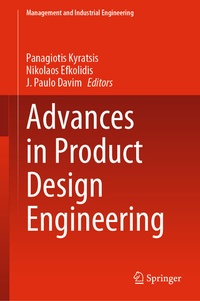
Advances in Product Design Engineering
Description

More details
Other editions
Additional editions
Persons
Dr Panagiotis Kyratsis is Associate Professor in the Department of Product and Systems Design Engineering, University of Western Macedonia, Greece. He is the Director of the Institute of Traditional Architecture and Cultural Heritage, University Research Centre "TEMENUS" (urc.uowm.gr) and Director of the Computational Design and Digital fabrication research Laboratory. Dr Panagiotis Kyratsis received his Ph.D. in the area of CAD-based manufacturing process simulations from the Department of Production Engineering and Management, Technical University of Crete, Greece. He holds a diploma in Mechanical Engineering from the Aristotle's University of Thessaloniki-Greece, and he received his M.Sc. in Automotive Product Engineering and M.Sc. in CAD/CAM from Cranfield University-UK, in 1997 and 1999, respectively. He has been involved in a number of industrial projects, and he has a great deal of expertise in both the design and the manufacturing aspects of product development. His main research interests include manufacturing, machining, CAD/CAM/CAE systems, product design, reverse engineering and prototyping.
Nikolaos Efkolidis is Assistant Professor in the Department of Product and Systems Design Engineering, University of Western Macedonia, Greece. He received his Ph.D. in the area of Sustainability "Development of Sustainable Methodologies in Product Design, Manufacturing and Education", from the University of Zaragoza, Spain. He holds a diploma in Industrial Design from the University of Western Macedonia, Greece, and a M.Sc. in Product Design and Management, from the University of Liverpool, UK. His main research interests include product design, sustainable design, manufacturing, machining, CAD/CAM/CAE systems, reverse engineering and prototyping. He is Co-Founder of the Computational Design and Digital fabrication Lab (CODE+) and heptahedron.studio.
Professor J. Paulo Davim is Full Professor at the University of Aveiro, Portugal. He is also distinguished as Honorary Professor in several universities/colleges/institutes in China, India, and Spain. He received his Ph.D. degree in Mechanical Engineering in 1997, M.Sc. degree in Mechanical Engineering (materials and manufacturing processes) in 1991, Mechanical Engineering degree (5 years) in 1986, from the University of Porto (FEUP), the Aggregate title (Full Habilitation) from the University of Coimbra in 2005, and the D.Sc. (Higher Doctorate) from London Metropolitan University in 2013. He is Senior Chartered Engineer by the Portuguese Institution of Engineers with an MBA and Specialist titles in Engineering and Industrial Management as well as in Metrology. He is also Eur Ing by FEANI-Brussels and Fellow (FIET) of IET-London. He has more than 30 years of teaching and research experience in Manufacturing, Materials, Mechanical and Industrial Engineering, with special emphasis in Machining & Tribology. He has also interest in Management, Engineering Education, and Higher Education for Sustainability. He has guided large numbers of postdoc, Ph.D., and master's students as well as has coordinated and participated in several financed research projects. He has received several scientific awards and honours. He has worked as Evaluator of projects for ERC-European Research Council and other international research agencies as well as Examiner of Ph.D. thesis for many universities in different countries. He is Editor in Chief of several international journals, Guest Editor of journals, books Editor, book Series Editor, and Scientific Advisory for many international journals and conferences.
