

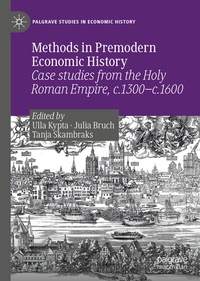
Methods in Premodern Economic History
Description

Case studies stem from the Holy Roman Empire, one of the most important economic regions in premodern times, and reconnect the German premodern economic history approach with the grand narratives that have been developed mainly for Western European regions. Methodological approaches stemming from economics as well as from sociology and cultural studies show how multifaceted research in economic history can be, and how it might accordingly offer us new insights into premodern economies.
Chapters 9 and 10 are available open access under a Creative Commons Attribution 4.0 International License via link.springer.com.
More details
Other editions
Additional editions
Persons
Ulla Kypta is Assistant Professor at the University of Basel, Switzerland. Her research interests include medieval economic history, trade in the late Middle Ages and administrative history.
Julia Bruch is Assistant Professor at the University of Cologne, Germany. Her research interests include medieval economic history, artisan and urban culture in the late Middle Ages and the history of monasteries.
Tanja Skambraks is Assistant Professor at the University of Mannheim, Germany. Her research interests include medieval economic history, banking in the late Middle Ages and ritual history.
Content
Chapter 1: Introductory Remarks.- Chapter 2: Grand Narratives in Premodern Economic History.- Chapter 3: Introduction into the Study of Production.- Chapter 4: Introduction into the Study of Markets.- Chapter 5: Introduction into the Study of Money and Credit.- Chapter 6: Reviewed Sample Studies on Production.- Chapter 7: Reviewed Sample Studies on Markets.- Chapter 8: Reviewed Sample Studies on Money and Credit.- Chapter 9: Glossary of Methodological Approaches.- Chapter 10: Glossary of Sources.- Chapter 11: Conclusion: How to Do Economic History?.
