

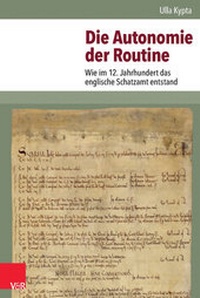
Die Autonomie der Routine
Wie im 12. Jahrhundert das englische Schatzamt entstand
1st Edition
Published on 17. September 2014
357 pages
978-3-647-36723-1 (ISBN)
Description

Das englische Schatzamt entstand im 12. Jahrhundert aus unhinterfragten, kontinuierlich wiederholten Routineakten: Jedes Jahr kamen die Verwalter der königlichen Güter zur Abrechnung an den Hof. Ihre Ausgaben und Einnahmen wurden detailliert auf große Pergamentrollen geschrieben. Diese Praxis der Rechnungslegung verfestigte sich nach und nach zu einer Behörde. Genau darin liegt das Geheimnis ihres 700-jährigen Bestehens. Ulla Kypta untersucht diesen Institutionalisierungsprozess und entwirft dabei eindrucksvoll die Entstehungsgeschichte einer der wichtigsten Säulen der Verwaltung des britischen Königreichs.
During the 12th century, one of the most durable institutions of the English government emerged: the Exchequer. For seven centuries, it was a corner stone of the royal financial administration. The study explains how the ground was laid for this long-lasting organisation. No one had planned it, not the king nor any outstanding administrative figure. The Exchequer slowly crystallized out of everyday routine actions: The sheriffs came to the royal clerks to render account of all the revenues they had received and all the expenses they had made in the name of the king. The clerks wrote down everything on large parchment rolls, called the pipe rolls. The clerks and the sheriffs were the only ones to understand the accounting language. They could easily restrict access to their group and thus create a sense of a special identity. Nevertheless, accounting procedures remained flexible enough to cope with new challenges. Slowly, a sense of belonging to the accounting team as well as standardized procedures emerged. At the end of the century, something new had developed: A certain group of people quite proud of themselves managed the accounting procedures according to certain rules. Without anyone supervising or designing the process, routine actions had themselves transformed into an organisation.
During the 12th century, one of the most durable institutions of the English government emerged: the Exchequer. For seven centuries, it was a corner stone of the royal financial administration. The study explains how the ground was laid for this long-lasting organisation. No one had planned it, not the king nor any outstanding administrative figure. The Exchequer slowly crystallized out of everyday routine actions: The sheriffs came to the royal clerks to render account of all the revenues they had received and all the expenses they had made in the name of the king. The clerks wrote down everything on large parchment rolls, called the pipe rolls. The clerks and the sheriffs were the only ones to understand the accounting language. They could easily restrict access to their group and thus create a sense of a special identity. Nevertheless, accounting procedures remained flexible enough to cope with new challenges. Slowly, a sense of belonging to the accounting team as well as standardized procedures emerged. At the end of the century, something new had developed: A certain group of people quite proud of themselves managed the accounting procedures according to certain rules. Without anyone supervising or designing the process, routine actions had themselves transformed into an organisation.
More details
Other editions
Additional editions
Book
09/2014
1st Edition
Vandenhoeck & Ruprecht
from
€75.00
Shipment within 7-9 days
Person
Content
- Cover
- Title Page
- Copyright
- Table of Contents
- Body
- Danksagung
- 1. Einleitung
- 1.1. England, Verwaltung, Schriftlichkeit: Der Forschungsstand
- 1.2. Historische Semantik: Das Analyseinstrumentarium
- 1.3. Fachsprache, Evolution, Institution: Der Aufbau der Arbeit
- 1.4. Zeitraum, Dokumente, Beschreibungssprache: Der Rahmen der Arbeit
- 2. Ausgangspunkt: Die Routine des Pipe Roll-Schreibens
- 2.1. Herstellung einer Pipe Roll
- 2.2. Aufbau und Layout einer Pipe Roll
- 2.2.1. Makrostruktur: Wie sieht eine Pipe Roll aus?
- 2.2.2. Kohärenz: Wie wurde eine Seite gestaltet?
- 2.2.3. Syntax: Wie bauten die Schreiber die Rechnungsposten auf?
- 2.2.4. Lexik: Welche Art von Lexemen verwendeten die Schreiber?
- 3. Die Fachlichkeit der Rechnungssprache: Die Abgrenzungswirkung
- 3.1. Die Sprache der Pipe Rolls: Eine Techniksprache
- 3.1.1. Vorgehen bei der Analyse auf Fachlichkeit
- 3.1.2. Die Analyse auf Fachlichkeit
- 3.1.2.1. Kriterium (1): Fachtermini
- 3.1.2.2. Kriterium (2): Standardisierung
- 3.1.2.3. Kriterium (3): Kürze
- 3.1.3. Bilanz: Die Sprache der Pipe Rolls: Eine Fachsprache
- 3.1.4. Konkretisierung: Die Fachsprache der Pipe Rolls: Eine Techniksprache
- 3.2. Die Entstehung der Abgrenzungswirkung: Lernen in der Praxis
- 3.2.1. Dialogus de Scaccario: Kein theoretisches Lehrbuch
- 3.2.2. Die Ausbildung der königlichen Verwalter: Learning by Doing
- 3.2.3. Die Habitussicherung der königlichen Verwalter: Dialogus de Scaccario
- 3.2.4. Bilanz: Die Schreiber der Pipe Rolls: Techniker
- 3.3. Die Wirkung der Techniksprache der Pipe Rolls: Abgrenzung und Effizienz
- 4. Die Veränderung der Rechnungssprache: Die Anpassungsfähigkeit
- 4.1. Diachrone Veränderungen in den Pipe Rolls des 12. Jahrhunderts
- 4.1.1. Vorgehen bei der Analyse der diachronen Veränderungen
- 4.1.2. Variation, Selektion und Stabilisierung
- 4.1.3. Variation und Selektion
- 4.1.4. Variation
- 4.2. Ein Modell unintendierten Wandels
- 4.3. Synchrone Ausdifferenzierungen in den verschiedenen Verwaltungsrollen des 12. Jahrhunderts
- 4.3.1. Vorgehen bei der Analyse der Ausdifferenzierungen
- 4.3.2. Norman Pipe Roll
- 4.3.3. Fine Roll
- 4.3.4. Originalia Roll
- 4.3.5. Curia Regis Roll
- 4.3.6. Memoranda Roll
- 4.3.7. Rotuli de Dominabus
- 4.3.8. Close Roll
- 4.3.9. Zusammenfassung
- 4.4. Ein Modell unintendierter Ausdifferenzierung
- 4.5. Die Folge der Anpassungsfähigkeit der Rechnungssprache: Die Beständigkeit der Pipe Rolls
- 4.6. Die Funktionalität der Pipe Rolls: Reproduktion interner Rechenschaftslegung
- 5. Ergebnis: Der Exchequer als Organisation
- 5.1. Definitionen einer Organisation
- 5.2. Die Emergenz des Exchequer
- 5.3. Die Legitimität der Abrechnungspflicht
- 5.4. Von der Routine zur Organisation 1: Die Entstehung des Exchequer
- 5.5. Von der Routine zur Organisation 2: Indizien für ein Transformationsmodell
- 6. Von der Routine zur Organisation: Eine mittelalterliche Geschichte?
- Tafelteil
- Quellen- und Literaturverzeichnis
- Abbildungsverzeichnis
- Abkürzungsverzeichnis
- Personen- und Sachregister
