

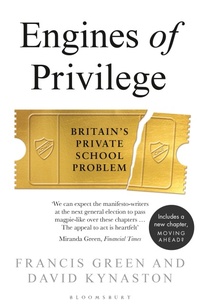
Engines of Privilege
Britain'S Private School Problem
1st Edition
Published on 7. February 2019
320 pages
978-1-5266-0124-7 (ISBN)
Description

'Thoroughly researched and written with such calm authority, yet makes you want to scream with righteous indignation' John O'Farrell
'We can expect the manifesto-writers at the next general election to pass magpie-like over these chapters ... The appeal to act is heartfelt' Financial Times
___________________
Includes a new chapter, 'Moving Ahead?'
Britain's private, fee-paying schools are institutions where children from affluent families have their privileges further entrenched through a high-quality, richly-resourced education. Engines of Privilege contends that, in a society that mouths the virtues of equality of opportunity, of fairness and of social cohesion, the educational apartheid separating private schools from our state schools deploys our national educational resources unfairly; blocks social mobility; reproduces privilege down the generations; and underpins a damaging democratic deficit in our society.
Francis Green and David Kynaston carefully examine options for change, while drawing on the valuable lessons of history. Clear, vigorous prose is combined with forensic analysis to powerful effect, illuminating the painful contrast between the importance of private schools in British society and the near-absence of serious, policy-shaping debate.
___________________
'An excoriating account of the inequalities perpetuated by Britain's love affair with private schools' The Times
'We can expect the manifesto-writers at the next general election to pass magpie-like over these chapters ... The appeal to act is heartfelt' Financial Times
___________________
Includes a new chapter, 'Moving Ahead?'
Britain's private, fee-paying schools are institutions where children from affluent families have their privileges further entrenched through a high-quality, richly-resourced education. Engines of Privilege contends that, in a society that mouths the virtues of equality of opportunity, of fairness and of social cohesion, the educational apartheid separating private schools from our state schools deploys our national educational resources unfairly; blocks social mobility; reproduces privilege down the generations; and underpins a damaging democratic deficit in our society.
Francis Green and David Kynaston carefully examine options for change, while drawing on the valuable lessons of history. Clear, vigorous prose is combined with forensic analysis to powerful effect, illuminating the painful contrast between the importance of private schools in British society and the near-absence of serious, policy-shaping debate.
___________________
'An excoriating account of the inequalities perpetuated by Britain's love affair with private schools' The Times
More details
Edition
1. Auflage
Language
English
Place of publication
London
United Kingdom
ISBN-13
978-1-5266-0124-7 (9781526601247)
Copyright in bibliographic data and cover images is held by Nielsen Book Services Limited or by the publishers or by their respective licensors: all rights reserved.
Schweitzer Classification
Other editions
Additional editions
Book
09/2019
Bloomsbury Publishing PLC
€16.50
Shipment within 10-20 days
Book
02/2019
Bloomsbury Publishing PLC
€44.80
Article exhausted; check different version
Persons
Francis Green is Professor of Work and Education Economics at IOE, UCL's Faculty of Education and Society, University College London, UK. He is the author of ten books, and writes often on the economic and social effects of private schooling in the past and present. He works frequently as an advisor to the OECD, the European Union and the World Bank, as well as to the UK government.
David Kynaston has been a professional historian since 1973 and has written nineteen books, including a series covering the history of post-war Britain (1945-79), 'Tales of a New Jerusalem'. He is currently a visiting professor at Kingston University.
David Kynaston has been a professional historian since 1973 and has written nineteen books, including a series covering the history of post-war Britain (1945-79), 'Tales of a New Jerusalem'. He is currently a visiting professor at Kingston University.
Content
- Cover
- A Note on the Authors
- Title Page
- Contents
- Preface
- 1 What Is the Problem?
- 1997-2018: a brief, expensive history
- Life's gilded path
- How do they do it?
- The Problem Explored
- The Choice in an Age of Choice
- 2 Roads Not Taken
- Before 1939: No Violent or Precipitate Legislation
- 1939-51: The Public Schools Are Saved
- 1951-70: We May Say A Lot, But We'll Never Do Anything
- 1970-79: The Wrong Target
- 1979-2017: Off the Table
- History Lessons
- 3 The Making of a Service Industry
- 1382-1860: Poor and Needy Scholars?
- 1860-1945: The Certainties of Privilege
- 1945-79: Challenges
- 1979-2000: A Machine is Built
- 4 Learning and Luxury: Private Schools in the Twenty-First Century
- A Question of Resources
- The Resources Gap and the Gilded Path
- Private School Peers
- Independent governance: another factor, producing better management?
- Learning and luxury: an ungainly coupling
- Under threat?
- 5 Who Chooses Private School and Why?
- Affordability
- Motives
- Is it worth it?
- The Politics of Hypocrisy
- Using the best motives
- 6 Bubbling Under
- Moments
- Silences and Evasions
- On the Table
- Mixed-up Confusion
- 7 Defending the Status Quo: Illusions and Propaganda
- Boosting economic performance?
- Diffusing the democratic deficit?
- Mitigating Social Injustice?
- The problem lies elsewhere?
- Free to choose?
- An End to Fatalism?
- 8 Options for Reform
- Handicap stakes
- Upping the cost
- Crossing the tracks 1: partially integrated, yet private control over admissions
- Crossing the tracks 2: partially integrated, with social control over admissions
- Crossing the tracks 3: fully integrated
- What won't work and what could
- Viable reform policies versus the shaming game
- 9 We Need to Talk
- Entrenched, formidable and thoroughly modern
- Whispers and Cries
- A Fair Shake
- Postscript: Moving Ahead?
- Notes
- Acknowledgements
- Index
- Copyright Page
