

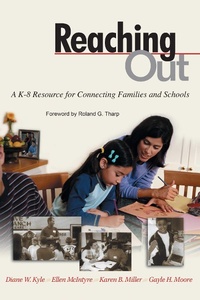
Reaching Out
A K-8 Resource for Connecting Families and Schools
Published on 26. May 2015
144 pages
978-1-63220-982-5 (ISBN)
Description

Too often, today's student feels alienated from school, and learning suffers as a result. Developing a relationship with the family can provide the missing link in the educational chain. Reaching Out is an invaluable resource for compassionate educators interested in building strong relationships with their students' families.
A dynamic team of teachers and teacher educators have combined their first-hand experience and in-depth research in this essential guidebook. By involving the entire family in the educational experience, teachers can bridge the gap separating home and school and help produce happier, healthier, and smarter kids.
Highlights include:
-Building trust with families
-Communicating in positive ways with students' families
-Implementing family workshops
-Involving families through innovative homework ideas
Based on a five-year study, the information will be particularly helpful for teachers whose classrooms reflect a diverse student population. By incorporating these concepts and techniques, you not only enhance the learning experience you also help your students to be more compassionate and excited about school.
A dynamic team of teachers and teacher educators have combined their first-hand experience and in-depth research in this essential guidebook. By involving the entire family in the educational experience, teachers can bridge the gap separating home and school and help produce happier, healthier, and smarter kids.
Highlights include:
-Building trust with families
-Communicating in positive ways with students' families
-Implementing family workshops
-Involving families through innovative homework ideas
Based on a five-year study, the information will be particularly helpful for teachers whose classrooms reflect a diverse student population. By incorporating these concepts and techniques, you not only enhance the learning experience you also help your students to be more compassionate and excited about school.
More details
Other editions
Additional editions
Diane W. Kyle | Ellen McIntyre | Karen B. Miller
Reaching Out
A K-8 Resource for Connecting Families and Schools
Book
06/2015
Skyhorse Publishing
€14.50
Shipment within 3-4 weeks
Persons
Diane W. Kyle: Diane W. Kyle is a professor in the Department of Teaching and Learning at the University of Louisville. She codirected with Ellen McIntyre a research project, "Children's Academic Development in Nongraded Primary Programs,? funded by the Center for Research on Education, Diversity, and Excellence (CREDE) at the University of California at Santa Cruz. She lives in Louisville, KY.
Ellen McIntyre: Ellen McIntyre is a literacy professor in the Department of Teaching and Learning at the University of Louisville, where she teaches courses on literacy research and instruction and studies children's development in light of instructional contexts. She also codirected with Diane Kyle a research project, "Children's Academic Development in Nongraded Primary Programs,? funded by the Center for Research on Education, Diversity, and Excellence (CREDE) at the University of California at Santa Cruz. She lives in Louisville, KY.
Karen B. Miller: Karen B. Miller has taught elementary school for more than twenty years in grades 1-4. She currently teaches at Roby Elementary in Bullitt County, Kentucky. She lives in Shepherdsville, KY.
Gayle H. Moore: Gayle H. Moore recently retired after teaching elementary school for thirty-one years at grades K-8, including nine years in the nongraded primary program at LaGrange Elementary in Oldham County, Kentucky. She lives in La Grange, KY.
Ellen McIntyre: Ellen McIntyre is a literacy professor in the Department of Teaching and Learning at the University of Louisville, where she teaches courses on literacy research and instruction and studies children's development in light of instructional contexts. She also codirected with Diane Kyle a research project, "Children's Academic Development in Nongraded Primary Programs,? funded by the Center for Research on Education, Diversity, and Excellence (CREDE) at the University of California at Santa Cruz. She lives in Louisville, KY.
Karen B. Miller: Karen B. Miller has taught elementary school for more than twenty years in grades 1-4. She currently teaches at Roby Elementary in Bullitt County, Kentucky. She lives in Shepherdsville, KY.
Gayle H. Moore: Gayle H. Moore recently retired after teaching elementary school for thirty-one years at grades K-8, including nine years in the nongraded primary program at LaGrange Elementary in Oldham County, Kentucky. She lives in La Grange, KY.
Content
- Intro
- Dedication
- Title Page
- Copyright
- Contents
- Foreword
- Preface
- Acknowledgments
- About the Authors
- 1. Connecting With Families
- Connecting Families and Schools: A Vital Goal
- Improving Student Achievement
- Celebrating Differences: Seeing Through Families' Eyes
- Why We Care
- 2. Building Trusting Relationships
- Examining Our Assumptions
- Teachers Are People, Too
- Sharing Struggles
- See and Be Seen
- Parents Are People, Too
- How Does Trust Develop?
- No Deaf Ears: Dealing With the Hard Stuff
- Knowing Our Students
- Parents and Guardians as Experts
- Suggested Steps
- Summary
- 3. Strategies for Enhancing Communication
- Postcards
- Newsletters
- Take a Look: Photos and Videos
- Suggestion-Response Box
- Compliment Box
- Homework Comment Sheets
- Day Planners
- The Agenda
- Family Message Journals
- Family Stories
- Student-Led Conferences
- Voice Mail
- Phone Home
- "How-Am-I-Doing?" Surveys
- Summary
- 4. Building Effective Partnerships Through Family Workshops
- Being Welcoming and Aware
- Clarifying Expectations
- Themed Workshops
- More Ideas for Family Workshops
- Tips for Organizing Workshops Schoolwide
- Funding a Family Workshop
- Summary of Tips on Implementing Family Workshops
- Summary
- 5. Reaching Out Through Family Visits
- Building on Family/Community Literacy
- What Else We Learned
- What Families Learn From Us
- Family Appreciation
- Issues in Doing Family Visits
- Doing Family Visits: First Steps and Beyond
- Summary
- 6. Modifying Instructional Practices to Increase Family Involvement
- The Limits of Traditional Instruction
- Contextualized Instruction
- Understanding Teaching and Learning
- Possible Steps to Take
- Summary
- 7. Involving Families in Homework
- Managing and Monitoring Homework
- Teachers Doing Homework
- Family Involvement in Homework: Creative Alternatives
- Tips for Principals: How to Implement Family-Connected Homework Schoolwide
- Summary Tips for Family-Connected Homework
- Summary
- Conclusion
- Resource A: Books of Interest to Elementary Students and Their Families
- Resource B: Books of Interest to Middle School Students and Their Families
- References
- Index
