

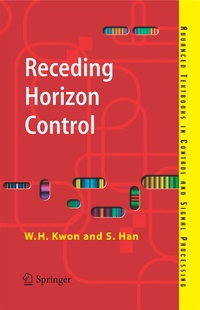
Receding Horizon Control
Description

Receding Horizon Control (RHC) introduces the essentials of a successful feedback strategy that has emerged in many industrial fields. RHC has several advantages over other types of control: greater adaptability to parametric changes than infinite horizon control; better tracking than PID and good constraint handling among others.
The text builds understanding starting with optimal controls for simple linear systems and working through constrained systems to nonlinear cases. RHC is applied to discrete-time systems for easier computer application and its techniques are unified using the state-space framework. Examples and exercises allow you to practise as you go. MATLAB® files for the solution of selected examples can be downloaded from http://extras.springer.com.
Students following masters and doctoral courses in control will find this book an excellent companion to tuition and research. Tutors and academics researching predictive control can use it not only as a scholarly textbook but as a co-ordinated reference for its wide range of RHC schemes.
More details
Other editions
Additional editions
Persons
Professor Kwon was President of IFAC between from 2006 to 2008. He has an excellent reputation as a leading control engineer and an important member of IFAC. He has specialised in model predictive control for many years.
Professor Kwon was a research associate at Brown University in 1975 and from 1976 to 1977 he was an adjunct assistant professor at the University of Iowa. Since 1977, which includes a period from 1981 to 1982 when he was a visiting assistant professor at Stanford University, he has been with Seoul National University.
During his career Professor Kwon has published more than 60 international journal papers and approximately 120 international conference papers. In recognition of his academic and industrial achievements in Korea he was endowed with a POSCO professorship from Pohang Steel Company in 1995, and in 1997 received the National Academy of Sciences Award. He is a Fellow of the Korean Academy of Science and Technology and is also a member of the National Academy of Engineering. Since 1991 he has been the Director of the Engineering Research Center for Advanced Control and Instrumentation established at SNU by the Korean Science and Engineering Foundation. This Center won the prestigious University LEAD Award of the Society of Manufacturing Engineers (SME) in the US under his guidance in 1996. He was a key founder of the Korea Automatic Control Conference, now in its fourteenth year, in which about 650 people participate every year. He was a key founder and is now President of the Institute of Control Automation and Systems Engineers which is the Korean National Member Organisation of IFAC. He became the Vice-President of IFAC in July 1999. He will be President elect of the Korean Institute of Electrical Engineers next year.
He was the founding Vice-Chairman of the Asian Control Professors Association in 1996 and is now the Chairman. He was also a founding member of the Steering Committee of the Asian Control Conference.
