

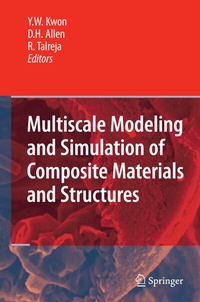
Multiscale Modeling and Simulation of Composite Materials and Structures
Description

Researchers are interested in the development of modeling methods applied to predicting the atomistic, microscopic and macroscopic response of composite materials under stress and hostile environment. Material behaviors at the macroscale level are controlled by their characteristics at lower scale levels. This fact is even more significant for composite materials. As a result, in order to design and analyze composite structures as well as new composite materials, it is necessary to model material behaviors at different length scales and to couple them. This book presents the state of the art in multiscale modeling and simulation techniques for composite materials and structures. It focuses on the structural and functional properties of engineering composites and the sustainable high performance of components and structures. The multiscale techniques can be also applied to nanocomposites which are important application areas in nanotechnology.
This book will provide useful information for engineers for better design and analysis of composite structures. It will also serve as an invaluable reference for researchers.
Reviews / Votes
From the reviews:
"This book is built upon some papers written by several experts in the area of composite materials and structures. It contains 13 chapters with a very rich reference list. . The book is well written, and the organization of various topics on composite materials is well established. This book will be useful for researchers working in the area of composites and structural modeling." (Hilmi Demiray, Zentralblatt MATH, Vol. 1145, 2008)
More details
Other editions
Additional editions
Persons
Dr. Kwon is Professor of Mechanical and Aeronautical Engineering Department of Naval Postgraduate School (NPS) in Monterey, California. He was the past Chair of the department. He was also Professor and Chair of the Department of Mechanical Engineering and Energy Processes of Southern Illinois University Carbondale (SIUC). He received his Ph.D. degree from Rice University, MS degree from Oklahoma State University, and B.S. degree from Seoul National University, all in mechanical engineering.
Dr. Allen earned a bachelor's degree in aerospace engineering at A&M (1972) and spent three years as a weather officer in the U.S. Air Force before returning to College Station to earn a master's degree in civil engineering in 1977 and a doctorate in aerospace engineering in 1980. He is a fellow and past president of the Society of Engineering Science, a fellow of the American Society of Mechanical Engineers and an associate fellow of the American Institute of Aeronautics and Astronautics. He has received numerous awards, but is most proud of the Distinguished Teaching Award he received in 1999 from the Texas A&M University Association of Former Students.
