

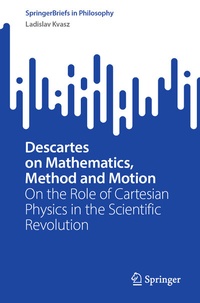
Descartes on Mathematics, Method and Motion
Description

This book argues that Descartes' physics was a milestone on the road to modern mathematical physics. After Newton introduced a completely different approach to mathematical description of motion, Descartes' physics became obsolete and even difficult to comprehend. This text follows the language of Descartes and the means of which motion can be described. It argues that Descartes achieved almost everything that later Newton was able to do-to describe the motion of interacting bodies- by different (i.e. algebraic) means. This volume completely refutes the received view according to which Descartes' physics was merely a kind of discursive natural philosophy. To make this interpretation more plausible the book follows Descartes' ideas from his early work in mathematics, through his invention of the analytic method towards his mature physics. It shows that Descartes followed a similar heuristic pattern.
The volume appeals to students and researchers; it invites the reader equippedwith minimal understanding of college mathematics to follow Descartes on his intellectual journey through the Scientific Revolution. The reader will gain a deeper understanding of the role of mathematical language in the creation of modern physics and a glimpse into the fascinating world of Descartes' scientific thought. Several of Descartes' philosophical ideas can be traced back to his scientific interests and thus the book elucidates the motivation behind some of Descartes' key positions in the area of epistemology and method. In the penultimate chapter the book presents four arguments in favor of seeing Descartes as a physicist on par with Galileo and Newton.
More details
Other editions
Additional editions
Person
Ladislav Kvasz studied mathematics and philosophy at Comenius University. He spent longer sojourns at the University of Vienna, King's College London, University of California at Berkeley and Technical University in Berlin. His book Patterns of Change (2008) was awarded the International Fernando Gil Prize for the Philosophy of Science. He is interested in the changes of the formal language of science and the consequences which linguistic innovations (such as invention of variables, or introduction of functions) had on scientific method and thought.
Content
Chapter 1. Schuster's interpretation of Descartes in Descartes Agonistes.- Chapter 2. Who was Descartes?.- Chapter 3. What is mathesis universalis?.- Chapter 4. What is method?.- Chapter 5. What is mathematical physics?.- Chapter 6. Arguments showing that Descartes' physics was mathematical.- Chapter 7. Conclusion.
