

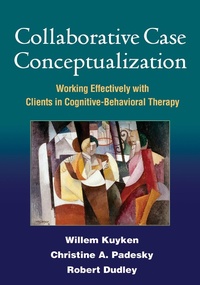
Collaborative Case Conceptualization
Description

Practitioners, students, and residents in clinical psychology, psychiatry, counseling, social work, and related mental health fields. Serves as a supplemental text in graduate-level CBT courses and clinical practica.
More details
Other editions
Additional editions
Persons
Willem Kuyken, PhD, is the Ritblat Professor of Mindfulness and Psychological Science at the University of Oxford, United Kingdom, and Director of the Oxford Mindfulness Centre. His work focuses on preventing depression, promoting mental health, and flourishing across the lifespan. Dr. Kuyken has published more than 150 journal articles and has been named one of the world's most highly cited researchers. He lives in London.
Christine A. Padesky, PhD, a clinical psychologist, is cofounder of the Center for Cognitive Therapy in Huntington Beach, California; codeveloper of Strengths-Based CBT; and coauthor of seven books, including the bestselling self-help resource Mind Over Mood, Second Edition. Dr. Padesky is a recipient of the Aaron T. Beck Award for significant and enduring contributions to the field of cognitive therapy from the Academy of Cognitive Therapy (now the Academy of Cognitive and Behavior Therapies; ACBT), the Distinguished Contribution to Psychology Award from the California Psychological Association, and the British Association for Behavioural and Cognitive Psychotherapies (BABCP) Award for Most Influential International CBT Therapist. She has been named a Distinguished Founding Fellow of the ACBT and an Honorary Fellow of the BABCP. The BABCP voted Mind Over Mood the most influential CBT book of all time. Dr. Padesky has taught workshops to more than 50,000 therapists internationally and is renowned for her ability to integrate theory, empiricism, creativity, and practical therapy skills. She consults worldwide and develops audio and video training materials for therapists. Her free video training series for therapists is posted at www.youtube.com/ChristinePadesky. Her websites are www.mindovermood.com (for the general public) and www.padesky.com (for mental health professionals).
Robert Dudley, PhD, is a Consultant Clinical Psychologist for the Early Intervention in Psychosis Service at the Northumberland, Tyne, and Wear Mental Health NHS Trust, United Kingdom. He also serves on the staff of the Institute of Neuroscience at Newcastle University. Dr. Dudley's primary clinical and research focus is the understanding and treatment of psychotic symptoms. As a clinician, trainer, and supervisor, he developed an interest in case conceptualization and has undertaken several research projects in this area.
Content
1. The Procrustean Dilemma
2. The Case Conceptualization Crucible: A New Model
3. Two Heads Are Better Than One: Collaborative Empiricism
4. Incorporating Client Strengths and Building Resilience
5. ?Can You Help Me??: Descriptive Case Conceptualization
6. ?Why Does This Keep Happening to Me??: Cross-Sectional Explanatory Conceptualizations
7. ?Does My Future Look Like My Past??: Longitudinal Explanatory Conceptualizations
8. Learning and Teaching Case Conceptualization
9. Appraising the Model
Appendix. Aid to History Taking Form
