

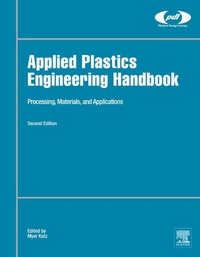
Applied Plastics Engineering Handbook
Processing, Materials, and Applications
2nd Edition
Published on 15. September 2016
784 pages
978-0-323-39041-5 (ISBN)
Description

Applied Plastics Engineering Handbook: Processing, Materials, and Applications, Second Edition, covers both the polymer basics that are helpful to bring readers quickly up-to-speed if they are not familiar with a particular area of plastics processing and the recent developments that enable practitioners to discover which options best fit their requirements.New chapters added specifically cover polyamides, polyimides, and polyesters. Hot topics such as 3-D printing and smart plastics are also included, giving plastics engineers the information they need to take these embryonic technologies and deploy them in their own work.With the increasing demands for lightness and fuel economy in the automotive industry (not least due to CAFÉ standards), plastics will soon be used even further in vehicles. A new chapter has been added to cover the technology trends in this area, and the book has been substantially updated to reflect advancements in technology, regulations, and the commercialization of plastics in various areas.Recycling of plastics has been thoroughly revised to reflect ongoing developments in sustainability of plastics. Extrusion processing is constantly progressing, as have the elastomeric materials, fillers, and additives which are available.Throughout the book, the focus is on the engineering aspects of producing and using plastics. The properties of plastics are explained, along with techniques for testing, measuring, enhancing, and analyzing them. Practical introductions to both core topics and new developments make this work equally valuable for newly qualified plastics engineers seeking the practical rules-of-thumb they don't teach you in school and experienced practitioners evaluating new technologies or getting up-to-speed in a new field.
- Presents an authoritative source of practical advice for engineers, providing guidance from experts that will lead to cost savings and process improvements
- Ideal introduction for both new engineers and experienced practitioners entering a new field or evaluating a new technology
- Updated to include the latest technology, including 3D Printing, smart polymers, and thorough coverage of biopolymers and biodegradable plastics
More details
Other editions
New editions
Myer Kutz
Applied Plastics Engineering Handbook
Processing, Sustainability, Materials, and Applications
E-Book
11/2023
3rd Edition
William Andrew
€245.00
Available for download
Additional editions
Book
10/2016
2nd Edition
William Andrew Publishing
€222.50
Shipment within 15-20 days
Content
Part I: Plastics, elastomeric and biobased materials1. Engineering Thermoplastics - Materials, Properties, Trends2. Polyolefins3. Introduction to Fluoropolymers4. Poly(Vinyl Chloride)5. Thermoplastic Elastomers6. Thermoset Elastomers7. Biodegradable and Biobased Polymers8. Polymeric Biomaterials
Part II: Plastics processing9. Recycling of Plastics10. Injection Molding Technology11. Microcellular Injection Molding12. Extrusion Processes13. Blow Molding14. Compression Molding15. Rotational Molding16: Thermoforming17. Process Monitoring and Process Control: An Overview18. Polymer Stabilization19. Chaotic Advection and Its Application to Extruding Micro- and Nanostructured Plastic Materials
Part III: Additives, colorants and fillers20. Surface Modification of Plastics21. Plastics Additives22. Dispersants and Coupling Agents23. Functional Fillers for Plastics24. Plasticizers25. Adhesion Promoters: Silane Coupling Agents
Part IV: Design and applications26. Plastics Joining27. Design of Plastic Parts28. Three-Dimensional Printing of Plastics29. Plastics in Buildings and Construction30. Automotive Applications of Plastics: Past, Present, and Future31. Infrastructure Applications of Fiber-Reinforced Polymer Composites32. The Plastic Piping Industry in North America33. PET Use in Blow Molded Rigid Packaging
