

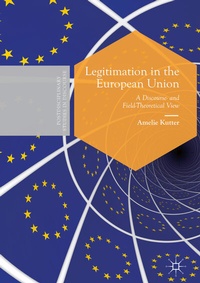
Legitimation in the European Union
Description

This book offers a transdisciplinary perspective on the question of how political legitimacy is constructed in the increasingly contested postnational setting of the European Union. Drawing on the example of the controversy about the EU constitution and the use of 'EU constitution speak' in commentaries published by Polish and French broadsheets, it reveals the transformation that constructions of political authority and association undergo when they are being transposed from the discourse field of multilateral negotiation to that of national news media. Through an original combination of the linguistic theory of discourse developed in Critical Discourse Analysis, Bourdieu's field theory and notion of symbolic power, and political thought on polity-building, it develops a framework for the discourse study of legitimation and Europeanisation, and proposes applications beyond the case studies in the book.To students of European integration, it demonstrates the potential these concepts have for unravelling the implicit practices of postnational polity building. Discourse researchers, on the other hand, will discover how detailed text analyses gain significance in debates related to the macro level of political organisation when guided by sociological and political theory.
Reviews / Votes
"With her groundbreaking book, Kutter introduces a novel perspective for discourse studies that centres on the formation of political authority and legitimacy beyond the nation-state. Developed against the background of Bourdieusian sociology, this book's field theoretical view masterfully reveals the potential of the 'linguistic turn' in IR constructivism and EU political sociology that has so far been unexplored. A must-read for scholars of European Integration and International Relations." (Antje Wiener, Chair in Political Science, with a Particular Focus on Global Governance, University of Hamburg, Germany)
"This groundbreaking book analyses European Integration in new theoretical and methodological terms. The insightful combination of Critical Discourse Studies, communication and media studies and political sciences is truly impressive, tracing in systematic detail the transformation of EU polity in recent years. A must-read for graduate students and scholars alike." (Ruth Wodak, Emeritus Distinguished Professor and Chair in Discourse Studies, Lancaster University, UK)
More details
Other editions
Additional editions
Person
- Amelie Kutter is a Lecturer and Researcher in European Studies at European University Viadrina Frankfurt (Oder), Germany.
