

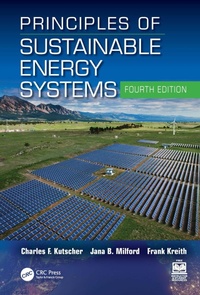
Principles of Sustainable Energy Systems
4th Edition
Published on 14. August 2025
664 pages
978-1-040-39642-1 (ISBN)
Description

Principles of Sustainable Energy Systems provides students with a fundamental and practical understanding of the energy transition. It discusses the design, production, and economics of energy conversion and storage technologies, as well as requirements and technologies for the end-use sectors of transportation, buildings, and industry.
This book begins by introducing students to the important field of sustainability and then presents comprehensive coverage of solar, wind, hydropower, biomass and bio-fuels, geothermal, nuclear, and ocean-based energy technologies. This new edition features recent advances in batteries and other storage technologies, electricity transmission, electric vehicles, and beneficial electrification and demand response in buildings, as well as approaches for reducing emissions from shipping and aviation. It introduces new material on low-carbon building materials, heat pumps, and the practical design aspects of solar photovoltaic systems. This book also covers economics and energy systems analysis methods such as life cycle assessment and greenhouse gas accounting, including detailed examples of design and financial analysis using the System Advisor Model (SAM).
This book is intended for upper-level undergraduate and graduate engineering students taking courses in Renewable Energy, Energy Systems, and Energy Conversion.
Instructors will have access to a Solutions Manual and Figure Slides for their course.
This book begins by introducing students to the important field of sustainability and then presents comprehensive coverage of solar, wind, hydropower, biomass and bio-fuels, geothermal, nuclear, and ocean-based energy technologies. This new edition features recent advances in batteries and other storage technologies, electricity transmission, electric vehicles, and beneficial electrification and demand response in buildings, as well as approaches for reducing emissions from shipping and aviation. It introduces new material on low-carbon building materials, heat pumps, and the practical design aspects of solar photovoltaic systems. This book also covers economics and energy systems analysis methods such as life cycle assessment and greenhouse gas accounting, including detailed examples of design and financial analysis using the System Advisor Model (SAM).
This book is intended for upper-level undergraduate and graduate engineering students taking courses in Renewable Energy, Energy Systems, and Energy Conversion.
Instructors will have access to a Solutions Manual and Figure Slides for their course.
More details
Series
Edition
4th edition
Language
English
Place of publication
London
United Kingdom
Publishing group
Taylor & Francis Ltd
Target group
College/higher education
Professional and scholarly
Illustrations
94 Tables, black and white; 249 Line drawings, black and white; 53 Halftones, black and white; 302 Illustrations, black and white
File size
100,84 MB
ISBN-13
978-1-040-39642-1 (9781040396421)
Copyright in bibliographic data and cover images is held by Nielsen Book Services Limited or by the publishers or by their respective licensors: all rights reserved.
Schweitzer Classification
Other editions
Additional editions
Charles F. Kutscher | Jana B. Milford | Frank Kreith
Principles of Sustainable Energy Systems
Book
08/2025
4th Edition
CRC Press
€232.20
Shipment within 10-20 days

Charles F. Kutscher
Principles of Sustainable Energy Systems
Book
08/2025
CRC Press
Unfortunately, price unknown
Available (delivery time upon request)
Persons
Charles F. Kutscher is a fellow of the Renewable and Sustainable Energy Institute (RASEI), a joint institute between the University of Colorado Boulder (CU-Boulder) and the National Renewable Energy Laboratory (NREL). He served as the Director of the Buildings and Thermal Sciences Center at NREL from 2013 until his retirement in 2018. He has worked in the field of renewable energy for over four decades, during which time he has led research investigations on solar heating and cooling, building energy efficiency, solar industrial process heat, geothermal power, and concentrating solar power. He is a fellow of the American Solar Energy Society (ASES) and served as the Society's chair in 2000 and 2001. He was the chair of two major conferences: the SOLAR 2006 National Solar Energy Conference and the 2012 World Renewable Energy Forum. He led the ASES study, Tackling Climate Change in the U.S., which detailed how energy efficiency and six renewable energy technologies could greatly reduce U.S. carbon emissions by 2030. He also served as the lead author of the RASEI study, Accelerating the US Clean Energy Transformation: Challenges and Solutions by Sector. He has served as an Adjunct Professor at the University of Colorado Boulder and the Colorado School of Mines. He earned a BS in Physics from the State University of New York at Albany, an MS in Nuclear Engineering from the University of Illinois at Urbana-Champaign, and a PhD in Mechanical Engineering from the University of Colorado Boulder. He is a registered professional engineer in California and Colorado.
Jana B. Milford is an Emeritus Professor in the Department of Mechanical Engineering and the Environmental Engineering Program at the University of Colorado at Boulder, where she worked from 1994 to 2022. Her research and teaching interests have focused on air quality modeling and data analysis, environmental impacts of energy systems, and environmental law and policy. She has also worked as a congressional fellow and analyst at the Congressional Office of Technology Assessment, Assistant Professor in the Department of Civil Engineering at the University of Connecticut, and a senior scientist and staff attorney at the Environmental Defense Fund. She has served as a member of the Colorado Air Quality Control Commission, the Board of Environmental Studies and Toxicology of the National Academy of Sciences, the Science Advisory Board of the U.S. Environmental Protection Agency, and the Review Committee of the Health Effects Institute. She holds a BS in Engineering Science from Iowa State University, a MS in Civil Engineering from Carnegie Mellon University, a PhD in Engineering and Public Policy from Carnegie Mellon University, and a JD from the University of Colorado School of Law.
Frank Kreith taught at the University of California, Lehigh University, and the University of Colorado, as a Professor Emeritus of Engineering. From 1988 to 2001, he was the American Society of Mechanical Engineers International (ASME) legislative fellow for Energy and Environment at the National Conference of State Legislatures (NCSL) where he provided assistance on energy, transportation, and environmental protection to legislators in all 50 state governments. Prior to joining NCSL in 1988, Kreith was the chief of thermal research at the Solar Energy Research Institute (SERI), currently the National Renewable Energy Laboratory. During his tenure at SERI, he participated in the Presidential Domestic Energy Review, served as an energy advisor to the Governor of Colorado, and was the editor of the ASME Journal of Solar Energy Engineering. He was the author of over a hundred peer-reviewed articles and textbooks on heat transfer, solar energy, and transportation. He was the recipient of the Charles Greeley Abbot Award from the American Solar Energy Society and the Max Jakob Award from ASME-AIChE, and in 1997, he received the Washington Award for "unselfish and preeminent service in advancing human progress." In 1998, Kreith was awarded the ASME Medal for research, publications, and public service, and in 2004, he was named ASME Honorary Member. In 2005, the ASME established the Frank Kreith Energy Award in recognition of Kreith's contribution to heat transfer and renewable energy.
Jana B. Milford is an Emeritus Professor in the Department of Mechanical Engineering and the Environmental Engineering Program at the University of Colorado at Boulder, where she worked from 1994 to 2022. Her research and teaching interests have focused on air quality modeling and data analysis, environmental impacts of energy systems, and environmental law and policy. She has also worked as a congressional fellow and analyst at the Congressional Office of Technology Assessment, Assistant Professor in the Department of Civil Engineering at the University of Connecticut, and a senior scientist and staff attorney at the Environmental Defense Fund. She has served as a member of the Colorado Air Quality Control Commission, the Board of Environmental Studies and Toxicology of the National Academy of Sciences, the Science Advisory Board of the U.S. Environmental Protection Agency, and the Review Committee of the Health Effects Institute. She holds a BS in Engineering Science from Iowa State University, a MS in Civil Engineering from Carnegie Mellon University, a PhD in Engineering and Public Policy from Carnegie Mellon University, and a JD from the University of Colorado School of Law.
Frank Kreith taught at the University of California, Lehigh University, and the University of Colorado, as a Professor Emeritus of Engineering. From 1988 to 2001, he was the American Society of Mechanical Engineers International (ASME) legislative fellow for Energy and Environment at the National Conference of State Legislatures (NCSL) where he provided assistance on energy, transportation, and environmental protection to legislators in all 50 state governments. Prior to joining NCSL in 1988, Kreith was the chief of thermal research at the Solar Energy Research Institute (SERI), currently the National Renewable Energy Laboratory. During his tenure at SERI, he participated in the Presidential Domestic Energy Review, served as an energy advisor to the Governor of Colorado, and was the editor of the ASME Journal of Solar Energy Engineering. He was the author of over a hundred peer-reviewed articles and textbooks on heat transfer, solar energy, and transportation. He was the recipient of the Charles Greeley Abbot Award from the American Solar Energy Society and the Max Jakob Award from ASME-AIChE, and in 1997, he received the Washington Award for "unselfish and preeminent service in advancing human progress." In 1998, Kreith was awarded the ASME Medal for research, publications, and public service, and in 2004, he was named ASME Honorary Member. In 2005, the ASME established the Frank Kreith Energy Award in recognition of Kreith's contribution to heat transfer and renewable energy.
Content
1. Introduction to Sustainable Energy. 2. Economics of Energy Generation and Conservation Systems. 3. Energy Systems Analysis Methodologies. 4. Energy Use and Efficiency in Buildings and Industry. 5. Electricity Supply Systems. 6. Fossil Fuels. 7. Nuclear Power. 8. Wind Energy. 9. Capturing Solar Energy through Biomass. 10. Fundamentals of Solar Radiation. 11. Photovoltaics. 12. Solar Thermal Collectors and Systems. 13. Ocean, Hydropower, and Geothermal Energy Conversion. 14. Storage Technologies. 15. Transportation.
