

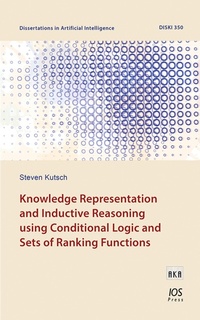
Knowledge Representation and Inductive Reasoning using Conditional Logic and Sets of Ranking Functions
1st Edition
Published on 15. February 2021
184 pages
978-1-64368-163-4 (ISBN)
Description

A core problem in Artificial Intelligence is the modeling of human reasoning. Classic-logical approaches are too rigid for this task, as deductive inference yielding logically correct results is not appropriate in situations where conclusions must be drawn based on the incomplete or uncertain knowledge present in virtually all real world scenarios.
Since there are no mathematically precise and generally accepted definitions for the notions of plausible or rational, the question of what a knowledge base consisting of uncertain rules entails has long been an issue in the area of knowledge representation and reasoning. Different nonmonotonic logics and various semantic frameworks and axiom systems have been developed to address this question.
The main theme of this book, Knowledge Representation and Inductive Reasoning using Conditional Logic and Sets of Ranking Functions, is inductive reasoning from conditional knowledge bases. Using ordinal conditional functions as ranking models for conditional knowledge bases, the author studies inferences induced by individual ranking models as well as by sets of ranking models. He elaborates in detail the interrelationships among the resulting inference relations and shows their formal properties with respect to established inference axioms. Based on the introduction of a novel classification scheme for conditionals, he also addresses the question of how to realize and implement the entailment relations obtained.
In this work, "Steven Kutsch convincingly presents his ideas, provides illustrating examples for them, rigorously defines the introduced concepts, formally proves all technical results, and fully implements every newly introduced inference method in an advanced Java library (...). He significantly advances the state of the art in this field." - Prof. Dr. Christoph Beierle of the FernUniversitaet in Hagen
Since there are no mathematically precise and generally accepted definitions for the notions of plausible or rational, the question of what a knowledge base consisting of uncertain rules entails has long been an issue in the area of knowledge representation and reasoning. Different nonmonotonic logics and various semantic frameworks and axiom systems have been developed to address this question.
The main theme of this book, Knowledge Representation and Inductive Reasoning using Conditional Logic and Sets of Ranking Functions, is inductive reasoning from conditional knowledge bases. Using ordinal conditional functions as ranking models for conditional knowledge bases, the author studies inferences induced by individual ranking models as well as by sets of ranking models. He elaborates in detail the interrelationships among the resulting inference relations and shows their formal properties with respect to established inference axioms. Based on the introduction of a novel classification scheme for conditionals, he also addresses the question of how to realize and implement the entailment relations obtained.
In this work, "Steven Kutsch convincingly presents his ideas, provides illustrating examples for them, rigorously defines the introduced concepts, formally proves all technical results, and fully implements every newly introduced inference method in an advanced Java library (...). He significantly advances the state of the art in this field." - Prof. Dr. Christoph Beierle of the FernUniversitaet in Hagen
More details
Series
Language
English
Place of publication
London
Netherlands
Publishing group
IOS Press
Target group
Professional and scholarly
File size
5,68 MB
ISBN-13
978-1-64368-163-4 (9781643681634)
Copyright in bibliographic data and cover images is held by Nielsen Book Services Limited or by the publishers or by their respective licensors: all rights reserved.
Schweitzer Classification
Other editions
Additional editions

Steven Kutsch
Knowledge Representation and Inductive Reasoning using Conditional Logic and Sets of Ranking Functions
Book
02/2021
1st Edition
IOS Press,US
€86.85
Shipment within 10-20 days
Content
- Intro
- Title Page
- Contents
- Chapter 1. Introduction
- 1.1 Context and Motivation
- 1.2 Research Questions and Contributions
- 1.3 Outline
- 1.4 Previous Publications
- Chapter 2. Background
- 2.1 Logical Preliminaries
- 2.2 From Preferential Inference to Plausibility Measures
- 2.3 Ranking Functions
- 2.4 Inductive Reasoning in System Z
- Chapter 3. Inference Using Sets of Ranking Functions
- 3.1 Modes of Inference
- 3.2 C-Representations and C-Inference
- 3.3 Interrelationships of Inference Systems
- Chapter 4. Classification of Conditionals for Calculating Closures of Inference Relations
- 4.1 Classes of Conditionals
- 4.2 Complete Inference Relations
- Chapter 5. Inference Cores and Redundant Conditionals
- 5.1 Inference Cores for Comparing Inference Relations
- 5.2 Structural Inference and Redundant Conditionals
- Chapter 6. Maximal Impacts for C-Inference
- 6.1 Regular and Sufficient Maximal Impacts
- 6.2 Lower and Upper Bounds for Regular and Sufficient Maximal Impacts
- Chapter 7. Compact Representations of Knowledge Bases for Optimising C-Inference
- 7.1 Representing C-Inference as CSPs
- 7.2 Compact Representation of Static Knowledge Bases
- 7.3 Computational Benefits
- 7.4 Compact Representation of Evolving Knowledge Bases
- Chapter 8. Formal Properties and Evaluation of Nonmonotonic Inference Relations
- 8.1 Skeptical Inference
- 8.2 Credulous Inference
- 8.3 Weakly Skeptical Inference
- 8.4 Rationality of C-Inference Relations
- 8.5 Empirical Evaluation of Nonmonotonic Inference Relations
- Chapter 9. InfOCF: Implementing Inference Over Sets of Ranking Models
- 9.1 InfOCF-Lib
- 9.2 Implementing EvaluateKBs(RM)
- 9.3 Applications, Expansions and Future Work
- Chapter 10. Conclusions, Open Questions and Final Remarks
- 10.1 Summary
- 10.2 Future Work and Outlook
- Bibliography
