

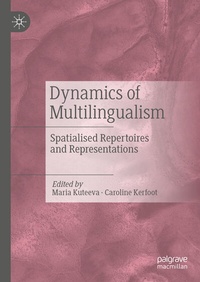
Dynamics of Multilingualism
Description

Reviews / Votes
"Emphasizing the central roles that bodies, birthday cakes, bullet-riddled signs, accents and gateways may play in wider semiotic repertoires, this fascinating and important book urges us to consider the dynamism of assemblages as multilingual resources are entangled with a multiplicity of artefacts, spaces and lived experiences." (Alastair Pennycook, Emeritus Professor, University of Technology Sydney, Australia)
"As linguists shift from their traditional logocentrism to treat assemblage as their unit of analysis, they confront many difficult questions for research. The studies in this collection analyze communication in a range of interesting contexts to throw light on the specific semiotic resources that shape it. These insightful studies should help scholars immensely toward operationalizing the assemblage approach in their own research." (Suresh Canagarajah, Evan Pugh University Professor, Pennsylvania State University, USA)
"This book provides a much-needed critical account of the interplay between multi-semiotic practices and the material realisation of spaces. Empirical studies provide intriguing perspectives on identity and belonging as well as issues of power and ideologies." (Sari Pöyhönen, Professor, University of Jyväskylä, Finland)
More details
Other editions
Additional editions
Persons
Maria Kuteeva is Professor of English Linguistics in the Department of English, Stockholm University, Sweden.
Caroline Kerfoot is Professor in Bilingualism at the Centre for Research on Bilingualism, Stockholm University, Sweden.
Content
Chapter 1. Dynamics of multilingualism: Spatialised repertoires and representations in unstable times (Caroline Kerfoot and Maria Kuteeva).- Chapter 2.- Testing the limits: A bodily response to engineered affect in a museum exhibition (Natalia Volvach).- Chapter 3.- Translanguaging the diaspora through religion: The creative construction of spatial repertoires in an African Pentecostal church (Michele Cunico).- Chapter 4.- "¡Hey! Un patacón ahí ": Mobilization of meanings and construction of identities in the Getsemaní neighborhood (Cartagena de Indias, Colombia) in Bizarre Foods (Julio Armando Morales-Fonseca).- Chapter 5.- "As if by magic, the gate will open once you have said what you want" - Gateways as agents in semiotic practices (Anna Mammitzsch).- Chapter 6.- Language, identity, and the body in relation to others: Making sense in a new migratory space (Tim Roberts).- Chapter 7.- "I don't speak Lithuanian in Sweden" - Anassemblage approach to heritage language practices (Frederik Bissinger).- Chapter 8.- "[I don't know why he has] an American accent, super weird": Ideological denaturalisation and the discursive construction of authentic accents in YouTube comment sections (Kate O'Farrell).- Chapter 9.- Coda (Brigitta Busch).
