

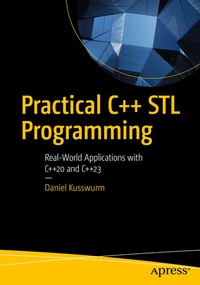
Practical C++ STL Programming
Description

Learn how to use the classes, algorithms, and other programming constructs of C++ STL. This comprehensive and practical guide covers a broad range of STL programming topics and highlights numerous programming constructs from the C++20 and C++23 standards.
Mastering use of STL can be daunting for both new and experienced C++ programmers. It doesn't help that the ISO C++ specification documents are meticulous and verbose. This book is organized to help you quickly understand C++ STL programming, focusing on the real-world aspects of its usage. Rather than spend time providing extensive explanations of the inner workings of STL, author Daniel Kusswurm judiciously explores these intricacies only when they advance the reader's understanding of a particular topic.
This book is accompanied by over 100 source code examples, designed to accelerate learning by emphasizing practical use cases. It coincides with the C++20 and C++23 standards and works with any OS platform that supports these standards including Windows (Visual C++), Linux (GNU C++) and macOS (clang). After reading Practical C++ STL Programming , you'll be able to exploit the computational capabilities of STL to implement a wide variety of software algorithms and solve unique programming challenges.
What You Will Learn
- Explore STL capabilities, including how to generate formatted output, utilize sequence containers, apply utility classes, exploit smart pointers, manipulate associative containers, and exercise container adaptors.
- Apply algorithms and iterators to perform a wide variety of container operations including sorts, searches, insertions, removals, and erasures.
- Utilize ranges and range iterators, adaptors, views, compositions, projections, and factories.
- Perform file and directory operations using STL's file system classes.
- Execute chronological calculations and formatting using the time classes.
- Employ STL's random number generation and distribution classes.
- Implement numerical processing algorithms using STL's std::valarray and std:complex classes.
- Accelerate program performance using STL's concurrency classes and algorithm execution policies.
Who This Book Is For
Software developers and programmers who understand the basic syntax and semantics of C++ and want/need to learn how to use STL's classes and algorithms, or programmers who have experience using STL as specified by the C++11/14/17 standards and are interested in learning how to use the new STL classes and algorithms of C++20/23. Computer science/engineering students or hobbyists who want to learn about or better understand the capabilities of STL.
More details
Other editions
Additional editions
Person
Daniel Kusswurm has 40+ years of professional experience as a software developer, computer scientist, and author. During his career, he has developed innovative software for medical devices, scientific instruments, and image processing applications. On many of these projects, he successfully utilized ISO C++ and the standard template libraries to create quality software and solve unique programming challenges. His educational background includes a BS in electrical engineering technology from Northern Illinois University along with an MS and PhD in computer science from DePaul University.
Kusswurm is the author multiple computer programming books including Modern X86 Assembly Language Programming (Third Edition), Modern Arm Assembly Language Programming , and Modern Parallel Programming with C++ and Assembly Language , all published by Apress.
Content
Prologue.- Chapter 1: C++ Review.- Chapter 2: Formatted I/O.- Chapter 3: Sequence Containers - Part 1.- Chapter 4: Sequence Containers - Part 2.- Chapter 5: General Utilities Library.- Chapter 6: Smart Pointers.- Chapter 7: Associative Containers.- Chapter 8: Unordered Associative Containers.- Chapter 9: Container Adaptors.- Chapter 10: Algorithms - Part 1.- Chapter 11: Algorithms - Part 2.- Chapter 12: Algorithms - Part 3.- Chapter 13: Algorithms - Part 4.- Chapter 14: Ranges - Part 1.- Chapter 15: Ranges - Part 2.- Chapter 16: Time Library.- Chapter 17: File Systems.- Chapter 18: Numerical Processing - Part 1.- Chapter 19: Numerical Processing - Part 2.- Chapter 20: Concurrency - Part 1.- Chapter 21: Concurrency - Part 2.- Appendix A: Source Code and Development Tools.- Appendix B: References and Resources.
