

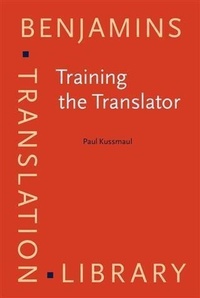
Training the Translator
1st Edition
Published on 16. March 1995
X, 178 pages
978-90-272-8362-7 (ISBN)
Description

This book begins by investigating, through the use of think-aloud protocols, the mental processes of students when they translate. The creative and successful processes observed can be used directly for teaching purposes, while the unsuccessful ones can serve to find out where remedial training is needed. The book then goes on to discuss methods for improving a translator's competence. The strategies offered are based on the pragmatic and semantic analysis of texts from a functional point of view, and they include such practical matters as the use of dictionaries and the evaluation of translations and error analysis. The book is intended for teachers in translator-training institutions, but it can also be used by students for self-training.
More details
Other editions
Additional editions
Paul Kussmaul
Training the Translator
Book
03/1995
John Benjamins Publishing Co
€111.30
Shipment within 10-15 days
Person
Content
- TRAINING THE TRANSLATOR
- Editorial page
- Title page
- Copyright page
- Acknowledgements
- Dedication
- Table of contents
- Introduction
- Chapter 1. What goes on in the translator's mind?
- 1.1 Types of empirical research
- 1.2 Methodological problems with think-aloud protocols
- 1.2.1 Choice of subjects
- 1.2.2 Elicitation methods
- 1.2.3 Explanatory models and text material
- 1.3 Some unsuccessful mental processes: Symptoms and diagnoses
- 1.3.1 Interferences
- 1.3.2 Fear of interferences
- 1.3.3 Faulty one-to-one correspondences
- 1.3.4 Misuse of bilingual dictionaries
- 1.3.5 Misuse of world knowledge and one's own experiences
- 13.6 Incomplete paraphrasing
- 1.4 Desirable attitudes: self-awareness and self-confidence
- 1.5 Error analysis revisited
- Chapter 2. Creativity in translation
- 2.1 Point of departure
- 2.2 Cognition and the four-phase model
- 2.3 Fluency of thinking
- 2.4 Divergent thinking
- 2.5 Emotions
- 2.6 Evaluation
- 2.7 Teaching creative translation
- Chapter 3. Pragmatic analysis
- 3.0 Overview
- 3.1 Situational dimensions
- 3.2 Communicative functions of utterances, texts and translations
- 3.3 The cultural background
- 3.4 Pragmatics and text types
- 3.5 Instruction leaflets and manuals - a case study
- 3.6 Some didactic implications
- Chapter 4. The analysis of meaning
- 4.0 Overview
- 4.1 Meaning, comprehension and translation
- 4.2 "Bedroom" - a prototypical case
- 4.3 Similar Cases
- 4.4 "Lexical gaps" and how to fill them
- 4.5 Teaching meaning, comprehension and translation
- Chapter 5. Text analysis and the use of dictionaries
- 5.1 Harmony between monolingual dictionaries and context
- 5.2 Problems with examples
- 5.3 Dictionary versus context
- 5.4 Unusual use
- 5.5 Stylistic labels
- 5.6 Teaching the use of dictionaries
- Chapter 6. Evaluation and errors
- 6.1 Opposing views among teachers of translation
- 6.2 Categories for evaluation
- 6.2.1 Cultural adequacy
- 6.2.2 Situational adequacy
- 6.2.3 Speech acts
- 6.2.4 Meaning of words
- 6.2.5 "Language errors
- 6.3 Source text defects
- Chapter 7. A summary of strategies
- 7.1 The rational approach
- 7.2 Solving translation problems
- 7.3 Evaluating translations
- Bibliography
- Subject Index
- Author Index
