

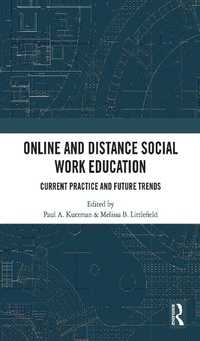
Online and Distance Social Work Education
Current Practice and Future Trends
1st Edition
Published on 29. June 2020
356 pages
978-1-000-05228-2 (ISBN)
Description

Online and Distance Social Work Education: Current Practice and Future Trends provides a comprehensive presentation on the evolution, current status and future direction of distance learning and online education in the social work profession.
Documenting the current state-of-the-art, this book demonstrates the power of distance learning and online technology and addresses future trends in web-based social work education. Written by widely recognized experts, the chapters represent an authoritative statement of the present state-of-the-art in the application of technology to contemporary social work education. The insights of these experts will be of great interest to students and faculty in the 798 accredited social work programs in the United States. They are creating a revolution in the profession which will forever change the nature of education for professional practice.
Authored by widely recognized educators on the cutting edge of technological innovation, this text will be relevant to social work students and educators in baccalaureate, masters and doctoral programs in the USA and internationally.
The chapters in this book were originally published in the Journal of Teaching in Social Work.
Documenting the current state-of-the-art, this book demonstrates the power of distance learning and online technology and addresses future trends in web-based social work education. Written by widely recognized experts, the chapters represent an authoritative statement of the present state-of-the-art in the application of technology to contemporary social work education. The insights of these experts will be of great interest to students and faculty in the 798 accredited social work programs in the United States. They are creating a revolution in the profession which will forever change the nature of education for professional practice.
Authored by widely recognized educators on the cutting edge of technological innovation, this text will be relevant to social work students and educators in baccalaureate, masters and doctoral programs in the USA and internationally.
The chapters in this book were originally published in the Journal of Teaching in Social Work.
More details
Edition
1. Auflage
Language
English
Place of publication
London
United Kingdom
Publishing group
Taylor & Francis Ltd
Target group
College/higher education
ISBN-13
978-1-000-05228-2 (9781000052282)
Copyright in bibliographic data and cover images is held by Nielsen Book Services Limited or by the publishers or by their respective licensors: all rights reserved.
Schweitzer Classification
Other editions
Additional editions
Paul A. Kurzman | Melissa Littlefield
Online and Distance Social Work Education
Current Practice and Future Trends
Book
06/2024
1st Edition
Routledge
€66.50
Shipment within 10-20 days
Paul A. Kurzman | Melissa Littlefield
Online and Distance Social Work Education
Current Practice and Future Trends
Book
03/2020
1st Edition
Routledge
€207.20
Shipment within 15-20 days
Persons
Paul A. Kurzman, PhD, ACSW is a Professor of Social Work at Hunter College and Professor of Social Welfare at The Graduate Center of the City University of New York where he teaches policy and practice in the MSW and Ph.D. programs. He is an author/editor of 10 books and Editor-in-Chief of the Journal of Teaching in Social Work.
Melissa B. Littlefield, PhD, LGSW is Associate Professor and Chair of the Master of Social Work Department at Morgan State University in Baltimore, Maryland. She is a recognized expert on multiculturalism, race, ethics and computer technology.
Melissa B. Littlefield, PhD, LGSW is Associate Professor and Chair of the Master of Social Work Department at Morgan State University in Baltimore, Maryland. She is a recognized expert on multiculturalism, race, ethics and computer technology.
Content
Part I. An Overview and Perspective
1. An Introduction: Reimagining Social Work Education for the Digital Age
2. The Current Status of Social Work Online and Distance Education
Part II. Emergent Paradigms
3. Community of Inquiry (CoI): A Framework for Social Work Distance Educators
4. Beyond the Online Versus On-Campus Debate: Leveraging Technology in a CoI Framework to Enhance Student and Faculty Presence in the MSW Classroom
5. A Synchronous Online Social Work PhD Program: Educational Design and Student/ Faculty Response
6. Reflections of an Online Social Work Professor: Illuminating an Alternative Pedagogy
7. Web-Based Social Work Courses: Guidelines for Developing and Implementing an Online Environment
Part III. Ethical and Diversity Considerations
8. Digital Ethics in Social Work Education
9. Globalization or Colonization in Online Education: Opportunity or Oppression?
10. Diversity and Difference in the Online Environment
11. The Teacher-Learner Relationship: Considerations for Social Work in the Digital Age.
Part IV. Strategies for Engagement
12. Introducing Social Work to Hyflex Blended Learning: A Student-Centered Approach
13. Teacher as Client Therapy (TACT): A Model for Simulated Learning for Traditional and Online Delivery Models
14. VoiceThread as a Tool in Online BSW Education
15. Exploring Online and Blended Course Delivery in Social Group Work
16. Converting a Face-to-Face Introductory Research Methods Course to an Online Format: Pedagogical Issues and Technological Tools
17. Using A Virtual Agency to Teach Research
Part V. Tools for Assessment and Administration
18. Designing for Quality: Distance Education Rubrics for Online MSW Programs
19. Developing and Supporting Faculty Training for Online Social Work Education: The Columbia University School of Social Work Online Pedagogy Institute
20. The One-Minute Paper as a Catalyst for Change in Online Pedagogy
21. Cutting the Distance in Distance Education: Reflections on the Use of E-Technologies in a New Zealand Social Work Program
22. Human Service Administrator Perceptions of Online MSW Degree Programs
1. An Introduction: Reimagining Social Work Education for the Digital Age
2. The Current Status of Social Work Online and Distance Education
Part II. Emergent Paradigms
3. Community of Inquiry (CoI): A Framework for Social Work Distance Educators
4. Beyond the Online Versus On-Campus Debate: Leveraging Technology in a CoI Framework to Enhance Student and Faculty Presence in the MSW Classroom
5. A Synchronous Online Social Work PhD Program: Educational Design and Student/ Faculty Response
6. Reflections of an Online Social Work Professor: Illuminating an Alternative Pedagogy
7. Web-Based Social Work Courses: Guidelines for Developing and Implementing an Online Environment
Part III. Ethical and Diversity Considerations
8. Digital Ethics in Social Work Education
9. Globalization or Colonization in Online Education: Opportunity or Oppression?
10. Diversity and Difference in the Online Environment
11. The Teacher-Learner Relationship: Considerations for Social Work in the Digital Age.
Part IV. Strategies for Engagement
12. Introducing Social Work to Hyflex Blended Learning: A Student-Centered Approach
13. Teacher as Client Therapy (TACT): A Model for Simulated Learning for Traditional and Online Delivery Models
14. VoiceThread as a Tool in Online BSW Education
15. Exploring Online and Blended Course Delivery in Social Group Work
16. Converting a Face-to-Face Introductory Research Methods Course to an Online Format: Pedagogical Issues and Technological Tools
17. Using A Virtual Agency to Teach Research
Part V. Tools for Assessment and Administration
18. Designing for Quality: Distance Education Rubrics for Online MSW Programs
19. Developing and Supporting Faculty Training for Online Social Work Education: The Columbia University School of Social Work Online Pedagogy Institute
20. The One-Minute Paper as a Catalyst for Change in Online Pedagogy
21. Cutting the Distance in Distance Education: Reflections on the Use of E-Technologies in a New Zealand Social Work Program
22. Human Service Administrator Perceptions of Online MSW Degree Programs
