

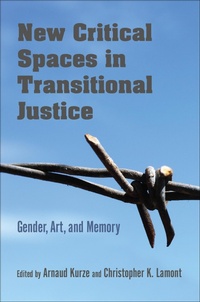
New Critical Spaces in Transitional Justice
Description

Since the 1980s, transitional justice mechanisms have been increasingly applied to account for mass atrocities and grave human rights violations throughout the world. Over time, post-conflict justice practices have expanded across continents and state borders and have fueled the creation of new ideas that go beyond traditional notions of amnesty, retribution, and reconciliation. Gathering work from contributors in international law, political science, sociology, and history, New Critical Spaces in Transitional Justice addresses issues of space and time in transitional justice studies. It explains new trends in responses to post-conflict and post-authoritarian nations and offers original empirical research to help define the field for the future.
More details
Other editions
Additional editions
Persons
Arnaud Kurze is Assistant Professor of Justice Studies at Montclair State University and Visiting Professor at New York University. He was appointed a Global Fellow at Woodrow Wilson Center in Washington, DC (2016-2018).
Christopher K. Lamont is Associate Professor of International Relations in the Institute for International Strategy at Tokyo International University. He is author of International Criminal Justice and the Politics of Compliance and Research Methods in International Relations.
Content
Acknowledgements
Introduction:
Reconceptualizing Transitional Justice: Exploring the Nexus between Agency and Spatiality / Arnaud Kurze and Christopher K. Lamont
Part I: Art, Activism and Politics: Redefining Space in Transitional Justice
1. Borrowing Achilles' Armor: The Political Afterlife of Former Transitional Justice Mechanisms / Marcos Zunino
2. The Site and Sights of Transitional Justice: Art at the Constitutional Court in Johannesburg /
Eliza Garnsey
3. Youth Activism, Art and Transitional Justice: Emerging Spaces of Memory After the Jasmine Revolution / Arnaud Kurze
Part II: Civil Society, Gender and Transitions: Emerging Spaces and Victimhood
4. Gendered PostConflict Justice: Male Survivors of Sexual Violence in Northern Uganda / Philipp Schulz
5. Claiming Space: Advocacy for Gender Justice in Cambodia / Katharina Behmer
6. The Question of Gender Inclusiveness of BottomUp Strategies in Bosnia and Herzegovina
Caterina Bonora
Part III: Spatiality, Temporality and the State
7. Libya in Transition: Spaces for Justice After Qadhafi / Christopher K. Lamont
8. Navigating the Narrow Spaces for Transitional Justice in Iraq / Mieczyslaw P. Boduszynski
9. Accountability in Syria: What are the Options? / Iva Vukusic
10. Dignity for the Defeated: Recognizing the "Other" in PostYugoslav Commemorative Practices / Vjeran Pavlakovic
Conclusion: Practicing Critical Transitional Justice and the Road Ahead / Arnaud Kurze and Christopher K. Lamont
Bibliography
Index
