

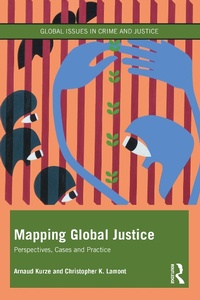
Mapping Global Justice
Perspectives, Cases and Practice
1st Edition
Published on 14. October 2022
292 pages
978-1-000-65516-2 (ISBN)
Description

Persistent international conflicts, increasing inequality in many regions or the world, and acute environmental and climate-related threats to humanity call for a better understanding of the processes, actors and tools available to face the challenges of achieving global justice.
This book offers a broad and multidisciplinary survey of global justice, bridging the gap between theory and practice by connecting conceptual frameworks with a panoply of case studies and an in-depth discussion of practical challenges. Connecting these critical aspects to larger moral and ethical debates is essential for thinking about large, abstract ideas and applying them directly to specific contexts. Core content includes:
Key debates in global justice from across philosophy, postcolonial studies, political science, sociology and criminology
The origins of global justice and the development of the human rights agenda; peacekeeping and post-conflict studies
Global poverty and sustainable development
Global security and transnational crime
Environmental justice, public health and well-being
Rather than providing a blueprint for the practice of global justice, this text problematizes efforts to cope with many justice related issues. The pedagogical approach is designed to map the difficulties that exist between theory and praxis, encourage critical thinking and fuel debates to help seek alternative solutions.
Bringing together perspectives from a wealth of disciplines, this book is essential reading for courses on global justice across criminology, sociology, political science, anthropology, philosophy and law.
This book offers a broad and multidisciplinary survey of global justice, bridging the gap between theory and practice by connecting conceptual frameworks with a panoply of case studies and an in-depth discussion of practical challenges. Connecting these critical aspects to larger moral and ethical debates is essential for thinking about large, abstract ideas and applying them directly to specific contexts. Core content includes:
Key debates in global justice from across philosophy, postcolonial studies, political science, sociology and criminology
The origins of global justice and the development of the human rights agenda; peacekeeping and post-conflict studies
Global poverty and sustainable development
Global security and transnational crime
Environmental justice, public health and well-being
Rather than providing a blueprint for the practice of global justice, this text problematizes efforts to cope with many justice related issues. The pedagogical approach is designed to map the difficulties that exist between theory and praxis, encourage critical thinking and fuel debates to help seek alternative solutions.
Bringing together perspectives from a wealth of disciplines, this book is essential reading for courses on global justice across criminology, sociology, political science, anthropology, philosophy and law.
Reviews / Votes
Hugely topical and timely. This far ranging book on global justice engages all of the leading contemporary debates from war and peace to climate change and economic development. It is an essential companion for academic and general audiences alike.Ruti Teitel, Ernst C Stiefel Professor of Comparative Law, New York Law School
This book by Kurze and Lamont beautifully maps out global justice discussions in the past, present and future across disciplines, capturing their entirety holistically, while categorizing them into three pillars - conflict and post-conflict, distributive justice, and environmental justice. A great read: first of its kind!
Ai Kihara-Hunt, Professor of International Human Rights Law and the Rule of Law, The University of Tokyo
In Mapping Global Justice, Arnaud Kurze and Christopher K. Lamont provide a comprehensive and critical assessment of a range of global justice debates and practices that transcend the topic of transitional justice to also include the crucial topics of environmental justice, global security threats, and racial and gender discrimination. This book is must reading for specialists and students interested in understanding the interconnected challenges facing these different realms of global justice.
Victor Peskin, Associate Professor, School of Politics and Global Studies, Arizona State University
An inspiring, must-read for students, scholars and practitioners. The authors tackle global justice issues, including conflict, inequality and environmental threats from a multidisciplinary perspective, providing us with a fresh perspective and practical insights on how to face today's major international challenges.
Sarine Karajerjian, Program Director of Environmental Politics Project, Arab Reform Initiative
More details
Series
Edition
1. Auflage
Language
English
Place of publication
London
United Kingdom
Publishing group
Taylor & Francis Ltd
Target group
College/higher education
Illustrations
3 Tables, black and white; 2 Line drawings, black and white; 5 Halftones, color; 1 Halftones, black and white; 5 Illustrations, color; 3 Illustrations, black and white
ISBN-13
978-1-000-65516-2 (9781000655162)
Copyright in bibliographic data and cover images is held by Nielsen Book Services Limited or by the publishers or by their respective licensors: all rights reserved.
Schweitzer Classification
Other editions
Additional editions
Book
10/2022
1st Edition
Routledge
€79.30
Shipment within 15-20 days
Book
10/2022
1st Edition
Routledge
€223.70
Shipment within 15-20 days
Persons
Arnaud Kurze is Associate Professor of Justice Studies at Montclair State University, United States.
Christopher K. Lamont is Associate Professor of International Relations at Tokyo International University, Japan.
Christopher K. Lamont is Associate Professor of International Relations at Tokyo International University, Japan.
Content
1.Introduction: Mapping Debates in Global Justice Part 1: The Idea of Global Justice: Philosophical and Theoretical Context 2.War and Peace 3.Inequality, Poverty and Postcolonial Perspectives 4.The Environment and Human Existence Part 2: Origins and Evolution 5.Pre-20th Century Justice Practices 6.Empires, Injustice and Legacies 7.Global Justice after 1945: The Era of Human Rights? 8.Nascent Issues: The Environment and Public Health Part 3: Contemporary Practice of Global Justice 9.Post-Cold War Justice Renaissance 10.The Right to Sustainable Development 11.Environmental Justice: From Advocacy to Adjudication? 12.Global Security Threats: Embracing Critical Approaches Part 4: Challenges and the Road Ahead 13.Consolidation, Crisis, or Collapse? 14.Interconnected Challenges and the Need for Holistic Solutions 15.Prospects for Global Justice: Perspectives on Race, Gender and LGBTQ
