

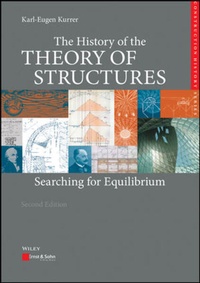
The History of the Theory of Structures
Searching for Equilibrium
2nd Edition
Published on 19. June 2018
XXX, 1212 pages
978-3-433-60914-9 (ISBN)
Description

Ten years after the publication of the first English edition of The History of the Theory of Structures, Dr. Kurrer now gives us a much enlarged second edition with a new subtitle: Searching for Equilibrium. The author invites the reader to take part in a journey through time to explore the equilibrium of structures. That journey starts with the emergence of the statics and strength of materials of Leonardo da Vinci and Galileo, and reaches its first climax with Coulomb's structural theories for beams, earth pressure and arches in the late 18th century. Over the next 100 years, Navier, Culmann, Maxwell, Rankine, Mohr, Castigliano and Müller-Breslau moulded theory of structures into a fundamental engineering science discipline that - in the form of modern structural mechanics - played a key role in creating the design languages of the steel, reinforced concrete, aircraft, automotive and shipbuilding industries in the 20th century. In his portrayal, the author places the emphasis on the formation and development of modern numerical engineering methods such as FEM and describes their integration into the discipline of computational mechanics.
Brief insights into customary methods of calculation backed up by historical facts help the reader to understand the history of structural mechanics and earth pressure theory from the point of view of modern engineering practice. This approach also makes a vital contribution to the teaching of engineers.
Dr. Kurrer manages to give us a real feel for the different approaches of the players involved through their engineering science profiles and personalities, thus creating awareness for the social context. The 260 brief biographies convey the subjective aspect of theory of structures and structural mechanics from the early years of the modern era to the present day. Civil and structural engineers and architects are well represented, but there are also biographies of mathematicians, physicists, mechanical engineers and aircraft and ship designers. The main works of these protagonists of theory of structures are reviewed and listed at the end of each biography. Besides the acknowledged figures in theory of structures such as Coulomb, Culmann, Maxwell, Mohr, Müller-Breslau, Navier, Rankine, Saint-Venant, Timoshenko and Westergaard, the reader is also introduced to G. Green, A. N. Krylov, G. Li, A. J. S. Pippard, W. Prager, H. A. Schade, A. W. Skempton, C. A. Truesdell, J. A. L. Waddell and H. Wagner. The pioneers of the modern movement in theory of structures, J. H. Argyris, R. W. Clough, T. v. Kármán, M. J. Turner and O. C. Zienkiewicz, are also given extensive biographical treatment. A huge bibliography of about 4,500 works rounds off the book.
New content in the second edition deals with earth pressure theory, ultimate load method, an analysis of historical textbooks, steel bridges, lightweight construction, theory of plates and shells, Green's function, computational statics, FEM, computer-assisted graphical analysis and historical engineering science. The number of pages now exceeds 1,200 - an increase of 50% over the first English edition.
This book is the first all-embracing historical account of theory of structures from the 16th century to the present day.
Brief insights into customary methods of calculation backed up by historical facts help the reader to understand the history of structural mechanics and earth pressure theory from the point of view of modern engineering practice. This approach also makes a vital contribution to the teaching of engineers.
Dr. Kurrer manages to give us a real feel for the different approaches of the players involved through their engineering science profiles and personalities, thus creating awareness for the social context. The 260 brief biographies convey the subjective aspect of theory of structures and structural mechanics from the early years of the modern era to the present day. Civil and structural engineers and architects are well represented, but there are also biographies of mathematicians, physicists, mechanical engineers and aircraft and ship designers. The main works of these protagonists of theory of structures are reviewed and listed at the end of each biography. Besides the acknowledged figures in theory of structures such as Coulomb, Culmann, Maxwell, Mohr, Müller-Breslau, Navier, Rankine, Saint-Venant, Timoshenko and Westergaard, the reader is also introduced to G. Green, A. N. Krylov, G. Li, A. J. S. Pippard, W. Prager, H. A. Schade, A. W. Skempton, C. A. Truesdell, J. A. L. Waddell and H. Wagner. The pioneers of the modern movement in theory of structures, J. H. Argyris, R. W. Clough, T. v. Kármán, M. J. Turner and O. C. Zienkiewicz, are also given extensive biographical treatment. A huge bibliography of about 4,500 works rounds off the book.
New content in the second edition deals with earth pressure theory, ultimate load method, an analysis of historical textbooks, steel bridges, lightweight construction, theory of plates and shells, Green's function, computational statics, FEM, computer-assisted graphical analysis and historical engineering science. The number of pages now exceeds 1,200 - an increase of 50% over the first English edition.
This book is the first all-embracing historical account of theory of structures from the 16th century to the present day.
Reviews / Votes
About this Edition"[...] K.-E. Kurrer's book is a compreshensive treatise on the theories that are used for analysis and design of structures from the earliest days (Archimedes' lever principle) to the present (finite element method). Those who have read the first edition of the book will be surprised by the huge amount of history and knowledge which has been added in the second edition. One can still read the individual chapters in isolation without losing the broad view on the total. The book is well illustrated with pictures, graphs, historical drawings and sketches, which makes for entertaining reading. It contains a wealth of information and is therefore a source for historians, especially interested in the history of technology, but also for professional engineers and graduate students of engineering and art history. The book is a necessary element of libraries and engineering departments."
em. Prof. Dr.-Ing. Dr. h.c. Dr. E.h. Hans-Wolf Reinhardt, University of Stuttgart, Germany (RILEM's website: www.rilem.net, July 2018)
"(...) Der Rezensent empfiehlt vorliegendes Buch wärmstens - auch den Lesern in Polen.
Bauingenieure, Architekten und Umweltingenieure und Studierende der genannten Disziplinen
finden dort zahlreiche Anregungen zum Nachdenken."
Prof. dr hab. inz. Zbigniew Cywinski in "Inzynieria Morska i Geotechnika", 4/2018, S. 313:
About the First English edition 2008
"[...] Ultimately, this is an extraordinary book that should be in every engineering library and on the bookshelf of every structural engineer who aspires to make a difference in the design, development, and preservation of civil infrastructure."
Prof. Sashi K. Kunnath, University of California, Davis, USA (Journal of Structural Engineering, March 2009, pp. 330-331)
"[...] Kurrer's achievement in compiling this book is colossal, and I commend it to anyone interested in the subject. It will, for a long time, stand well along side the other classics of the field - Timoshenko's "History of Strength of Materials", and Eduardo Benvenuto's "Introduction to the History of Structural Mechanics". [...]"
Dr. Bill Addis, Buro Happold, London, UK (International Journal of Space Structures, Vol. 23, No. 3, July 2008, p. 194)
"[...] As you can tell from my enthusiasm, I recommend this highly original study, first as a pleasure to read and a thoughtful examination of new avenues to explain the development of human understanding, and also as an aid and inspiration for further research."
Prof. Dr. Tom F. Peters, Lehigh University, USA (Technology and Culture, July 2009, Vol. 50, pp. 669-674)
"[...] Kurrer's book is truly a masterpiece. In the 800-plus pages, one finds no end of new and interesting pieces of information that contribute to the history of the theory of structures. [...]"
Prof. Dr. Harry H. West, The Pennsylvania State University, USA (Journal of Architectural Engineering, Vol. 14, Issue 4, December 2008, p. 130)
"[...] Whenever you want to learn about the subject or just want to browse through history - this is the book! It is certainly a must for every historically interested engineer as well as for historians of science. "The Kurrer" will become the standard reference book and will stay in that position for many years to come."
Prof. Dr. Thomas Sonar, Institute of Computational Mathematics, Technische Universität Braunschweig, Germany (ZAMP The Journal of Applied Mathematics and Physics, Vol. 60 (2009), p. 581)
"[...] German publisher Ernst & Sohn has brought to the English-speaking public this substantial monograph by Karl-Eugen Kurrer, which is a revised and considerably extended version of the highly successful 2002 German edition Geschichte der Baustatik. The additional content, especially the inclusion of more international developments, makes this book of truly worldwide significance."
Prof. Dr. Andreas Kahlow, Berlin, Germany (Proceedings of the Institution of Civil Engineers - Engineering History and Heritage, Vol. 164, February 20
More details
Other editions
Additional editions
Software
06/2018
Ernst & Sohn
€206.52
No shipping information available
Book
06/2018
2nd Edition
Ernst & Sohn
€169.00
Shipment within 5-7 days
Persons
Karl-Eugen Kurrer was born in Heilbronn, Germany, in 1952. After graduating from Stuttgart University of Applied Sciences with a general civil engineering degree in 1973, he worked as a structural timber engineer for Losberger GmbH in Heilbronn.
He then returned to university to study civil engineering and physical engineering sciences at TU Berlin, the city's science and technology university. As a tutor in the Theory of Structures Department at TU Berlin between 1977 and 1981, one of Karl-Eugen Kurrer's most important teaching and learning experiences was grasping the basic principles of structural analysis from the historical point of view. The intention of his handwritten introductory lecture notes on the history of each method of structural analysis was to help students understand that theory of structures, too, is the outcome of a socio-historical everyday process in which they themselves play a part and, in the end, help to shape. Another goal was to create a deeper sense of the motivation for and enjoyment of the learning of structural analysis. It was crucial to overcome the formula-type acquisition of the subject matter by introducing a didactic approach to the fundamentals of theory of structures through their historical appreciation. By 1998 this had evolved into a plea for a historico-genetic approach to the teaching of theory of structures.
His dissertation "Entwicklung der Gewölbetheorie vom 19. Jahrhundert bis zum heutigen Stand der Wissenschaft am Beispiel der Berechnung einer Bogenbrücke" (the development of vault theory from the 19th century to today using the example of structural calculations for an arch bridge) was completed in 1981. Since 1980, his many articles on the history of science and technology in general and construction history in particular have appeared in journals, newspapers, books and exhibition publications.
Karl-Eugen Kurrer completed his PhD - on the internal kinematic and kinetic of tube vibratory mills (advisers: Eberhard Gock, Wolfgang Simonis, Gerd Brunk) - with the highest level of distinction, summa cum laude, at TU Berlin in 1986 and went on to carry out externally funded research on energy efficiency in industry. He contributed to the development of a new eccentric vibratory mill that uses 50% less energy than comparable models. After 1995 the design successfully established itself on the international machine market (US and EU patents). The head of the "Eccentric vibratory mill" team at Clausthal University of Technology, Prof. Dr. Eberhard Gock (1937-2016), received an innovation award ("Technologietransferpreis der Industrie- und Handelskammer Braunschweig") for this work in 1998.
Summaries of the research results from Dr. Kurrer's work at the interface between mechanical process engineering, machine dynamics and raw materials engineering appeared in issues 124 and 282 of series 3 (process engineering) of the progress reports published by the VDI (Association of German Engineers), and also in numerous presentations and journal publications at home and abroad.
Between 1989 and 1995, Dr. Kurrer was employed at the Department of Antenna Design of Telefunken Sendertechnik GmbH (head of department: Dr.-Ing. Peter Bruger) in Berlin as a developer of structural systems for large long-, medium- and short-wave antenna systems. He worked on the further development of Telefunken's own program suite for the calculation, dimensioning and design of cable networks for short-wave antennas according to third-order theory. He also contributed to the design of a rotating steel short-wave curtain antenna.
For nearly 40 years, Karl-Eugen Kurrer has carried out research on the subject of construction history with a special emphasis on theory of structures. Since 1992, he has been involved in the conference series entitled "Between Mechanics and Architecture", which was established by Patricia Radelet-de Grave and Edoardo Benvenuto.
Since 1996, Dr. Kurrer has been Chair of the VDI's Working Group o
He then returned to university to study civil engineering and physical engineering sciences at TU Berlin, the city's science and technology university. As a tutor in the Theory of Structures Department at TU Berlin between 1977 and 1981, one of Karl-Eugen Kurrer's most important teaching and learning experiences was grasping the basic principles of structural analysis from the historical point of view. The intention of his handwritten introductory lecture notes on the history of each method of structural analysis was to help students understand that theory of structures, too, is the outcome of a socio-historical everyday process in which they themselves play a part and, in the end, help to shape. Another goal was to create a deeper sense of the motivation for and enjoyment of the learning of structural analysis. It was crucial to overcome the formula-type acquisition of the subject matter by introducing a didactic approach to the fundamentals of theory of structures through their historical appreciation. By 1998 this had evolved into a plea for a historico-genetic approach to the teaching of theory of structures.
His dissertation "Entwicklung der Gewölbetheorie vom 19. Jahrhundert bis zum heutigen Stand der Wissenschaft am Beispiel der Berechnung einer Bogenbrücke" (the development of vault theory from the 19th century to today using the example of structural calculations for an arch bridge) was completed in 1981. Since 1980, his many articles on the history of science and technology in general and construction history in particular have appeared in journals, newspapers, books and exhibition publications.
Karl-Eugen Kurrer completed his PhD - on the internal kinematic and kinetic of tube vibratory mills (advisers: Eberhard Gock, Wolfgang Simonis, Gerd Brunk) - with the highest level of distinction, summa cum laude, at TU Berlin in 1986 and went on to carry out externally funded research on energy efficiency in industry. He contributed to the development of a new eccentric vibratory mill that uses 50% less energy than comparable models. After 1995 the design successfully established itself on the international machine market (US and EU patents). The head of the "Eccentric vibratory mill" team at Clausthal University of Technology, Prof. Dr. Eberhard Gock (1937-2016), received an innovation award ("Technologietransferpreis der Industrie- und Handelskammer Braunschweig") for this work in 1998.
Summaries of the research results from Dr. Kurrer's work at the interface between mechanical process engineering, machine dynamics and raw materials engineering appeared in issues 124 and 282 of series 3 (process engineering) of the progress reports published by the VDI (Association of German Engineers), and also in numerous presentations and journal publications at home and abroad.
Between 1989 and 1995, Dr. Kurrer was employed at the Department of Antenna Design of Telefunken Sendertechnik GmbH (head of department: Dr.-Ing. Peter Bruger) in Berlin as a developer of structural systems for large long-, medium- and short-wave antenna systems. He worked on the further development of Telefunken's own program suite for the calculation, dimensioning and design of cable networks for short-wave antennas according to third-order theory. He also contributed to the design of a rotating steel short-wave curtain antenna.
For nearly 40 years, Karl-Eugen Kurrer has carried out research on the subject of construction history with a special emphasis on theory of structures. Since 1992, he has been involved in the conference series entitled "Between Mechanics and Architecture", which was established by Patricia Radelet-de Grave and Edoardo Benvenuto.
Since 1996, Dr. Kurrer has been Chair of the VDI's Working Group o
Content
Foreword of the series editors
Foreword by Prof. Ekkehard Ramm
Preface to the second English edition
About this series
About the series editors
About the author
1 The tasks and aims of a historical study of the theory of structures
2 Learning from history: 12 introductory essays
3 The first fundamental engineering science disciplines: theory of structures and applied mechanics
4 From masonry arch to elastic arch
5 The history of earth pressure theory
6 The beginnings of a theory of structures
7 The discipline-formation period of theory of structures
8 From construction with iron to modern structural steelwork
9 Member analysis conquers the third dimension: the spatial framework
10 Reinforced concrete's influence on theory of structures
11 The consolidation period of theory of structures
12 The development and establishment of computational statics
13 Thirteen scientific controversies in mechanics and theory of structures
14 Perspectives for a historical theory of structures
15 Brief biographiesof 260 protagonists of theory of structures
Bibliography
Name index
Subject index
Foreword by Prof. Ekkehard Ramm
Preface to the second English edition
About this series
About the series editors
About the author
1 The tasks and aims of a historical study of the theory of structures
2 Learning from history: 12 introductory essays
3 The first fundamental engineering science disciplines: theory of structures and applied mechanics
4 From masonry arch to elastic arch
5 The history of earth pressure theory
6 The beginnings of a theory of structures
7 The discipline-formation period of theory of structures
8 From construction with iron to modern structural steelwork
9 Member analysis conquers the third dimension: the spatial framework
10 Reinforced concrete's influence on theory of structures
11 The consolidation period of theory of structures
12 The development and establishment of computational statics
13 Thirteen scientific controversies in mechanics and theory of structures
14 Perspectives for a historical theory of structures
15 Brief biographiesof 260 protagonists of theory of structures
Bibliography
Name index
Subject index
