

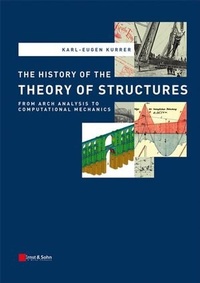
The History of the Theory of Structures
From Arch Analysis to Computational Mechanics Foreword by Ekkehard Ramm
1st Edition
Published on 9. January 2012
848 pages
978-3-433-60134-1 (ISBN)
Description

This book traces the evolution of theory of structures and strength of materials - the development of the geometrical thinking of the Renaissance to become the fundamental engineering science discipline rooted in classical mechanics. Starting with the strength experiments of Leonardo da Vinci and Galileo, the author examines the emergence of individual structural analysis methods and their formation into theory of structures in the 19th century. For the first time, a book of this kind outlines the development from classical theory of structures to the structural mechanics and computational mechanics of the 20th century. In doing so, the author has managed to bring alive the differences between the players with respect to their engineering and scientific profiles and personalities, and to create an understanding for the social context. Brief insights into common methods of analysis, backed up by historical details, help the reader gain an understanding of the history of structural mechanics from the standpoint of modern engineering practice. A total of 175 brief biographies of important personalities in civil and structural engineering as well as structural mechanics plus an extensive bibliography round off this work.
Reviews / Votes
"The history of statics is statics itself", claims Karl-Eugen Kurrer, paraphrasing Goethe. In "Geschichte der Baustatik", based on a long series of specialized articles and more than two decades of study, Kurrer spreads a host of personalities and their interests before us, weaving them together into a thematic whole. Thought is, of course, inextricably bound to personality and education, and Kurrer demonstrates how engineering thought, far from being abstractly objective, is imbued with the character of the thinkers, their teachers, and their pupils. Personal experience conditions the definition of theoretical problems and their solutions, and this renders theoreticians human and their thoughts part of an ongoing professional discourse.Prof. Dr. Tom F. Peters, Lehigh University, Betlehem/USA (Technology and Culture, Vol. 45, 2004)
The book is about much more than the origins of statics and its use in building and bridge engineering since the late sixteenth century. It is also about the very ideas of "statics" and "strength of materials" and how they came to be an integral part of the engineer's life; how they were developed into an academic discipline and a rigorous technique in engineering education; How they became the subject of growing numbers of technical books and periodicals, both for the academicians and the practitioners; and last, but not least, how the epistemology of the subject developed. Nowhere is the point of this book better demonstrated than in its title and, for non-German readers, how it should be rendered into English, or French or Spanish. "Baustatik" is not statics, or building statics; it is not structural engineering or strength of materials or structural science or analysis or design or calculation. It is a part of all these, and more. It is what united and binds a whole community of professionals together (...). Kurrer's excellent work makes for an interesting comparison with Antoine Picon's book "L'invention de l'Ingénieur Moderne" which charts the history and contribution of the "École des ponts et chausées" between 1747 and 1851.
Bill Addis PhD, Buro Happold Consulting Engineers, London (Construction History, Vol. 18, 2002)
Kurrer is the Chief Editor of the German journal "Stahlbau" (Steel Construction). His book is an important contribution to a subject on which little has been published so far.
Prof. Dr. H. J. Cowan, University of Sydney (Architectural Science Review, Vol. 46, 2003)
This "history of theory of structures" could only have been written by an expert, an engineer who knows the discipline inside out. This fully revised English edition, which explores international developments in greater depths, follows on from the highly successful German edition We should be very grateful to Dr. Kurrer, and also "his" publisher, Ernst & Sohn, for this treatise.
PROF. EKKEHARD RAMM, UNIV. OF STUTTGART
Erstmalig wird eine zusammenfassende Darstellung der Entwicklung von der klassischen Baustatik zur Strukturmechanik und "Computational Mechanics" im letzten Jahrhundert geboten.
Summary: This book offers fascinating insights into the emerge of theory of structures and structural analysis itself on various levels. ... So on the whole a cohorent picture of the development of theory of structures emerges. Recommendation: definitely worth reading!
HOLGER EGGEMANN, BRÜHL
Das vorliegende Werk ist weit mehr als ein Fachbuch zur Gesschichte einer technikwissenschaftlichen Disziplin. Es ist spannendste Ingenieurlektüre in einer heute selten gewordenen, gepflegten Sprache.
WILFRIED B. KRÄTZIG, BAUTECHNIK, HEFT 9/2008
-----------------------------
Das Buch ist ein wunderbares Werk, welches die Bedeutung der Geschichte im strukturellen Ingenieurbau unterstreicht. Es bildet ein Werk, das zum kurzen Nachlesen von statischen Verfahren und auch gleichzeitig zur Aneignung von Hintergrundwissen bezüglich der zugehörigen geschichtlichen Entwicklungen geeignet ist.
ALFRED STRAUSS, BETON- UND STAHLBETONBAU, HEF
More details
Other editions
Additional editions
Karl-Eugen Kurrer
The History of the Theory of Structures
From Arch Analysis to Computational Mechanics Foreword by Ekkehard Ramm
Book
04/2008
Ernst & Sohn
€139.00
Article exhausted; check for reprint
Persons
Dr.-Ing. Karl-Eugen Kurrer has been chief editor of the journal "Stahlbau", published by Ernst & Sohn, Berlin, since 1996. His interest in the history of theory of structures from the scientific and engineering perspectives began some 30 years ago. The great success of his book "Geschichte der Baustatik" published at the end of 2002, the repeated requests for an English edition and the members of the Berlin-based VDI History of Engineering Study Group inspired him to write this revised edition.
Content
Foreword by Prof. Ekkehard Ramm
Preface
Preface to the first, German edition
The tasks and aims of a historical study of theory of structures
Learning from the history of structural analysis: 11 introductory essays
The first fundamental engineering science disciplines: theory of structures and applied mechanics
From masonry arch to elastic arch
The beginnings of a theory of structures
The discipline-formation period of theory of structures
From construction with iron to modern structural steelwork
Member analysis conquers the third dimension: the spatial framework
Reinforced concrete's influence on theory of structures
From classical to modern theory of structures
Twelve scientific controversies in mechanics and theory of structures
Perspectives for theory of structures
Brief biographies
Bibliography
Name index
Subject index
Preface
Preface to the first, German edition
The tasks and aims of a historical study of theory of structures
Learning from the history of structural analysis: 11 introductory essays
The first fundamental engineering science disciplines: theory of structures and applied mechanics
From masonry arch to elastic arch
The beginnings of a theory of structures
The discipline-formation period of theory of structures
From construction with iron to modern structural steelwork
Member analysis conquers the third dimension: the spatial framework
Reinforced concrete's influence on theory of structures
From classical to modern theory of structures
Twelve scientific controversies in mechanics and theory of structures
Perspectives for theory of structures
Brief biographies
Bibliography
Name index
Subject index
