

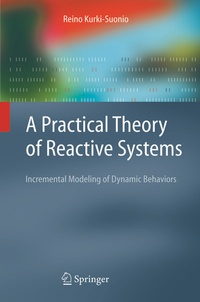
A Practical Theory of Reactive Systems
Description

Reviews / Votes
From the reviews:
"Kurki-Suinio's book aims at developing a practical theory for the development of distributed reactive systems. . The approach presented in the book is the result of many years of research. The design method developed by the author has been successfully used for the construction of many distributed parallel systems. . Potential audience of this book is definitely found among software engineers . . The book is also useful for researchers working in the mentioned area." (Klaus Schneider, The Computer Journal, 2007)
"This book deals with reactive systems by first explaining a simple condition action effect language, which is similar to the language Unity or the one used in I/O automata. . The book is usable as an extensive introduction for those who acquire the skill to use and extend it elsewhere. Of course as such it also usable for those who want to know what is going on in the field of concurrency from a TLA perspective." (Jan Friso Groote, Zentralblatt MATH, Vol. 1070, 2005)
"It is rare to find a book that answers the questions of software engineers who are working with dynamic systems . where formalisms of actions and behaviors are often answered by abstract theories of artificial intelligence. . . Overall, this is a well-written book, which takes a practical software engineering approach, rather than a philosophical artificial intelligence (AI) one. The book will make a good complementary reading for courses on intelligent agents, showing a practical route for translating theory into software specifications." (Aladdin Ayesh, Computing Reviews, April, 2006)
More details
Other editions
Additional editions
Person
Reino Kurki-Suonio has a PhD in mathematics from the University of Helsinki. He entered the field of computing in 1960. In 1965 he moved from industry to the University of Tampere to start the first computer science department in Finland. In 1980 he was invited to develop education in information technology at Tampere University of Technology, where he currently serves as professor emeritus at the Institute of Software Systems. During his career he has held visiting positions at Carnegie Mellon and Stanford Universities, and has served as the Chair of IFIP Technical Committee on Software, Theory and Practice.
