

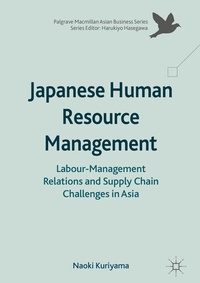
Japanese Human Resource Management
Description

This book is a comprehensive study underpinned by thirty years of research conducted by the author relating to Japanese human resource management and labour-management relations. Its aim is to achieve a better understanding of the Japanese model for human resource management and labour standards issues, and its transferability to supply chains in Asia. Seeking a better understanding of the strength of Japanese management and its applicability to foreign countries, Japanese Human Resource Management introduces a new agenda for Japanese corporations that wish to operate in sustainable and inclusive ways in local societies and in global supply chains. Organized into three major themes this comprehensive study is essential reading for students, researchers and government who wish to promote productivity improvement and constructive labour-management relations.
More details
Other editions
Additional editions
Person
Naoki Kuriyama is Professor of Human Resources Management at the Department of Business Administration of Soka University located in Hachioji, Tokyo, Japan. Previously he was employed as an expert on employment for ILO, Geneva (1988-1991), visiting scholar at International Institute of Labour Studies and Modern Asia Research Centre, Geneva (1999-2000). His research interests concern the relationships between internal and external stakeholders such as CSR and HRM. Coordination of the university programme of "Business Education of Sustainable Development" with extensive research visits to Europe and Asia is one of the priority fields.
Content
Part ? : A model of Japanese-style management.- Chapter 1 Stereotypes of Japanese Human Resource Management and Labour Management Relations.- Chapter 2 Practical wisdom of Labour-Management Relations (LMR) through the productivity movement in Japan.- Chapter 3 The case of the food and drink industries in Japan in response to technological change and employment adjustment in the late 1990s.- Chapter 4 The Formation of Industrial Subcontracting in the Japanese Manufacturing Industry.- Part ? Transferability to Asia.- Chapter 5 Resilience of Japanese automobile investment in Thailand during the 1997 Asian financial crisis.- Chapter 6 Japanese TNC-SME linkages through industrial subcontracting .- Chapter 7 Soft side of technology transfer.- Chapter 8 New technologies and employment of Japanese subsidiaries in Thai manufacturing.- Chapter 9 Prospects for human resources development of SMEs, micro enterprises and informal sectors.- Chapter 10Employment Situations in Japan and the effects of Human Resources Development to globalizing Asia in the 90s.- Part ? Labour standards and conditions at supply chains in Asia.- Chapter 11 The ILO Standards with regards to Developing Countries in the late 1980s and particular relations to the circumstances of ASEAN countries.- Chapter 12 Core Labour Standards and globalization.- Chapter 13 Labour Standards of international CSR initiatives and the perspectives of Asian Employers -With Reference to a survey for Asian Employers' Organizations in 2011.- Chapter 14 Role of business in Asian living and working conditions.
