

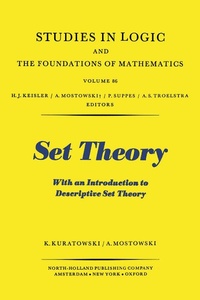
Set Theory
With an Introduction to Descriptive Set Theory
2nd Edition
Published on 14. May 2014
529 pages
978-0-08-095495-0 (ISBN)
Description

SET THEORY
More details
Series
Edition
2nd ed.
Language
English
Place of publication
Burlington
Netherlands
ISBN-13
978-0-08-095495-0 (9780080954950)
Copyright in bibliographic data and cover images is held by Nielsen Book Services Limited or by the publishers or by their respective licensors: all rights reserved.
Schweitzer Classification
Other editions
Additional editions

Lev D. Beklemishev
Provability, Computability and Reflection: Volume 86
Book
04/2000
Elsevier
€252.55
Article exhausted; check different version
Previous edition
Ayda I. Arruda | Lev D. Beklemishev
Mathematical Logic in Latin America
Proceedings of the IV Latin American Symposium on Mathematical Logic Held in Santiago, December 1978
E-Book
06/2014
1st Edition
Elsevier
€215.00
Available for download
Content
- Front Cover
- Set Theory: With an Introduction to Descriptive Set Theory
- Copyright Page
- Contents
- Preface to the first edition
- Preface to the second edition
- CHAPTER I. Algebra of sets
- § 1. Propositional calculus
- § 2. Sets and operations on sets
- § 3. Inclusion, Empty set
- § 4. Laws of union, intersection, and subtraction
- § 5. Properties of symmetric difference
- § 6. The set 1, complement
- § 7. Constituents
- § 8. Applications of the algebra of sets to topology
- § 9. Boolean algebras
- 10. Lattices
- CHAPTER II. Axioms of set theory. Relations. Functions
- § 1. Set theoretical formulas. Quantifiers
- § 2. Axioms of set theory
- § 3. Some simple consequences of the axioms
- § 4. Cartesian products . Relations
- § 5. Equivalence relations. Partitions
- § 6. Functions
- § 7. Images and inverse images
- § 8. Functions consistent with a given equivalence relation. Factor Boolean algebras
- § 9. Order relations
- § 10. Relational systems, their isomorphisms and types
- CHAPTER III. Natural numbers. Finite and infinite sets
- § 1. Natural numbers
- § 2. Definitions by induction
- § 3. The mapping J of the set N × N onto N and related mappings
- § 4. Finite and infinite sets
- CHAPTER IV. Generalized union, intersection and Cartesian product
- § 1. Set-valued functions . Generalized union and intersection
- § 2. Operations on infinite sequences of sets
- § 3. Families of sets closed under given operations
- § 4. s-additive and d-multiplicative families of sets
- § 5. Reduction and separation properties
- § 6. Generalized Cartesian products
- § 7. Cartesian products of topological spaces
- § 8. The Tychonoff theorem
- § 9. Reduced direct products
- § 10. Infinite operations in lattices and in Boolean algebras
- § 11. Extensions of ordered sets to complete lattices
- § 12. Representation theory for distributive lattices
- CHAPTER V. Theory of cardinal numbers
- § 1. Equipollence. Cardinal numbers
- § 2. Countable sets
- § 3. The hierarchy of cardinal numbers
- § 4. The arithmetic of cardinal numbers
- § 5. Inequalities between cardinal numbers. The Cantor-Bernstein theorem and its generalizations
- § 6. Properties of the cardinals a and c
- § 7. The generalized sum of cardinal numbers
- § 8. The generalized product of cardinal numbers
- CHAPTER VI. Linearly ordered sets
- § 1. Introduction
- § 2. Dense, scattered, and continuous sets
- § 3. Order types ?, ?, and ?
- § 4. Arithmetic of order types
- § 5. Lexicographical ordering
- CHAPTER VII. Well-ordered sets
- § 1. Definitions. Principle of transfinite induction
- § 2. Ordinal numbers
- § 3. Transfinite sequences
- § 4. Definitions by transfinite induction
- § 5. Ordinal arithmetic
- § 6. Ordinal exponentiation
- § 7. Expansions of ordinal numbers for an arbitrary base
- § 8. The well-ordering theorem
- § 9. Von Neumann's method of elimination of ordinal numbers
- CHAPTER VIII. Alephs and related topics
- § 1. Ordinal numbers of power a
- § 2. The cardinal K(m). Hartogs' aleph
- § 3. Initial ordinals
- § 4. Alephs and their arithmetic
- § 5. The exponentiation of alephs
- § 6. The exponential hierarchy of cardinal numbers
- § 7. The continuum hypothesis
- § 8. The number of prime ideals in the algebra P(A)
- § 9. m-disjoint sets
- § 10. Families of disjoint open sets
- § 11. Equivalence of certain statements about cardinal numbers with the axiom of choice
- CHAPTER IX. Trees and partitions
- § 1. Trees
- § 2. The lexicographical ordering of zero-one sequences ?? sets
- § 3. König's infinity lemma
- § 4. Arohszajn's trees
- § 5. Souslin trees
- § 6. Some partition theorems
- CHAPTER X. Inaccessible cardinals
- § 1. Normal functions and stationary sets
- § 2. Weakly and strongly inaccessible cardinals
- § 3. A digression on models of S? [TR]
- § 4. Higher types of inaccessible numbers
- § 5. Weakly compact cardinals
- § 6. Measurable cardinals
- § 7. Measurable cardinals and reduced products
- Incroduction to descriptive set theory
- CHAPTER XI. Auxiliary notions
- § 1. The notion of a metric space. Various fundamental topological notions
- § 2. Exponential topology. Compact-open topology
- § 3. Complete and Polish spaces
- § 4. L-measurable mappings
- § 5. The operation A
- § 6. The Lusin sieve
- CHAPTER XII. Borel sets. B-measurable functions. Baire property
- § 1. Elementary properties of Borel subsets of a metric space
- § 2. Ambiguous Borel sets
- § 3. Borel-measurable functions
- § 4. B-measurable complex and product functions
- § 5. Universal functions for Borel classes
- § 6. Borel subsets of Polish spaces
- § 7. Further properties of Borel sets
- § 8. Baire property
- CHAPTER XIII. Souslin spaces. Projective sets
- § 1. Souslin spaces. Fundamental properties
- § 2. Applications of countable order types to Souslin spaces
- § 3. Coanalytic sets (CA-sets)
- § 4. The s-algebra S generated by Souslin sets and the S-measurablemappings
- § 5. The PCA-sets and sets of higher projective classes
- CHAPTER XIV. Measurable selectors
- § 1. The general selector theorem
- § 2. Selectors for measurable partitions of Polish spaces
- § 3. Selectors for point-inverses of continuous mappings
- Bibliography
- List of important symbols
- Subject index
