

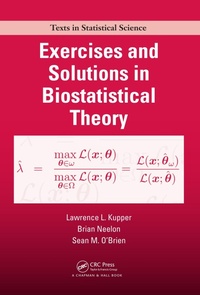
Exercises and Solutions in Biostatistical Theory
1st Edition
Published on 9. November 2010
420 pages
978-1-040-05991-3 (ISBN)
Description

Drawn from nearly four decades of Lawrence L. Kupper's teaching experiences as a distinguished professor in the Department of Biostatistics at the University of North Carolina, Exercises and Solutions in Biostatistical Theory presents theoretical statistical concepts, numerous exercises, and detailed solutions that span topics from basic probability to statistical inference. The text links theoretical biostatistical principles to real-world situations, including some of the authors' own biostatistical work that has addressed complicated design and analysis issues in the health sciences.
This classroom-tested material is arranged sequentially starting with a chapter on basic probability theory, followed by chapters on univariate distribution theory and multivariate distribution theory. The last two chapters on statistical inference cover estimation theory and hypothesis testing theory. Each chapter begins with an in-depth introduction that summarizes the biostatistical principles needed to help solve the exercises. Exercises range in level of difficulty from fairly basic to more challenging (identified with asterisks).
By working through the exercises and detailed solutions in this book, students will develop a deep understanding of the principles of biostatistical theory. The text shows how the biostatistical theory is effectively used to address important biostatistical issues in a variety of real-world settings. Mastering the theoretical biostatistical principles described in the book will prepare students for successful study of higher-level statistical theory and will help them become better biostatisticians.
This classroom-tested material is arranged sequentially starting with a chapter on basic probability theory, followed by chapters on univariate distribution theory and multivariate distribution theory. The last two chapters on statistical inference cover estimation theory and hypothesis testing theory. Each chapter begins with an in-depth introduction that summarizes the biostatistical principles needed to help solve the exercises. Exercises range in level of difficulty from fairly basic to more challenging (identified with asterisks).
By working through the exercises and detailed solutions in this book, students will develop a deep understanding of the principles of biostatistical theory. The text shows how the biostatistical theory is effectively used to address important biostatistical issues in a variety of real-world settings. Mastering the theoretical biostatistical principles described in the book will prepare students for successful study of higher-level statistical theory and will help them become better biostatisticians.
Reviews / Votes
"This book is a rich collection of class-tested material given in the form of exercises followed by their complete solutions. ... The material is well chosen and well structured. ... The exercises are of a different nature: some are relatively elementary; others are more advanced. This makes the book useful for both undergraduate and graduate courses. The solutions are so detailed that the book can be used for self-learning. The authors are successful in presenting elements of statistical theory and also in showing how to answer important questions when analysing statistical models of real-life phenomena. ... It is of no doubt that it will be useful for students and their teachers."-Jordan Stoyanov, Journal of the Royal Statistical Society, Series A, February 2014
"I can highly recommend this book for readers who are interested in learning statistical theory and its applications. The book provides good supplementary material for various teaching purposes in biostatistics, but also for self-study for anyone who is willing to deepen their theoretical knowledge in statistics using good examples."
-International Statistical Review, 2013
"... this book provides a nice collection of problems in statistical theory. It is definitely useful for students who need additional problems for practice. It is also helpful for instructors who seek extra problems for their lectures, homework, and exams. In fact, I used one problem in my mid-term exam while I was reviewing this book."
-Kui Zhang, The American Statistician, November 2013
"... it should appeal to a broader audience of anyone interested in mastering the concepts of probability and mathematical statistics at the advanced undergraduate and beginning graduate levels ... Students and instructors of such courses as well as anyone studying on their own to brush up their knowledge of statistical theory will find the book very useful. ... Overall, I like this book very much. The problems are carefully chosen and cover a wide range of real-world applications of biostatistical methods. Instructors and students will find this book to be a good source of supplementary problems for practice. ... I have taught courses in mathematical statistics on several prior occasions and wish a book like this was available earlier."
-Kaushik Ghosh, Journal of Biopharmaceutical Statistics, Vol. 22, 2012
"... a fairly extensive collection of problems such as might be used in a senior undergraduate or first year graduate mathematical statistics course aimed at biostatistics majors. ... this book would definitely be of value to students who wanted additional examples and problems related to the material most commonly encountered in a first mathematical statistics course. ... I have recommended the book to some of my graduate students who are studying for their qualifying exams. ... I would also think that it would be of use to instructors who were interested in identifying examples for use in their lectures, homework, or examinations."
-Scott Emerson, Biometrics, June 2011
More details
Series
Edition
1. Auflage
Language
English
Place of publication
London
United Kingdom
Publishing group
Taylor & Francis Ltd
Target group
College/higher education
ISBN-13
978-1-040-05991-3 (9781040059913)
Copyright in bibliographic data and cover images is held by Nielsen Book Services Limited or by the publishers or by their respective licensors: all rights reserved.
Schweitzer Classification
Other editions
Additional editions
Lawrence Kupper | Brian Neelon | Sean M. O'Brien
Exercises and Solutions in Biostatistical Theory
Book
08/2017
1st Edition
CRC Press
€282.26
Shipment within 10-20 days
Lawrence Kupper | Brian Neelon | Sean M. O'Brien
Exercises and Solutions in Biostatistical Theory
Book
11/2010
1st Edition
Chapman & Hall/CRC
€96.90
Shipment within 15-20 days
Persons
Lawrence L. Kupper, Ph.D., is an emeritus alumni distinguished professor of biostatistics at the University of North Carolina at Chapel Hill. Dr. Kupper has received several teaching and research awards during his career and has been involved with many research areas in the health sciences, including epidemiology, environmental and occupational health, maternal and child health, and medicine. His research interests concern the development of innovative biostatistical methods for the design and analysis of public health research studies.
Brian H. Neelon, Ph.D., is a research statistician with the Children's Environmental Health Initiative (CEHI) in the Nicholas School of the Environment at Duke University. Before working at Duke University, Dr. Neelon was a Postdoctoral Research Fellow in the Department of Health Care Policy at Harvard University. He earned his Ph.D. from the University of North Carolina. His research interests include Bayesian methods, longitudinal data analysis, finite mixture models, and health policy statistics.
Sean M. O'Brien, Ph.D., is an assistant professor of biostatistics and bioinformatics at the Duke University School of Medicine. Dr. O'Brien earned his Ph.D. from the University of North Carolina. His research interests include statistical methods for healthcare provider profiling, observational studies, and Bayesian data analysis.
Brian H. Neelon, Ph.D., is a research statistician with the Children's Environmental Health Initiative (CEHI) in the Nicholas School of the Environment at Duke University. Before working at Duke University, Dr. Neelon was a Postdoctoral Research Fellow in the Department of Health Care Policy at Harvard University. He earned his Ph.D. from the University of North Carolina. His research interests include Bayesian methods, longitudinal data analysis, finite mixture models, and health policy statistics.
Sean M. O'Brien, Ph.D., is an assistant professor of biostatistics and bioinformatics at the Duke University School of Medicine. Dr. O'Brien earned his Ph.D. from the University of North Carolina. His research interests include statistical methods for healthcare provider profiling, observational studies, and Bayesian data analysis.
Content
Basic Probability Theory. Univariate Distribution Theory. Multivariate Distribution Theory. Estimation Theory. Hypothesis Testing Theory. Appendix. References. Index.
