

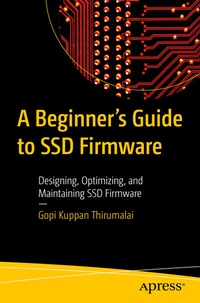
A Beginner's Guide to SSD Firmware
Description

Explore the concepts and techniques that are essential for designing, optimizing, and maintaining SSD (solid state drive) firmware. This book discusses the role of firmware in the functioning of SSDs and the importance of keeping firmware up to date to ensure optimal performance and security.
The book starts with an introduction to SSD firmware and its role in SSDs. You will then learn basic NAND operations and common firmware features, followed by various design considerations and best practices for optimizing and maintaining SSD firmware. Moving ahead, you will learn some of the advanced features that are included in modern SSD firmware, such as wear leveling algorithms, garbage collection algorithms, error prevention and correction methods, and algorithms to reduce write amplification. User data flow and exception handling are discussed next, along with performance and debugging. To wrap things up, you will gain insight into possible future developments and innovations inSSD firmware.
After reading this book, you will have a solid understanding of the key concepts and techniques that are crucial to designing, optimizing, and maintaining SSD firmware.
What Will You Learn
- Understand the fundamentals of NAND flash memory, including its architecture, operation, and limitations
- Explore the basics and evolution of firmware, specifically in the context of SSDs
- Grasp the basics of firmware, including its purpose, structure, and development process
- Survey the specific features of SSD firmware, such as wear leveling, error correction, and garbage collection
- Understand performance criteria for SSDs
- Master the art of designing a fundamental SSD firmware, encompassing host interfaces and vital requirements
Who Is This Book For:
Engineers involved in designing and developing firmware.More details
Other editions
Additional editions
Person
Gopi Kuppan Thirumalai is a highly experienced embedded design engineer with a proven track record of success in the industry. He has over 15 years of experience in a variety of domains, including wireless networks, software, automotive, and storage. He is an expert in client and data center SSD design and implementation, and has a history of leading and mentoring teams to achieve their goals.. He is also an outdoor enthusiast and enjoys hiking, fitness, reading books and cooking.
Content
1. Introduction to SSD firmware.- 2. Understanding the role of firmware in SSDs.- 3. The history and evolution of SSD firmware.- 4. Basic of Flash Memory.- 5. 3D Vertical NAND.- 6. Basic understanding of NAND Flash Interface.- 7. Common SSD firmware features.- 8. SSD firmware design considerations.- 9. Flash Translation Layer - FTL.- 10. User Data Flow.- 11. Throttling.- 12. Exception Handling.- 13. Performance.- 14. Debugging.- 15. Future developments and innovations in SSD firmware.- 16. Closing.- Bibliography.
