

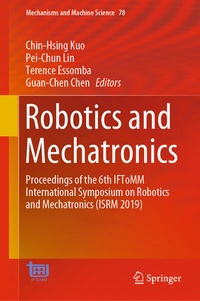
Robotics and Mechatronics
Proceedings of the 6th IFToMM International Symposium on Robotics and Mechatronics (ISRM 2019)
1st Edition
Published on 26. September 2019
XV, 521 pages
978-3-030-30036-4 (ISBN)
Description

This book gathers the latest advances, innovations and applications in the field of robotics and mechatronics, as presented by leading international researchers and engineers at the 6th IFToMM International Symposium on Robotics and Mechatronics (ISRM), held in Taipei, Taiwan, on October 28-30, 2019. It covers highly diverse topics, including mechanism synthesis, analysis, and design, kinematics and dynamics of multibody systems, modelling and simulation, sensors and actuators, novel robotic systems, industrial- and service-related robotics and mechatronics, medical robotics, and historical developments in robotics and mechatronics. The contributions, which were selected through a rigorous international peer-review process, share exciting ideas that spur novel research directions and foster new, multidisciplinary collaborations.
More details
Series
Language
English
Place of publication
Cham
Switzerland
Publishing group
Springer International Publishing
Product notice
Reflowable
Illustrations
XV, 521 p. 402 illus., 303 illus. in color.
File size
98,79 MB
ISBN-13
978-3-030-30036-4 (9783030300364)
DOI
10.1007/978-3-030-30036-4
Schweitzer Classification
Other editions
Additional editions
Chin-Hsing Kuo | Pei-Chun Lin | Terence Essomba
Robotics and Mechatronics
Proceedings of the 6th IFToMM International Symposium on Robotics and Mechatronics (ISRM 2019)
Book
09/2019
Springer
€160.49
Shipment within 7-9 days
Content
- Intro
- Preface
- Organization
- Honorary Chair
- General Chair
- General Co-chair
- Program Chair
- Program Co-chairs
- Special Session Co-chairs
- Publication Chair
- Organized Sessions Chair
- Publicity Chairs
- Local Arrangement Chairs
- Best Paper Awards Chair
- International Scientific Committee
- Program Committee
- Best Paper Awards Committee
- Webmaster
- Contents
- Mechanism Synthesis, Analysis, and Design
- Stiffness Analysis of a Semi-symmetrical Three-Translation Delta-CU Parallel Robot
- Abstract
- 1 Introduction
- 2 Delta-CU Structure
- 3 Stiffness Modeling
- 3.1 Motion Equation of the Limb
- 3.2 Equilibrium Equation
- 3.3 Cartesian Stiffness Matrix
- 4 Numerical Analysis
- 4.1 Structural Parameters
- 4.2 Delta-CU Mechanism Stiffness Analysis
- 4.3 Stiffness Comparison of Delta-CU and Delta
- 5 Conclusion
- Acknowledgments
- References
- Review on Powered Mobility and Meal Preparing Assistive Devices for Physically Disabled Persons
- Abstract
- 1 Introduction
- 2 Challenges and Issues Faced by Disabled in Daily Living
- 3 Powered Mobility Device
- 4 Transfer Aides for Bathroom and Toilet
- 4.1 Transfer Aides for Bathroom
- 4.2 Transfer Aides for Toilet
- 5 Meal Preparing Assistive Devices
- 6 Discussion
- 7 Conclusion
- References
- Performance Evaluation of a Class of Gravity-Compensated Gear-Spring Planar Articulated Manipulators
- Abstract
- 1 Introduction
- 2 The Studied Manipulators
- 3 Performance Evaluation
- 3.1 The 1-DOF Articulated Manipulator
- 3.2 The 2-DOF Articulated Manipulator
- 3.3 The 3-DOF Articulated Manipulator
- 4 Discussion and Conclusions
- References
- Design and Analysis of a Mechanism for Spherical Surface Processing
- Abstract
- 1 Introduction
- 2 Mechanism Design
- 3 Structural Analysis
- 4 Kinematic Analysis
- 5 Conclusions
- Acknowledgments
- References
- A Short Note on Equivalent Four-Bar Linkages of Direct-Contact Mechanisms
- Abstract
- 1 Introduction
- 2 Equivalent Four-Bar Linkage of a Three-Link Direct-Contact Mechanism
- 3 Kinematic Analysis for Planar Gear Mechanisms with Involute Spur Gears
- 4 Kinematic Analysis for Disk Cam Mechanisms with a Circular-Arc Cam and an Oscillating Roller Follower
- 5 Conclusions
- Acknowledgement
- References
- Dynamic Analysis and Motion Simulation of the 3 DOFs Waist Mechanism for Humanoid Robots
- Abstract
- 1 Introduction
- 1.1 The Human Trunk
- 2 State of the Art
- 3 Dynamic Analysis
- 4 Motion Simulation and Results
- 5 Conclusion
- References
- Kinematics and Dynamics of Multibody Systems
- On Kinetostatics and Workspace Analysis of Multi-platform Cable-Driven Parallel Robots with Unlimited Rotation
- Abstract
- 1 Introduction
- 2 Kinetostatics of Single-Platform Cable Robots
- 3 Multi-body Modeling of Cable Robots with Multiple Platforms
- 3.1 Position Constraints of Platform and Linkage
- 3.2 Kinetostatics of Multi-platform Cable Robots
- 4 A Planar Case Study with Unlimited Rotation
- 4.1 Force Distribution
- 4.2 Workspace Analysis
- 5 Outlook and Conclusion
- Acknowledgments
- References
- Kinematics of a Planar Parallel Robot via Screw Theory: Details not Mentioned
- Abstract
- 1 Introduction
- 2 Kinematics
- 2.1 Brief Mathematical Background
- 2.2 Direct Position Analysis
- 2.3 Velocity Analysis
- 2.4 Acceleration Analysis
- 3 Numerical Example
- 4 Conclusions
- References
- Dynamic Modeling for Spatial Revolute Joint with Clearances in Multibody Systems Based on HLCP
- Abstract
- 1 Introduction
- 2 Mathematical Model of SRJC
- 2.1 Contact State Description
- 2.2 Kinematic Description of SRJC
- 3 LCP Formulation
- 4 Dynamic Equations of MBS on Lie Group
- 5 Numerical Example
- 6 Conclusions
- Acknowledgments
- References
- Kinematic Analysis of (2-RRU)-URR Parallel Mechanism Performing 2R1T Output Motion
- Abstract
- 1 Introduction
- 2 (2-RRU)-URR Mechanism and Its Mobility
- 3 Kinematic Analysis of the Proposed Mechanism
- 3.1 Forward Kinematics of Planar Motion Generator
- 3.2 Inverse Kinematics of Planar Motion Generator
- 3.3 Forward and Inverse Kinematics of Orientation Generator
- 4 Kinematic Performance Analysis
- 4.1 Workspace of Planar Motion Generator
- 4.2 Rotational Capability and Sensitivity of Orientation Generator
- 5 Discussion and Conclusion
- References
- Development of an Innovative 2-DOF Continuous-Rotatable Mechanism
- Abstract
- 1 Introduction
- 2 Rotation Behavior of Existing 2 DOF Structure
- 3 Design and Implementation of the 2-DOF Mechanism
- 4 Dynamic Simulation
- 5 Experimental Validation of the 2-DOF Mechanism
- 6 Conclusion and Future Works
- Acknowledgment
- References
- Modelling and Simulation
- Dynamic Model of a Crank Press in the Process of Braking
- Abstract
- 1 Introduction
- 2 Brake of Crank Press
- 3 Dynamic Model of Crank Press with Brake
- 4 Conclusion
- Acknowledgments
- References
- Workspace Modelling of a Parallel Robot with Relative Manipulation Mechanisms Based on Optimization Methods
- Abstract
- 1 Introduction
- 2 Formulation of the Problem
- 3 Determination the Workspace of the Tripod Mechanism
- 4 Algorithm for Determining the RMD Workspace
- 5 Conclusion
- Acknowledgements
- References
- Disk Cam Mechanisms with a Translating Follower Having Double Oblique Flat Faces
- Abstract
- 1 Introduction
- 2 Disk Cam Mechanisms with a Translating Follower Having Double Oblique Flat Faces
- 3 The Cam Profile
- 3.1 The Cam Profile for the Circular Arc Contact
- 3.2 The Cam Profile for the Oblique Flat-Faced Contact with an Oblique Angles ?r
- 3.3 The Cam Profile for the Oblique Flat-Faced Contact with an Oblique Angles ?f
- 4 Examples
- 5 Force Analysis
- 6 Overturning Moment Analysis
- 7 The Reduction on the Overturning Moment
- 8 Discussion
- 9 Conclusions
- Acknowledgments
- References
- Computationally Efficient Cable Force Calculation Outside the Wrench-Feasible Workspace
- 1 Introduction
- 2 Modeling and Cable-Robot Basics
- 2.1 Wire Force Distribution
- 3 Calculation Algorithm
- 3.1 Optimizing
- 3.2 Nearest-Corner-Method
- 4 Simulation and Results
- 5 Conclusion and Outlook
- References
- A 3-Dimensional Dynamic Model of the Aerotrain and the Horizontal Tail Effect on the Longitudinal Stability
- Abstract
- 1 Introduction
- 2 Dynamic Model of the Aerotrain
- 2.1 Wing-In-Ground Effect Model
- 2.2 Aerodynamic Force Along the Z-Axis
- 2.3 Aerodynamic Force Along the Y-Axis
- 2.4 Aerodynamic Moment About the X, Y, Z Axes
- 2.5 Horizontal Tail Model
- 3 Simulations
- 4 Conclusions and Future Work
- References
- Towards Grey Box Modeling in Modelica
- 1 Introduction
- 1.1 Motivation
- 1.2 State of the Art
- 1.3 Goals
- 2 Main Part
- 2.1 Reference System
- 2.2 Models with ANN
- 2.3 ANN Structure
- 2.4 Application
- 3 Results
- 3.1 Training Process
- 3.2 Simulation of a Different Maneuver
- 3.3 Requested Points in Feature Space
- 3.4 An Approach to Detect Unreliable Extrapolation
- 4 Conclusion
- References
- Sensors and Actuators
- Development of an Interactive System for a Companion Robot Based on Telepresence Technology
- Abstract
- 1 Introduction
- 2 Presentation of Wobot
- 3 Interactive System
- 3.1 Wobot and Wobot Care App Design and Development
- 3.2 Action Control Program for Servo Motors
- 4 Preliminary Experiments
- 5 Conclusions
- References
- Motion Experiment of Reducer-Integrated Motor Using Inscribed Planetary Gear Mechanism
- Abstract
- 1 Introduction
- 2 Proposed Reducer-Integrated Motor
- 3 Motion Experiment
- 4 Conclusions
- Acknowledgment
- References
- Conductive Fabric Strain Sensor Design and Electromechanical Characterization
- Abstract
- 1 Introduction
- 2 Sensor Architecture and Design
- 2.1 Sensor Design
- 2.2 Material Selection
- 3 Sensor Characterization
- 3.1 Strain Axis Electromechanical Property
- 3.2 Geometric Parameters Affecting Electromechanical Property
- 3.3 Sensor Electrical Hysteresis
- 4 Discussion
- 5 Conclusion
- References
- Based on a Calibration Machine and Process to Develop a Six-Axis Force/Torque Sensor
- Abstract
- 1 Introduction
- 2 Geometric Structure of the Six-Axis Force/Torque Sensor
- 2.1 Locations of Strain Gauges
- 2.2 Wheatstone Bridge Connection Methods
- 2.3 Strain Analysis on the Z-Axis Force
- 2.4 Six-Axis Force/Torque Sensor Prototype
- 2.5 Signal Processing
- 3 Design of the Calibration Platform
- 4 Calibration System and Transformation Matrix
- 5 Using the Nonlinear Least Squares Method to Establish a Transformation Matrix
- 6 Conclusion
- Acknowledgements
- References
- Novel Robotic Systems
- Parallel Mechanism Designs for Humanoid Robots
- Abstract
- 1 Introduction
- 2 Parallel Mechanisms in Human Anatomy
- 3 Requirements and Design Performance for Humanoid Robots
- 4 An Example: LARMbot
- 5 Conclusions
- References
- Development and Optimization of an Intelligent Parking Slot Allotter and Billing System Based on Machine Learning and OCR
- Abstract
- 1 Introduction
- 2 Car's License Number Plate Detection and Text Identification
- 2.1 Image Acquisition
- 2.2 Number Plate Extraction
- 2.3 Number Plate Character Segmentation
- 2.4 Optical Character Recognition
- 3 Vehicle Type Detection
- 4 Allot Best Fit Parking Area
- 5 Experimental Results
- 6 Conclusion
- Acknowledgement
- References
- Design and Requirements for a Mobile Robot for Team Cooperation
- Abstract
- 1 Introduction
- 2 Design Problems and Targets
- 3 Design Solution
- 4 Sensing Design and Software
- 5 Conclusions
- Acknowledgements
- References
- Learning Emotion Recognition and Response Generation for a Service Robot
- Abstract
- 1 Introduction
- 2 Learning Emotion-Aware Human-Robot Dialogues
- 2.1 The Service Robot Framework
- 2.2 Emotion Recognition
- 2.3 Learning Emotion-Aware Dialogues
- 2.4 Knowledge Expansion
- 3 Experiments and Results
- 3.1 User Identification
- 3.2 Training Classifiers for Emotion Recognition
- 3.3 Evaluation of Training a Dialogue Model
- 4 Conclusion
- References
- Design and Testing of 2-Degree-of-Freedom (DOF) Printable Pneumatic Soft Finger
- Abstract
- 1 Introduction
- 2 Design and Testing of the Printable Pneumatic Soft Fingers
- 3 Vision-Based Measurements of Soft Finger Deformations
- 4 Study of Soft Finger Actuation Using Kriging Response Surface
- 5 Conclusions
- Acknowledgement
- References
- Industrial and Service Related Robotics and Mechatronics
- 465912_1_En_28_Chapter_OnlinePDF
- Intelligent Automation Module-Based Gear Edge Grinding System
- Abstract
- 1 Introduction
- 2 Intelligent Application Modules
- 2.1 Optimal Paths Are Generated Using Processing Quality Predictions
- 2.2 Automatic Calibration Technology
- 3 Gear Edge Grinding Application System
- 4 Conclusion
- Acknowledgement
- References
- 465912_1_En_29_Chapter_OnlinePDF
- Development of an Automated and Adaptive System for Robotic Hybrid-Wire Arc Additive Manufacturing (H-WAAM)
- 1 Introduction
- 2 System Overview and Workflow
- 3 Automation and Generalization Strategies
- 3.1 Unified Path Generation
- 3.2 Coordinate Systems
- 3.3 Sensing and Adaptive Function
- 4 Results and Discussion
- 5 Conclusions
- References
- A Motion Control System to Use Robots at up to 100 Times the Earth's Gravity
- Abstract
- 1 Introduction
- 2 Centrifuge Modelling Background
- 3 Motion Control System Design and Development
- 3.1 FACS Architecture and Electronics
- 3.2 FACS Software
- 4 Validation Case Study: Cone Penetration Test
- 5 Results and Discussion
- 6 Summary and Future Work
- Acknowledgments
- References
- Fault Signature Analysis of Industrial Machines
- Abstract
- 1 Introduction
- 2 Analysis Method
- 2.1 Fast Fourier Transform Analysis (FFT)
- 2.2 Current Divided by Voltage Analysis
- 2.3 Fault Feature
- 3 Data Analysis
- 3.1 Equipment Specification
- 3.2 Healthy Motor
- 3.3 Misalignment Failure
- 3.4 Transmission Fault
- 3.5 Bearing Fault
- 3.6 Broken Rotor Fault
- 3.7 Stator Short Turns Failure
- 4 Conclusion
- References
- Robot-Assisted Double-Pulse Gas Metal Arc Welding for Wire and Arc Additive Manufacturing
- Abstract
- 1 Introduction
- 2 Experimental Setup and Parameter
- 2.1 Experiment Material and Equipment
- 2.2 Double-Pulse Parameters
- 2.3 Experiment Parameters Study
- 2.4 Build-Up Dimension
- 3 Experimented Results and Discussion
- 3.1 Single-Pass
- 3.2 Multi-layer Build-Up
- 4 Conclusion
- References
- Development of a Close-Fitting Assistive Suit with Adjustable Structure for Arm and Back as Needed - e.z.UP®
- Abstract
- 1 Introduction
- 2 Close-Fitting Assistive Suit
- 2.1 Arm and Lower Limb Assistance
- 2.2 Back Assistance
- 3 Simulation Evaluation
- 4 Experimental Evaluation
- 5 Conclusions
- References
- An Experimental Characterization of the BIT Astronaut Robot
- Abstract
- 1 Introduction
- 2 The BIT Astronaut Robot
- 3 An Experimental Characterization with a Demo Test
- 4 Test Results
- 5 Conclusions
- References
- Advances in Medical Robotics
- An Experimental Test Procedure for Validation of Stiffness Model: A Case Study for R-CUBE Parallel Mechanism
- 1 Introduction
- 2 R-CUBE Mechanism
- 3 Stiffness Model
- 4 Experimental Setup
- 5 Experimental Procedure
- 6 Test Results and Comparison with the VJM Model
- 7 Conclusion
- References
- Multi-camera Vision-Guided Manipulation: Application to Acne and Wrinkles Treatment
- Abstract
- 1 Introduction
- 2 Vision-Guided Manipulator
- 2.1 Acne and Wrinkles Identification
- 2.2 Obstacles Detection and Identification
- 2.3 Manipulator Trajectory Planning and Control
- 2.4 Manipulator Pose Optimization
- 3 Result and Discussion
- 4 Conclusion
- Acknowledgements
- References
- A Novel Three Degrees of Freedom Haptic Device for Rendering Texture, Stiffness, Shape, and Shear
- Abstract
- 1 Introduction
- 2 Background and Related Work
- 3 Design and Implementation of the Haptic Device
- 3.1 Kinematic Model of the Haptic Device
- 3.2 System Design
- 3.3 Semi-compliant Four-Link Mechanism
- 3.4 Working of the Prototype
- 4 Performance Analysis
- 4.1 Force Analysis
- 5 Results and Discussions
- 6 Conclusions and Future Work
- References
- Real-Time Resolution of the Forward Kinematic Model for a New Spherical Parallel Manipulator
- Abstract
- 1 Introduction
- 2 Kinematic of the New Spherical Parallel Manipulator
- 3 Forward Kinematic Model Resolution
- 3.1 Classical Method to Solve the Forward Kinematic Model
- 3.2 Improved Method to Solve the Forward Kinematic Model
- 3.3 Serial Method to Solve the Forward Kinematic Model
- 4 Experimental Comparison Between the Three Techniques of Solving the FKM
- 5 Conclusion
- References
- Kinematic Design of a Double Pantographic Mechanism for the Intracranial Echography on Incubated Newborns
- Abstract
- 1 Introduction
- 2 Specification Analysis
- 2.1 Motion Capture Experiments
- 2.2 Kinematic Requirements of Intra-incubated Echography
- 3 Kinematic Analysis of the Double Pantographic Mechanism
- 3.1 Definition of the Mechanical Architecture
- 3.2 Kinematic Model of the Mechanism
- 4 Simulations
- 5 Conclusion
- References
- Kinematic Design of a Six-Degrees of Freedom 3-RRPS Parallel Mechanism for Bone Reduction Surgery
- Abstract
- 1 Introduction
- 2 Mechanical Architecture and Kinematic Analysis
- 3 Mechanism Velocity Model
- 4 Simulation on the Mechanism and Bone Reduction
- 5 Conclusion
- References
- Multi-objective Optimization of a Reconfigurable Spherical Parallel Mechanism for Tele-Operated Craniotomy
- Abstract
- 1 Introduction
- 2 Specification Analysis
- 2.1 Experimental Protocol
- 2.2 Motion and Force Data Analysis
- 3 Reconfigurable Spherical Parallel Mechanism
- 3.1 Mechanical Architecture
- 3.2 Inverse Kinematic Model
- 4 Effort Model of the Mechanism
- 5 Multi-objective Optimization
- 5.1 Optimization Criteria and Formulation
- 5.2 Results and Simulations
- 6 Conclusion
- References
- Autonomous Robot-Assistant Camera Holder for Minimally Invasive Surgery
- Abstract
- 1 Introduction
- 2 Robot-Assistant Platform
- 3 Control Approach
- 3.1 Coordinates Transformation
- 3.2 Robot Control
- 4 Conclusion
- Acknowledgements
- References
- A Low-Cost 6-DoF Master Device for Robotic Teleoperation
- Abstract
- 1 Introduction
- 2 The 6-DoF Master Device
- 3 Control Architecture for Robotic Teleoperation
- 3.1 Teleoperation Platform
- 3.2 Kinematics and Translation/Orientation Relationships
- 4 Teleoperation Task and Experiments
- 5 Conclusion
- Acknowledgements
- References
- Historical Development in Robotics and Mechatronics
- The Exhibit of Industrial Robots Based on Concepts of Technology Education: Take "Smart Manufacturing Experience Zone" at National Science and Technology Museum as an Example
- Abstract
- 1 Introduction
- 2 Design Concepts of Exhibit
- 3 Industrial Robots of Smart Manufacturing Exhibit
- 3.1 Definition of Robot
- 3.2 Historical Development of Industrial Robots
- 3.3 Mechanical Structure
- 3.4 Applications of Industrial Robots
- 3.5 Robots in Industry 4.0
- 4 Statistical Analysis of Learning Records
- 5 Conclusions
- Acknowledgement
- References
- Ancient Chinese Puzzle Locks
- Abstract
- 1 Introduction
- 2 History of Locks' Development
- 3 Mechanical Structure
- 3.1 Open-Keyhole Puzzle Lock
- 3.2 Hidden-Keyhole Puzzle Lock
- 4 Conclusions
- Acknowledgements
- References
- A Historical Study of Rope Applications in Mechanical Devices in Three Eastern Countries
- Abstract
- 1 Introduction
- 2 Classification
- 3 Application Examples
- 3.1 Ancient China
- 3.2 Ancient Arab
- 3.3 Ancient Japan
- 4 Conclusions
- References
- Current Research Topics in Robotics at IGMR
- Abstract
- 1 Introduction
- 2 Multidirectional Additive Manufacturing
- 3 Human-Robot Collaboration
- 4 Agile Assembly Systems via Consensus of Robotic and Sensoric Networks
- 5 Cognition in Low Visibility Environments
- 5.1 Radar Technology: Benefits and Challenges
- 5.2 Radar-SLAM for Low Visibility Environments
- 6 Summary
- Acknowledgement
- References
