

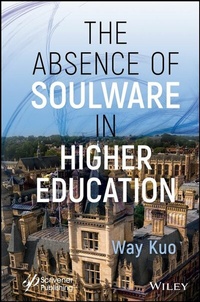
The Absence of Soulware in Higher Education
Description

The book offers an analytical account of higher education in Taiwan, Hong Kong and Mainland China with examples of best practices from higher education in the US for guidance.
This book is Professor Way Kuo's attempt to address issues that remain to be challenges for universities in the globalized 21 Century, namely academic autonomy and freedom, seamless integration between research and teaching, curricula update, innovative and problem-driven research, and adopting best global practices, based on his reflections about higher education from a global perspective through his personal experience as a senior academic leader in the US and Hong Kong. Borrowing from the languages of computer science, this book not only talks about the hardware and software in higher education, which refer to the infrastructure and the physical entities that provide an environment conducive to good teaching and research, it also highlights the importance of a third category for achieving great success: the presence of a certain mindset, a willingness to embrace due process and follow international standards and procedures or a vision in making the best use of the hardware and software to spearhead innovation in combining teaching and research for the benefit of students and the well-being of society. Such a mindset is called the soulware of higher education. Specifically, this book:
* Covers four key areas where a lack of proper soulware or mindset is deterring the advancement of higher education: internationalization; seamless integration of teaching and research; quality and evaluation; and creativity and innovation;
* The author's arguments are factual and comments are critical on what is perceived to be less desirable or a failure in higher education;
* The book offers useful insights into the future and a global perspective on trends, challenges, and opportunities in higher education.
Audience
Educators, policymakers, higher education providers and administrators, global stakeholders of higher education including students and parents, and the general public in both the East and the West who have an interest in global higher education.
More details
Other editions
Additional editions
Person
Way Kuo, Emeritus President and University Distinguished Professor at the City University of Hong Kong, is a member of the National Academy of Engineering and Academia Sinica in Taiwan, a foreign member of the Chinese Academy of Engineering, and an International Fellow of the Canadian Academy of Engineering. The Presidents of France and Italy bestowed on him the title and rank of the Chevalier de l'Ordre National de la Legion d' Honneur de France and the Cavaliere dell'Ordine della Stella d'Italia, respectively.
He has served on the senior management team of Oak Ridge National Laboratory and as the Dean of Engineering at the University of Tennessee. Following the 2011 earthquakes in Japan, he was the first invited foreign expert to assess the safety of the First Nuclear Power Plant in Fukushima. His popular science book Critical Reflections on Nuclear and Renewable Energy was published in Chinese and English (Wiley-Scrivener), and translated into Japanese, French, and Russian.
Content
Preface ix
List of Figures and Tables xxi
Acknowledgments xxiii
Introduction xxvii
Part I: Internationalization of Higher Education 1
1 Internationalization without Soulware 5
2 Higher Education in the UK 19
3 On Universities across the Strait 25
4 Simplicity is the Ultimate Sophistication 55
5 Blind Spots and Loss of Scholarship 69
6 Communicating Rigorously 79
Part II: Integration of Teaching and Research 101
7 The Essence of University 103
8 University Positioning 113
9 Pitfalls of Misaligning Whole-Person Education 123
10 Strategies for Nurturing Generalists and Specialists 137
11 The Successful Evergreen Tree 149
12 Students and I 161
Part III: Separation of Politics and Education 169
13 External Forces that Interfere with Soulware 175
14 Stains in Academic Freedom and Campus Autonomy 193
15 Mechanism of the Separation of Politics and Education 205
16 University: The Seedbed of Social Movements? 219
17 Populism: The Stumbling Block of Academic Progress 231
Part IV: Quality and Evaluation 251
18 Review is the Father of Success 255
19 Rankings in the Humanities and Liberal Arts 273
20 Tuition, Salary Comparisons of Professors and Graduates 281
21 Course Design and Choice of Majors 293
22 Accomplished Hermits behind Unprepossessing Gates 303
Part V: Creativity and Innovation 311
23 Creativity Depends on Asking Questions 315
24 How to Promote Innovative Technology? 323
25 Where Is the Innovative Talent? 339
26 Creativity in Higher Education and Risk-Taking 351
27 Setting Policy Direction and Avoiding Nano-Management 365
Epilogue: How Does a University Set the Trend? 371
References to Tables and Figures 377
Appendix: Basic Principle of Academic Governance 385
About the Author 387
Index 389
Preface
The Chinese and English editions of The Absence of Soulware in Higher Education are simultaneously published by Linking in Taipei and Wiley in New Jersey. The book reflects the momentous changes taking place in higher education in Taiwan, Hong Kong and Mainland China as well as globally in the past five years and analyzes strengths and weaknesses with concrete examples.
Reasons for Publishing
Before I took over the presidency at City University of Hong Kong (CityU) in 2008, I had been engaged in teaching and research in the US and Europe for 34 years, starting as a graduate student and progressing through the ranks to assistant professor, associate professor, professor, chair professor and university distinguished professor. During my tenure in the US, I also had progressive responsibilities in academic leadership, starting from being appointed the head of department to dean of engineering and associate vice-chancellor for engineering at Texas A&M University System. I was a Fulbright scholar during that period and was elected director of the Council of Industrial Engineering Academic Department Heads. I have also been an ABET (Accreditation Board for Engineering and Technology) member for ten years.
I have been personally involved in scientific research and innovation in the US, heading scientific research administration at national laboratories and serving as a high-tech and government consultant for over 40 years and as editor-in-chief for IEEE Transactions on Reliability for 16 years. Therefore, as I have access to and have provided first-hand higher education and research, I have a legitimate voice in this matter.
The English version of Soulware: The American Way in China's Higher Education, published by Wiley-Scrivener in New Jersey, 2019, highlighted the importance of separating politics from education. In the last four years, while tremendous changes have occurred in higher education across the Taiwan Strait (the Strait) including Taiwan, Hong Kong and Mainland China, political conflicts, street politics and populism have swept through campuses. Much worse, some media organizations have often acted as go-betweens for those entangling politics with education, a phenomenon hardly seen in the US. This is why significantly revising and updating the English version and publishing the Chinese version are required.
I endeavor to be as factual as possible in all these versions when I make my arguments. In several instances, my arguments are critical of what I perceive as serious mistakes in higher education, if not outright failures.
Soulware
Before moving on to higher education, it is necessary to define the terms I will be using. Borrowing from the verbiage of computer science, I will reference the hardware and software found in higher education.
By hardware, I mean a university's infrastructure or physical facilities, such as buildings, libraries, internet, laboratories, and so forth, which provide an environment conducive to good teaching and research. By software, I mean human resources, government policy, society's attitudes, strategic plans, the research abilities of faculty, and the sound educational background and preparedness of students. People often say grandmasters can be categorized as software and can be more important than grand buildings.
Whereas the hardware and the software are both essential for success in higher education, a third element is even more critical. It is essential for achieving greatness at a university and is related to education efficiency and internationalization.
In Chinese culture, people with great talent and ability are referred to as "1,000 li horses (supposedly able to gallop 1,000 li, approximately 400 kilometers, in a single day), while Bo Le is the legendary person who could judge a horse's qualities from appearance. While there may be 1,000 li horses here and there, finding the right judge of horses or Bo Le is hard. Here, 1,000 li horses refer to academic masters, and Bo Le is the recognition of soulware, the subject of this book.
Education calls for efficiency. The Chinese ancestors believed that education could not only enlighten our minds and cultivate our moral self so that we could learn to manage our families, govern our state and be a "gentleman" but also serve as a stepping stone for obtaining government positions at the imperial court. Today, for anyone receiving an education, we need to assess the results of education: the capability to pursue a personal career, give back as a citizen, advance social harmony, and maintain the sustainable development of the world. Internationalization is a commonly discussed topic among university administrators and governmental officials. It demands the presence of a certain mindset that goes beyond the hardware and the software of a university. This mindset enables better communication and coordination toward achieving greatness in education and research.
"Go ahead setting a high moral standard and advocating noble ideas, and don't overthink the rest, be it east or west, past or present." This mindset is what I have labeled soulware. So what exactly is soulware for a university?
At a more abstract level, I see soulware as a vision, as the crucial bringing together (or fusion) of technical virtuosity and humanistic cum spiritual engagements. Soulware entails a commitment to enable our hearts and souls to embrace due processes, follow international norms in all our educational endeavors, and devote ourselves truly to learning from our studies and research. Soulware can refer to moral character and Bildung (cultivation of self or formation of one's character).
Su Shi, a Chinese Song dynasty poet, once wrote, "With straw sandals and a bamboo staff, I am better suited than riding a horse / And fear not / The wind and storm in life though clad only in a palm-leaf plaited cape." If we keep our goals in sight and let them be, we can travel light no matter what happens. At the operational level, we need to make the best use of the hardware and software at our disposal and spearhead innovation, the combination of teaching and research, and the separation of politics and education for the betterment of society. Conceptually, I envision hardware, software, and soulware working and communicating in concert as the three constituting parts of a university, with soulware as an internal cosmic force, as shown in Figure 0.1.
Figure 0.1 Elements of university composition.
An ideal university has the pursuit of excellence in producing and disseminating knowledge as its goal. The soulware concept elaborated in this book encompasses anti-discrimination, openness and transparency, fair competition, equal treatment, and accountability applied to all stakeholders, including universities, government, and society. These principles provide a conducive environment for achieving the goal with significant opportunities for students' enlightenment. It sharpens both the pen and the sword, whereas the reverse might see them coerced by politics and politicians, making such students more like subcontractors who survive only by following trends. Achieving such goals depends on implementing healthy soulware in higher education, free from politics, government interference and the babbling of populists.
Simply put, the separation of politics and education, academic freedom, and campus autonomy constitute the ideal combination of higher education soulware and the three pillars that drive a great university forward. As shown in Figure 0.2, we can only guarantee academic freedom and campus autonomy by ensuring the separation of politics and education. With clear guidelines, universities should play a leadership role in integrating industry, education and research. To promote innovation, academics should refrain from holding positions simultaneously in industry, government and universities, and neither should the community encourage such practices. Instead, they should seek industry-university-research collaboration.
Higher education across the Strait
For the most part, the higher education system in the US has been the most advanced over the past century, and therefore it deserves to be studied and benchmarked.
Figure 0.2 Three wisdom pillars of higher education soulware.
Much of this book concerns higher education systems, in Taiwan, Hong Kong and Mainland China. Though I have somewhat less personal experience in the Mainland than in Taiwan and Hong Kong, my observations via my visits and other sources and data help provide sufficient evidence for the analysis presented in this book. Compared with the US, the observations and analysis made in this book regarding higher education across the Strait are equally applicable elsewhere, especially in universities in Europe, South Korea and Japan.
Ironically, some people in Taiwan and Hong Kong dissociate themselves politically and even economically from Mainland China. Some think of themselves as not Chinese; however, they turn out to be more Chinese and retain more traits of traditional Chinese culture than they may have realized or are willing to admit. Culturally speaking, they may be more Chinese than people on the Mainland because they did not experience the Cultural Revolution (1966-1976) when educational institutions from primary schools to universities were closed and intellectuals were targeted for ideological critique and physical abuse. The Mainland Chinese of that generation were subject to physical and...
