

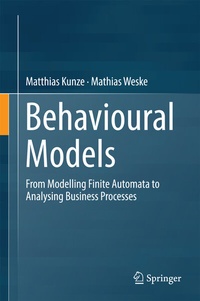
Behavioural Models
From Modelling Finite Automata to Analysing Business Processes
Published on 10. September 2016
XII, 279 pages
978-3-319-44960-9 (ISBN)
Description

This textbook introduces the basis for modelling and analysing discrete dynamic systems, such as computer programmes, soft- and hardware systems, and business processes. The underlying concepts are introduced and concrete modelling techniques are described, such as finite automata, state machines, and Petri nets. The concepts are related to concrete application scenarios, among which business processes play a prominent role.
The book consists of three parts, the first of which addresses the foundations of behavioural modelling. After a general introduction to modelling, it introduces transition systems as a basic formalism for representing the behaviour of discrete dynamic systems. This section also discusses causality, a fundamental concept for modelling and reasoning about behaviour. In turn, Part II forms the heart of the book and is devoted to models of behaviour. It details both sequential and concurrent systems and introduces finite automata, state machinesand several different types of Petri nets. One chapter is especially devoted to business process models, workflow patterns and BPMN, the industry standard for modelling business processes. Lastly, Part III investigates how the behaviour of systems can be analysed. To this end, it introduces readers to the concept of state spaces. Further chapters cover the comparison of behaviour and the formal analysis and verification of behavioural models.
The book was written for students of computer science and software engineering, as well as for programmers and system analysts interested in the behaviour of the systems they work on. It takes readers on a journey from the fundamentals of behavioural modelling to advanced techniques for modelling and analysing sequential and concurrent systems, and thus provides them a deep understanding of the concepts and techniques introduced and how they can be applied to concrete application scenarios.
The book consists of three parts, the first of which addresses the foundations of behavioural modelling. After a general introduction to modelling, it introduces transition systems as a basic formalism for representing the behaviour of discrete dynamic systems. This section also discusses causality, a fundamental concept for modelling and reasoning about behaviour. In turn, Part II forms the heart of the book and is devoted to models of behaviour. It details both sequential and concurrent systems and introduces finite automata, state machinesand several different types of Petri nets. One chapter is especially devoted to business process models, workflow patterns and BPMN, the industry standard for modelling business processes. Lastly, Part III investigates how the behaviour of systems can be analysed. To this end, it introduces readers to the concept of state spaces. Further chapters cover the comparison of behaviour and the formal analysis and verification of behavioural models.
The book was written for students of computer science and software engineering, as well as for programmers and system analysts interested in the behaviour of the systems they work on. It takes readers on a journey from the fundamentals of behavioural modelling to advanced techniques for modelling and analysing sequential and concurrent systems, and thus provides them a deep understanding of the concepts and techniques introduced and how they can be applied to concrete application scenarios.
Reviews / Votes
"In this book, which is primarily a textbook for graduate students, Kunze and Weske present conceptual tools required to develop such a model. . The authors provide bibliographical notes at the end of each chapter. This and the use of the same set of examples make the book quite easy to read and follow. Its comprehensive list of references has more than 70 entries. It is an excellent text." (Anoop Malaviya, Computing Reviews, February, 2017)More details
Series
Edition
1st ed. 2016
Language
English
Place of publication
Cham
Switzerland
Publishing group
Springer International Publishing
Target group
Primary & secondary/elementary & high school
Illustrations
XII, 279 p. 177 illus.
File size
5,55 MB
ISBN-13
978-3-319-44960-9 (9783319449609)
DOI
10.1007/978-3-319-44960-9
Schweitzer Classification
Other editions
Additional editions
Matthias Kunze | Mathias Weske
Behavioural Models
From Modelling Finite Automata to Analysing Business Processes
Book
09/2016
Springer
€53.49
Shipment within 10-15 days
Persons
Mathias Weske is chair of the business process technology research group at Hasso Plattner Institute of IT Systems Engineering at the University of Potsdam, Germany. The research group addresses real-world BPM problems with formal approaches and engineers useful prototypes. His research focuses on process oriented information systems, decision management, and event handling.
Matthias Kunze is a senior business process manager at Zalando SE. Before joining Zalando in 2015, he was a postdoctoral researcher and lecturer at the research group of Mathias Weske at the Hasso Plattner Institute. Besides his contributions to many practical aspects of BPM, his research work focussed on the behavioural analysis of business process models. Matthias Kunze received his PhD in 2013 for his dissertation on searching business process models.
Content
1 Introduction.- 2 Discrete Dynamic Systems.- 3 Sequential Systems.- 4 Concurrent Systems.- 5 Business Process Models.- 6 State Spaces.- 7 Comparing Behaviour.- 8 Verification.- References.- Index.
