

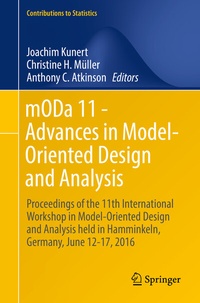
mODa 11 - Advances in Model-Oriented Design and Analysis
Description

This volume contains pioneering contributions to both the theory and practice of optimal experimental design. Topics include the optimality of designs in linear and nonlinear models, as well as designs for correlated observations and for sequential experimentation. There is an emphasis on applications to medicine, in particular, to the design of clinical trials. Scientists from Europe, the US, Asia, Australia and Africa contributed to this volume of papers from the 11th Workshop on Model Oriented Design and Analysis.
More details
Other editions
Additional editions
Persons
Christine Müller is Professor of Statistics with Applications in Engineering Sciences at TU Dortmund University. She is author and coauthor of two books and has published over 60 papers in scientific journals. She is coordinating editor and editor-in-chief of Statistical Papers and the president of the Deutsche Arbeitsgemeinschaft Statistik, an umbrella society of German statistics societies.
Anthony Atkinson is Emeritus Professor of Statistics at the London School of Economics. He is author, or coauthor, of six books and co-editor of a further six, including the Proceedings of mODa 5, 6, 9 and 10. In addition, he has published over 200 papers in scientific journals. He is an (elected) member of the International Statistical Institute and a fellow of the American Statistical Association.
Content
- Intro
- Preface
- Contents
- List of Contributors
- On Applying Optimal Design of Experiments when Functional Observations Occur
- 1 Introduction
- 2 Model Description
- 3 Infinite and Finite-Dimensional Results
- 4 Optimal Designs
- 4.1 Interpretation
- 4.1.1 Functional D-Optimum Designs
- 4.1.2 Functional A-Optimum Designs
- 4.1.3 Functional E-Optimum Designs
- 5 Future Developments
- References
- Optimal Designs for Implicit Models
- 1 Introduction
- 1.1 Case Study Background
- 1.2 Optimal Experimental Design: General Background
- 2 Inverse Function Theorem for Computing the FIM
- 3 Optimal Designs for the Case Study
- 4 Concluding Remarks
- References
- Optimum Experiments with Sets of Treatment Combinations
- 1 Introduction
- 2 A Simple Response Surface Example
- 3 Equivalence Theorem
- 4 Algorithms
- 5 Extensions
- References
- Design Keys for Multiphase Experiments
- 1 Experiments with a Single Phase
- 2 Two-Phase Experiments
- 3 Generalizations
- References
- On Designs for Recursive Least Squares Residuals to DetectAlternatives
- 1 Introduction
- 2 Recursive Residuals
- 3 Designs for Detecting Alternatives
- 4 Some Proofs
- References
- A Multi-objective Bayesian Sequential Design Based on Pareto Optimality
- 1 Introduction
- 2 Some Concepts from Multi-objective Optimisation
- 3 The Multi-objective Bayesian Sequential DOE Approach
- 3.1 The Proposed Bayesian Utility Function
- 4 Simulated Case Study
- 4.1 Performance Indicators
- 4.2 Results
- 5 Conclusions
- References
- Optimum Design via I-Divergence for Stable Estimation in Generalized Regression Models
- 1 Introduction
- 2 Basic Properties of Model (1)
- 3 Variability, Stability and I-Divergence
- 4 Extended Optimality Criteria
- References
- On Multiple-Objective Nonlinear Optimal Designs
- 1 Introduction
- 2 Set Up and Notation
- 3 Algorithm
- The Main Algorithm
- 3.1 Convergence and Computational Cost
- 4 Numerical Examples
- 5 Discussion
- References
- Futher Reading
- Design for Smooth Models over Complex Regions
- 1 Introduction
- 2 Smooth Supersaturated Model (SSM)
- 2.1 Univariate Polynomial Formulation
- 2.2 Multivariate Polynomial Formulation
- 2.3 Fitting the Interpolator to Data
- 3 Smoothing over Complex Regions
- 3.1 Boxing the Region
- 3.2 Polyhedral Regions
- 3.3 Gram-Schmidt Orthogonalization of SSM Bases
- 4 Designing for SSM in Complex Regions
- 4.1 Design Using Roughness ?2
- 4.2 Design for Distortion J
- 5 Discussion and Future Work
- References
- PKL-Optimality Criterion in Copula Models for Efficacy-Toxicity Response
- 1 Introduction
- 2 Bivariate Copula-Based Model
- 3 Binary Model for Efficacy and Toxicity
- 4 PKL-Optimality Criterion
- 5 Simulation
- References
- Efficient Circular Cross-over Designs for Models with Interaction
- 1 Introduction
- 2 Interaction Repeated Measurement Models and Information Matrices
- 3 Universally Optimal Approximate Designs
- 4 Examples of Optimal Designs
- 4.1 k=4, t=4
- 4.2 k=5, t=5
- 4.3 k=6, t=6
- 4.4 k=7, t=7
- 4.5 k=8, t=4
- References
- Survival Models with Censoring Driven by Random Enrollment
- 1 Introduction
- 2 Model
- 2.1 Assumptions and Notation
- 2.2 Elemental Information Matrix in Survival Analysis Setting
- 3 Random Subject Accrual
- 4 Example: Proportional Hazard Family
- 5 Conclusion
- References
- Optimal Design for Prediction in Random Field Models via Covariance Kernel Expansions
- 1 Introduction
- 2 Bayesian Linear Models
- 3 Optimal Design
- 4 Kernel Reduction for Models with Parametric Trend
- References
- Asymptotic Properties of an Adaptive Randomly Reinforced Urn Model
- 1 Introduction
- 2 Randomly Reinforced Urn Design
- 2.1 Asymptotic Results for an RRU Design
- 3 Adaptive Randomly Reinforced Urn Design
- 3.1 Consistency for an ARRU Model
- 3.2 Asymptotic Distribution for an ARRU Model
- 3.3 Conclusions
- References
- Design of Computer Experiments Using Competing Distances Between Set-Valued Inputs
- 1 Introduction
- 2 Motivating Case Study
- 3 Distance Methods: Basics and Considered Distances
- 4 Application Results
- 5 Conclusion and Perspectives
- References
- Optimal Design for the Rasch Poisson-Gamma Model
- 1 Introduction
- 2 The Poisson-Gamma Model for Count Data
- 3 Information and Design
- 4 Two Binary Predictors
- 5 Efficiency
- 6 Discussion
- References
- Regular Fractions of Factorial Arrays
- 1 Introduction
- 2 Generalized Word Length Patterns, SCCs, and R2 Values
- 3 The New Regularity Definitions
- 4 Final Remarks
- References
- Likelihood-Free Extensions for Bayesian Sequentially Designed Experiments
- 1 Introduction
- 2 Estimation Procedure
- 2.1 Sequential Monte Carlo Sampling for Sequential Design
- 2.2 Modifications for Intractable Likelihoods
- 2.3 Synthetic Likelihood
- 3 Example
- 3.1 Example Setup
- 3.2 Settings
- 3.3 Results
- 4 Conclusion
- References
- A Confidence Interval Approach in Self-Designing Clinical Trials
- 1 Introduction
- 2 Basic Principles of a Self-Designing Study
- 3 A Confidence Interval for the Mean Difference
- 4 Adaptive Planning for Sample Sizes and Weights
- 5 An Example Showing Switching from Non-inferiority to Superiority
- 6 Discussion
- References
- Conditional Inference in Two-Stage Adaptive Experiments via the Bootstrap
- 1 Introduction
- 2 The Model and an Illustration of the Problem
- 3 Conditional Bootstrap Inference
- 3.1 Technical Details for the Conditional Bootstrap
- 4 Adjusted Conditional Bootstrap Methods
- References
- Study Designs for the Estimation of the Hill Parameter in Sigmoidal Response Models
- 1 Introduction
- 2 Response Model and Problem Setting
- 3 Design Considerations
- 3.1 Designs for the Piecewise Linear Function
- 3.2 Design Criteria for the Sigmoid EMax Model
- 4 Design Evaluation
- 5 Discussion
- References
- Controlled Versus ``Random'' Experiments: A Principle
- 1 The Principle
- 2 A Simple Example
- 3 The General Regression Case
- 4 Future Research
- References
- Adaptive Designs for Optimizing Online Advertisement Campaigns
- 1 Introduction
- 2 Formal Statement of the Problem
- 2.1 Field-Aware Factorization Machines (FFM)
- 2.2 Gradient Boosting Machines (GBM)
- 3 Generic Adaptive Strategy for Maximizing the CTR of an Advertising Campaign
- 4 Analysis of Real Data
- References
- Interpolation and Extrapolation in Random Coefficient Regression Models: Optimal Design for Prediction
- 1 Introduction
- 2 Model Specification and Prediction
- 3 c-Optimal Design
- 4 Optimal Designs for Interpolation and Extrapolation
- 5 Discussion and Outlook
- References
- Invariance and Equivariance in Experimental Design for Nonlinear Models
- 1 Introduction
- 2 Model, Transformation and Local Optimality
- 3 Example
- 4 Weighted Optimality and Maximin Designs
- 5 Example (Continued)
- 6 Discussion
- References
- Properties of the Random Block Design for Clinical Trials
- 1 Introduction
- 2 Random Block Design
- 3 Exact Distribution of Dj
- 4 Selection Bias
- 5 Balancing Properties
- 6 Discussion
- References
- Functional Data Analysis in Designed Experiments
- 1 Introduction
- 2 Model and Analysis for Split-Plot Design
- 3 Hypothesis Tests
- 3.1 F-Type Test for Factor H
- 3.2 F-Type Tests for Factor A and for Interaction HA
- 4 Simulation Study
- 5 Conclusions
- References
- Analysis and Design in the Problem of Vector Deconvolution
- 1 Introduction
- 2 Solving the Estimation Problems
- 2.1 Matrix Form of the Convolution Operation
- 2.2 Solving the Estimation Problems
- 3 Solving the Design Problems
- 3.1 Solving Design Problem 1
- 3.2 Solving Design Problem 2
- 4 Application: Low-Rank Approximation of Hankel Matrices
- References
- Index
