

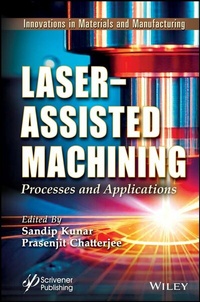
Laser-Assisted Machining
Description

This unique book develops exhaustive engineering perceptions of different laser-assisted techniques, reviews the engineering context of different laser fabrication techniques, and describes the application of laser-assisted fabrication techniques.
Lasers are essential in the area of material processing because they can produce coherent beams with little divergence. The fabrication process known as surface cladding includes joining (soldering, welding), material removal (laser-aided drilling, cutting, etc.), deformation (extrusion, bending), and material addition. Some remarkable advantages of laser-assisted material development include faster processing rates and preservation of essential alloying components. However, the lack of widespread understanding of various material phenomena and how laser parameters affect them prevents the technology from being widely accepted on an industrial scale.
Among the subjects Laser-Assisted Machining covers include high-powered lasers in material processing applications, laser-based joining of metallic and non-metallic materials, direct laser cladding, laser surface processing, laser micro and nano processing, emerging laser materials processing techniques, solid-state lasers, laser cutting, drilling and piercing, laser welding, laser bending or forming, laser cleaning, laser automation and in-process sensing, femtosecond laser micromachining, laser-assisted micro-milling/grinding, laser-assisted jet electrochemical micro-machining, laser-assisted water jet micro-machining, hybrid laser-electrochemical micromachining process, quill and nonreciprocal ultrafast laser writing, laser surface engineering, ultrashort pulsed laser surface texturing, laser interference patterning systems, laser interference lithography, laser-guided discharge texturing.
Audience
The book will be used by researchers in the fields of manufacturing technology and materials science as well as engineers and high-level technicians for a better understanding of various innovative and novel techniques to cope with the need of micromachining, as well as microfabrication industries for successful implementation of microproduct manufacturing.
More details
Other editions
Additional editions
Persons
Sandip Kunar, PhD, is an assistant professor in the Department of Mechanical Engineering, Aditya Engineering College, A.P., India. He has published more than 50 research papers in various reputed international journals, national and international conference proceedings, 16 book chapters, and 9 books as well as two patents. His research interests include non-conventional machining processes, micromachining processes, advanced manufacturing technology, and industrial engineering.
Prasenjit Chatterjee, PhD, is a Professor of Mechanical Engineering and Dean (Research and Consultancy) at MCKV Institute of Engineering, West Bengal, India. He has more than 5550 citations, h index of 39, and 120+ research papers in various international journals and peer-reviewed conferences. He has authored and edited more than 33 books on intelligent decision-making, fuzzy computing, supply chain management, optimization techniques, risk management and sustainability modeling. He has received numerous awards including Best Track Paper Award, Outstanding Reviewer Award, Best Paper Award, Outstanding Researcher Award and University Gold Medal. He is the Editor-in-Chief of Journal of Decision Analytics and Intelligent Computing. He is one of the developers of two multiple-criteria decision-making methods called Measurement of Alternatives and Ranking according to COmpromise Solution (MARCOS) and Ranking of Alternatives through Functional mapping of criterion sub-intervals into a Single Interval (RAFSI).
Content
Preface xxv
Acknowledgments xxix
1 Introduction to Laser-Assisted Machining 1
Sandip Kunar, K. Vijetha, Jagadeesha T., Abhishek Ghosh, S. Rama Sree, Prasenjit Chatterjee, Sreenivasa Reddy Medapati and Nabankur Mandal
2 Laser Welding in Manufacturing Applications 17
P. Sivasankaran
3 Laser-Assisted Machining for Advanced Materials 27
Sandip Kunar, Abhishek Ghosh, Rajesh Kumar, D.V. Janaki, Jagadeesha T., Norfazillah Talib, K.V.S.R. Murthy, Sreenivasa Reddy Medapati and Prasenjit Chatterjee
4 Optimization of Laser Cutting Parameters Using the Taguchi Approach 41
Ranjith Raj A., Senthamarai Kannan C. and Sivaramapandian J.
5 Laser-Assisted Micromilling (LAMM): Process and Applications 53
M. Sivakumar, S. Jayanth, S. Shriram and J. Jerald
6 Removing Algae and Moss Growth on Compressed Stabilized Earth Block Wall Surface by Laser Cleaning 69
Vinod B. R. and K.R. Ashwini
7 A Review of the Effects of Laser Cleaning on the Development of Corrosion and the Removal of Rust in Steel Bridges in Marine Environments 87
Vinod B. R. and Swetha G. A.
8 Laser-Assisted Machining: Its Capability and Future 115
Sandip Kunar, K. Vijetha, Adduri S. S. M. Sitaramamurty, Chanchal Biswas, S. Tripathy, Jagadeesha T. and Sujana Nowshin
9 A Review of the Applications of the Laser Crack Measurement for White Topping Road 129
Vinod B. R. and K.R. Ashwini
10 Characterization of Tensile and Impact Properties of Fabricated AlSi10Mg by Selective Laser Melting Technique 147
Sibabrata Mohanty, Ajit Kumar Senapati, Gopal Krusha Mohanty and Debesh Mishra
11 The Developments and Retrospect of Water-Laser Machining Technology: An Overview 161
Pravin Pawar, Amaresh Kumar and Raj Ballav
12 Laser Welding of Aluminum Alloys 207
Prerona Saha, Abhishek Ghosh, Kalyan Das, Uttam Kumar Murmu, Sandip Kunar and Manojit Ghosh
13 Laser-Assisted Grinding and Milling 227
A. C. Uma Maheshwer Rao
14 Trends in Laser-Assisted Hybrid Machining to Enhance the Performance Quality of Electrical Discharge Machining Process: Opportunities and Challenges 247
S. Tripathy, D.K. Tripathy and S.R. Biswal
15 Laser Welding of Thin Ferrous Sheets with Ferrous and Non-Ferrous Sheets 259
Dhanraj B. Waghmare and Partha Saha
16 Laser Cutting, Drilling, and Piercing 273
Yajush Walia, Roopak Varshney and Param Singh
17 Femtosecond Laser Machining 293
Jagadeesha T. and Sandip Kunar
18 Fundamentals of Laser Welding 315
Jagadeesha T., Sandip Kunar and Prasenjit Chatterjee
19 High-Power Laser in Material Processing Applications 333
Jagadeesha T. and Sandip Kunar
20 Hybrid Laser Electrochemical Micromachining 353
Jagadeesha T. and Sandip Kunar
21 Introduction to Solid-State Lasers 367
Jagadeesha T. and Sandip Kunar
22 Laser Micro- and Nanoprocessing 381
Jagadeesha T., Sandip Kunar and Prasenjit Chatterjee
23 Waterjet-Guided Laser Cutting Technology 401
Jagadeesha T. and Sandip Kunar
24 Fundamentals of Laser Machining 415
Jagadeesha T. and Sandip Kunar
25 Opportunities and Challenges in Laser Bending 435
Omkumar M. and Saravanan R.
26 Laser Cleaning and Its Advancements 447
Omkumar M. and Saravanan R.
References 458
Index 461
1
Introduction to Laser-Assisted Machining
Sandip Kunar1*, K. Vijetha1, Jagadeesha T.2, Abhishek Ghosh3, S. Rama Sree4, Prasenjit Chatterjee5, Sreenivasa Reddy Medapati1 and Nabankur Mandal5
1Department of Mechanical Engineering, Aditya Engineering College, Surampalem, India
2Department of Metallurgy and Materials Engineering, Indian Institute of Engineering Science and Technology, Howrah, Shibpur, India
3Department of Mechanical Engineering, NIT Calicut, Kozhikode, India
4Department of Computer Science & Engineering, Aditya Engineering College, Surampalem, India
5Department of Mechanical Engineering, MCKV Institute of Engineering, Howrah, India
Abstract
Due to their inherent physical-mechanical qualities, advanced materials such as Ti6Al4V, Inconel, and sophisticated technical materials like composites and ceramics are explored and utilized extensively in biomedicine, nuclear power, etc. However, machining is always involved in turning these novel materials into engineered goods. These substances are regarded as advanced materials due to their machinability features, which include greater machining temperature, reduced surface quality, and less tool life expectancy. These substances are proven to be economically unfeasible to machines using conventional techniques. Recently, there have been numerous attempts to use external energy-aided machining to better these materials' machinability. Scientists in the field of material removal mechanism have recently concentrated their attention on laser-assisted machining (LAM), one of the various externally aided machining methods. The aim of this research article is to explore and describe the prospective applications of LAM for advanced materials, as well as the advantages and drawbacks of this technology.
Keywords: Laser-assisted machining, advanced materials, laser parameters
1.1 Introduction
In the industrial sector, the usage of advanced materials including tool steels, semiconductors, biomaterials, and smart materials is rising [1]. To fulfill the growing demand for greater heat and strength resistance, particularly in the aerospace industry, they are still being investigated and developed [2, 3]. These cutting-edge materials are often machinable because of higher thermal stress of the machining zone. The materials are challenging to manufacture because of characteristics like higher thermal effect and large machining forces. Thus, an innovative approach known as thermally aided machining was established. Plasma-assisted machining, induction and furnace preheating method, and gas torch are a few examples [4].
Although hard-to-cut materials have good qualities, their physical and chemical traits make them challenging to manufacture with standard machinery [5]. A brand-new and cutting-edge method for machining materials with high wear resistance is called laser-assisted machining. For softening the material during the cutting time, the laser is employed as a heating resource with the laser beam directed on the unmachined portion of the job. Heat is added to the substance, softening the surface layer and causing ductile deformation as opposed to delicate deformation during machining [6]. The most significant benefit of laser-aided cutting is its ability to generate job surfaces that are considerably improved compared with those generated by traditional machining, along with a superior material removal rate and low tool erosion [7]. LAM is suitable due to its greater laser beam intensity at less beam power, good concentrating features brought on by extremely brief pulse duration, simplified manufacturing process, eco-friendliness, and improved surface finish [8].
For applications requiring high strength and heat resistance, including those in the aerospace, medical, and electronic industries, advanced materials have been developed in recent decades. These materials include ferrous alloys, cobalt-chromium alloys, and composites [9, 15]. These materials have significant corrosion resistance and the capacity to maintain superior strength at high temperatures. These materials outperform more traditional engineering materials in terms of strength and toughness. However, since converting a final component costs half of the product's final cost, applications of these materials are currently not expanding [9, 10]. Low cutting speed and reduced cut depth because of increased tool wear are to blame for this. As a result, these materials are regarded as being tough to cut. Numerous issues arise during machining, including excessive heat creation during cutting time, a propensity for BUE creation, and catastrophic cutting tool failure [11-14]. Due to these machining processes, poor capability of machinability, higher capital cost, and low efficiency may be substantially affected. The intrinsic properties of hard-to-cut materials make traditional machining techniques like milling or turning ineffective. These materials are currently being machined using a variety of cutting-edge techniques, including electrochemical machining, plasma machining, and thermally aided machining techniques like laser machining. Due to its greater advantages, significant technological advancement, and commercial viability, laser-aided machining (LAM), one of the various techniques, is becoming more and more popular with advanced materials. The current state of LAM and its problems are highlighted in this research with respect to the impact of laser machining factors on the productivity of smart materials.
1.2 Laser-Assisted Machining-Overview
A high-power laser is utilized in laser-aided machining, a hybrid process, to heat the job before material removal using a traditional machine tool. The yield strength of fragile material drops down below its rupture strength at high temperatures, transforming the material's distortion behavior from fragile to ductile. Also, strong, ductile materials lose some of their yield strength at high temperatures, which lowers tool erosion and cutting ability while also enhancing surface quality.
Nd:YAG and CO2 laser are two primary laser sources that are frequently utilized in LAM studies. The latter has superior absorptivity because it has a shorter wavelength. Because the CO2 laser absorbs less laser energy than Nd:YAG, it is less effective in cutting the most advanced materials including titanium and composite materials. Most of the study has addressed the difficulties in traditional machining while concentrating on the advantages of LAM. However, the laser machining factors affect the LAM consequences. Feed rate, spot diameter, and cutting speed are the primary operational aspects associated with LAM. Due to the multiplicity of control factors and how they interact, finding the ideal LAM setting is challenging. Additionally, a numerical analysis based on experimental design is required to explore how the ideal LAM parameter affects other variables and how they interact. Figure 1.1 shows the schematic setup of LAM.
Figure 1.1 Schematic setup of LAM.
1.3 Machining of Advanced Materials
The adoption of advanced materials has accelerated with applications in automotive, shipbuilding, and semiconductors in recent years because they outperform standard metals in terms of high-temperature strength, durability, and corrosion resistance [16-19]. Titanium alloy [20], Inconel 718 alloy [21], compacted graphite iron [22], mullite [23], Si3N4 ceramic [24-26], Waspaloy [27], and A359 aluminum matrix [28] are a few examples of materials that are challenging to cut. Hard-to-cut materials also include magnesium AZ91 [29], stainless steel P550 [30], and AISI D2 steel [31].
1.3.1 Titanium Alloys
This is mainly because titanium alloys have properties like high creep, high wear resistance, fine biocompatibility, and high corrosion resistivity, which make them interesting materials in a variety of manufacturing areas like biomedical, nuclear, etc. Owing to their greater chemical attraction and less heat conductivity, titanium alloys are regarded as advanced materials. The tool life is decreased during the machining of titanium alloys.
S. Sun et al. [32] turned titanium alloy dry at various cutting speeds, feed rates, and cut depths to see how the repeated force frequency altered in relation to the cutting speed and feed rate. With greater cutting speed, the cutting force rises due to the strain rate hardening at higher and lower strain rates correspondingly. Outside of these cutting speed ranges, the cutting force reduces with boosting cutting speed because of the thermal tempering of material. Some investigations on titanium alloys demonstrate that cryogenic machining outperforms dry machining in terms of tool life. The impact of cryogenic machining was examined by M.J. Bermingham et al. [33] using various combinations of feed rate and depth of cut at fixed material removal rate and cutting speed. In dry machining, the combination of lower cutting speed and higher depth of cut improved tool life 1.6 times more than the combined lower depth of cut and higher speed. Tool life at the specified machining conditions is 13 min for dry machining and 20 min for cryogenic machining. Hybrid machining and laser-aided machining (LAM) were utilized to enhance metal removal and tool life. Surface finish, microstructure, and tool...
