

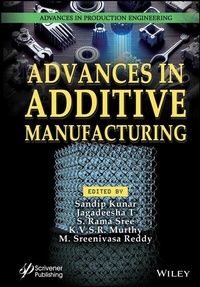
Advances in Additive Manufacturing
Description

This volume focuses on the fundamentals of additive manufacturing and its components, explains why and what we do, outlines what is crucial to the user, offers details on important applications such as in the aerospace, automotive, or medical areas, and the difficult certification process.
This book explores the advancements in additive manufacturing which produces solid, free-form, nearly net-shaped objects. This refers to items that are easy to use, out-of-the-box, and not bound by the design constraints of modern manufacturing techniques. AM expands the definition of 3D printing to encompass a variety of procedures that begin with a three-dimensional computer model, incorporate an AM production procedure, and result in a useful product. The AM process can be confusing due to the rapid rise of competing techniques for fabricating 3D parts. This volume provides a thorough review of the basic components and procedures involved in additive manufacturing. It outlines a road map for where to begin, what to study, how everything goes together, and how AM might enable ideas outside traditional processing to realize those ideas in AM. Furthermore, this book investigates the benefits of AM including affordable access to 3D solid modeling software. With this software, learning is achieved without having to invest in costly industrial equipment.
AM encompasses a variety of techniques, including those that use high-intensity beams to fuse powder or wire, and hybrid techniques that combine additive and subtractive manufacturing techniques. AM-related processes have developed at breakneck speed, giving rise to a deluge of acronyms and terminology, not to mention the emergence, acquisition, and demise of new businesses. By combining ideas and aspirations, better methods will be revealed that result in useful products that will serve and contribute to a lasting future.
Although expensive commercial additive manufacturing equipment can cost hundreds of thousands to millions of dollars, a lack of access to equipment does not preclude the study of the technology. 3D printing services will undoubtedly become more reasonable for small- and medium-sized organizations as their prices decline. Hybrid 3D plastic printing technologies and low-cost hobbyist 3D weld deposition systems are already in development which will make the best 3D printers accessible and affordable. This book will assist the reader in determining what is required to begin, which software, supplies, and procedures best suit, and where to obtain additional information.
Audience
The book will be used by engineers and R&D researchers involved in advanced additive manufacturing technology, postgraduate students in various disciplines such as mechanical, manufacturing, biomedical, and industrial engineering, etc. It will also serve as a reference manual for manufacturing and materials engineers involved in additive manufacturing and product development.
More details
Other editions
Additional editions
Persons
Sandip Kunar, PhD, is an assistant professor in the Department of Mechanical Engineering, Aditya Engineering College, A.P., India. He has published more than 50 research papers in various reputed international journals, national and international conference proceedings, 16 book chapters, and 9 books as well as two patents. His research interests include non-conventional machining processes, micromachining processes, advanced manufacturing technology, and industrial engineering.
Jagadeesha T, PhD, is an associate professor in the Department of Mechanical Engineering, National Institute of Technology Calicut, India. He has 25 years of industry and academic experience and has authored mechanical engineering workbooks and textbooks and published more than 75 papers in international and national journals/conferences. As well as four patents. His research interests are advanced machining, additive manufacturing, fluid power control, advanced materials, vibration and noise control, and FEM.
S. Rama Sree, PhD, is a professor in the Computer Science and Engineering Department, Aditya Engineering College, India. She has published more than 50 papers in international/national journals and conferences, four patents, and co-authored on data structures. Her research interests include software, soft computing, applications of machine learning techniques, medical diagnosis and cloud computing.
K. V. S. R. Murthy, PhD, is a professor in the Electrical and Electronics Engineering Department, Aditya Engineering College, India. He is an expert in power system operation and control, and the application of artificial intelligence techniques in power distribution systems. He has published 35 research papers in various journals/conferences.
M. Sreenivasa Reddy, PhD, is the Director of Aditya Group of Educational Institutions and Principal of Aditya Engineering College, India. He has more than 25 years of industry and academic experience and is an expert in additive manufacturing technology. He has 11 patents granted and published many journal articles and book chapters.
Content
Preface xix
Acknowledgment xxiii
1 Fundamentals and Applications of Additive Manufacturing 1
Sandip Kunar, Jagadeesha T., Gurudas Mandal, Akhilesh Kumar Singh and S. Rama Sree
2 Characteristics of Additive Manufacturing Process 15
Sandip Kunar, Jagadeesha T., Gurudas Mandal, Akhilesh Kumar Singh, Rajesh Kumar, Aezeden Mohamed and Param Singh
3 Directed Energy Deposition (DED) Process 39
M. Sivakumar, N.S. Balaji, G. Rajesh Kannan and R. Karthikeyan
4 Current Progress and Future Perspectives of Biomaterials in 3D Bioprinting 61
Prerona Saha, Ankita Nandi, Jaideep Adhikari, Abhishek Ghosh, Asiful H. Seikh and Manojit Ghosh
5 Powder Bed Fusion Process - State of Art 89
G. Rajesh Kannan, M. Sivakumar, B. Jagadeesh and N. S. Balaji
6 Cobalt-Chromium Alloy Additive Manufacturing Technologies for Biomedical Applications 109
Pravin Pawar, Amaresh Kumar and Raj Ballav
7 Cold Spray Additive Manufacturing: Principles, Applications, and Recent Advancements 121
Jagadeesha T. and Sandip Kunar
8 Integrating Metal Forming and Additive Manufacturing for Enhanced Product Quality and Efficiency 129
Jagadeesha T. and Sandip Kunar
9 Impacts of Additives on Failure Issues Linked with Additively Manufactured Products 145
Jagadeesha T. and Sandip Kunar
10 Nano-Additives for Advanced Additive Manufacturing: Enhancing Quality, Sustainability and Performance 157
Jagadeesha T. and Sandip Kunar
11 Processing of Biomaterials by Additive Manufacturing 165
R. Prayer Riju, S. Arulvel, D. Dsilva Winfred Rufuss, Jayakrishna Kandasamy and P. Jeyapandiarajan
12 Safety and Environmental Protection in Additive Manufacturing 187
N.S. Balaji, M. Sivakumar, G. Rajesh Kannan and R. Karthikeyan
13 Advanced Developments in Additive Manufacturing of Silicone Rubber Elastomers 203
Mohammad Bagher Jafari, Hossein Doostmohammadi, Mostafa Baghani and Majid Baniassadi
14 Laser-Assisted Additive Manufacturing Techniques for Advanced Composites 217
Nitai Chandra Adak, Fahim Sharia and Wonoh Lee
15 Stereolithography-Based Polymer Additive Manufacturing Process for Microfluidics Devices: A Review 237
Ajit Biswas, Amit Kumar Singh and Debasree Das
16 Biomaterials and Bioinks: A Synergistic Approach to Bioprinting 269
M. Abdur Rahman, G. Rajesh and N. Sri Rangarajalu
17 Significance of Additive Manufacturing in Aerospace and Automotive Industries 293
M. Abdur Rahman, Ravi Kumar S. and A.S. Selvakumar
18 Sustainability and Efficiency: The Green Potential of Additive Manufacturing 317
M. Abdur Rahman, Serajul Haque, N. Sri Rangarajalu and D. R. Rajendran
19 Role of Additive Manufacturing in IoT Medical Devices 343
K. Vijetha, Uzwalkiran Rokkala and Lingaraju Dumpala
20 Additive Manufacturing of Superhydrophobic Architectures 353
Hossein Doostmohammadi, Majid Baniassadi and Mostafa Baghani
21 Fiber-Reinforced Composite and Topology Optimization in Additive Manufacturing 373
Tien-Dat Hoang and Van Du Nguyen
22 Comparative Analysis of Mechanical Characteristics in Additive Manufacturing on Polylactic Acid and Acrylonitrile Butadiene Styrene Materials 389
Kaustubh Pravin Joshi and Anil Dube
23 A Comprehensive Review on Polymers and Metal Additive Manufacturing 405
Praveena B. A., Santhosh N. and Anand G.
24 Sub-Zero Additive Manufacturing: A Green Solution to Pattern Making in the Investment Casting Industry 419
Pushkar Kamble, K. P. Karunakaran and Yicha Zhang
25 Effect of Orientation on the Tensile Strength of 3D Printed Rectangular Solid Bars 427
Neel Kamal Gupta and Pawan Kumar Rakesh
26 Advanced Techniques in Wire Arc Additive Manufacturing: Monitoring, Control, and Automation 443
M. Sivakumar, R. Karthikeyan, N.S. Balaji and G. Rajesh Kannan
27 Vat Photopolymerization 467
J. Suresh Kumar, Akshaya Senthilkumar, S. Naveen Rajkumar and K. Kalaichelvan
Index 483
Preface
3D printing and additive manufacturing (AM) have become more well-known due to multimillion-dollar government support of additive and advanced manufacturing programs and business expenditures in research and development facilities. Enthusiasm has grown in several business and financial sectors, but most significantly among young people, opening the door to a lucrative future in AM. The greatest method to foster this interest is to present a fair assessment of where technology is now and where it can go in the future. How do we as makers become ready for this chance? How may this impact my bottom line as a business owner or my rivals? How developed is the technique, and what potential durable tactical benefits does it offer? To educate, inspire, and forge the future of this technique, a discussion about AM triumphs and difficulties, free of all the hype, is required.
This book explores the advancements in AM, which produces solid, free-form objects that are nearly net-shaped. This refers to items that are easy-to-use, out-of-the-box, and not bound by the design constraints of modern manufacturing techniques. The AM expands the definition of 3D printing to encompass a variety of procedures that begin with a three-dimensional computer model, incorporate an AM production procedure, and result in a useful product. The AM process can be confusing due to the rapid rise of competing techniques for fabricating 3D parts. This volume provides a thorough review of the basic components and procedures involved in additive manufacturing. It outlines a road map for where to begin, what to study, how everything goes together, and how AM might enable ideas outside traditional processing to realize those ideas in AM. To highlight present uses and future possibilities, current examples and applications are also presented. Furthermore, this book investigates the benefits of AM that include affordable access to 3D solid modelling software. With this software, learning is achieved without having to invest in costly industrial equipment.
AM encompasses a variety of techniques, including those that use high-intensity beams to fuse powder or wire, and hybrid techniques that combine additive and subtractive manufacturing techniques. AM-related processes have developed at breakneck speed, giving rise to a deluge of acronyms and terminology, not to mention the emergence, acquisition, and demise of new businesses. By combining ideas and aspirations, better methods will be revealed that result in useful products that will serve us and contribute to a lasting future.
Although expensive commercial additive manufacturing equipment can cost hundreds of thousands to millions of dollars, a lack of access to equipment does not preclude the study of the technology. 3D printing services will undoubtedly become more reasonable for small- and medium-sized organizations as their prices decline. Hybrid 3D plastic printing technologies and low-cost hobbyist 3D weld deposition systems are already in development. By the time we are ready to use them, the present pace of invention in this quickly evolving industry will make the best 3D printers accessible and affordable.
This book will assist you in determining what you require to begin, which software, supplies, and procedures best suit you, and where to obtain additional information. For those starting their careers or changing directions, the field of AM has the potential to be gratifying and financially rewarding, offering opportunities on the factory floor, in commercial research and development (R&D) labs, and in feasible marketable business ventures.
This volume focuses on the fundamentals of AM and its components, explains why we do and what we do, and outlines what is crucial to you as the maker. It offers details on important applications, like those in the aerospace, automotive, or medical areas, as well as the difficult certification process which is sometimes overlooked.
Chapter 1 discusses the additive manufacturing technique that builds up materials to create a three-dimensional form. Rapid prototyping and customized design solutions have made use of AM in conjunction with computer-aided design. This chapter discusses the fundamentals, types, and applications of additive manufacturing. Chapter 2 explores the characteristics of the additive manufacturing process, generation of layer information, stereolithography, laser sintering, and layer laminate manufacturing. Chapter 3 delves deeply into the foundational concepts and operations behind DED and explores the different DED methodologies. Additionally, this section includes a review of materials compatible with DED, highlighting their unique attributes in the final products.
Chapter 4 highlights promising opportunities for types of 3D bioprinting that can be used with technological advancements, improved resolution, and refined bio-inks. Additionally, it explores the essence of 3D bioprinting and its profound impact on a myriad of sectors. Chapter 5 explores the fundamental principles of laser powder bed fusion (L-PBF) as applied to metallic materials. This section delineates a procedural workflow for constructing a part, commencing with the design phase and culminating in post-processing. Chapter 6 discusses different additive manufacturing technologies for making biomedical parts and implants using cobalt chromium.
Chapter 7 gives a detailed overview of cold spray additive manufacturing, including principles, applications, and recent advancements. Chapter 8 offers a comprehensive examination of the incorporation of additives in various metal-forming processes. It also thoroughly explores the effects of slip additives, polymer additives, fluorinated additives, nanoadditives, wire additives, and metal additives on product quality and reliability. Moreover, the chapter provides insights into different manufacturing pathways that integrate additives, supported by real-world cases. Chapter 9 deals with various aspects of design, manufacture, and process improvements that can avoid various in-house and field failures. Various aspects such as cost, flexibility, complexities, dimensional accuracy, sustainability, and customization after product failures are discussed.
Chapter 10 highlights the effective use of nanoparticles to develop a green and better future with the limitless application of nanomaterials and additives. Chapter 11 details the post-processing strategies that refine additively manufactured biomaterials. This includes crosslinking, mechanical conditioning, surface treatment, and biofunctionalization techniques. Emphasizing the essentiality of these steps, the chapter underscores the role of additive manufacturing in manufacturing and processing biomaterials. Chapter 12 introduces the nascent field of additive manufacturing security, offering a comprehensive overview of current research and proposed attack taxonomies. Chapter 13 discusses the nature of silicone rubbers, then introduces the additive manufacturing techniques employed to design these architectures.
Chapter 14 investigates the laser-assisted additive micromanufacturing of composite materials. Chapter 15 explores the choice of materials and design factors and offers a thorough examination of the uses, difficulties, and subsequent possibilities of polymer additive manufacturing in microfluidics for medical applications. Chapter 16 deliberates the domains of materials science, bioengineering, and medicine to comprehend the fascinating breakthroughs in biomaterials and their enormous potential to revolutionize several sectors. Chapter 17 explores current AM research and development initiatives, analyzing prospective developments in materials, process scalability, and automation for aerospace and automotive industries. Chapter 18 discusses obstacles to further advancements in environmentally friendly materials, energy efficiency, and AM recycling techniques and highlights the need for a more environmentally conscious and sustainable manufacturing ecosystem.
Chapter 19 presents the potential results of integrating IoT with 3D printed medical devices. Chapter 20 investigates the fascinating subject of 3D printing of superhydrophobic structures, explores the challenges faced in achieving water repellence, and analyzes the pros and cons of various 3D printing techniques. Chapter 21 proposes an efficient integration of a topology optimization method and AM to design and manufacture CCF-reinforced composite structures. Chapter 22 explores the comparative analysis of mechanical characteristics in additive manufacturing on polylactic acid and acrylonitrile butadiene styrene materials.
Chapter 23 provides a comprehensive review of materials, methods, applications, and challenges in polymers and metal AM. Chapter 24 explains about sub-zero AM for a green solution to pattern making in the investment casting industry. Chapter 25 discusses the effect of orientation on the tensile strength of a 3D-printed rectangular solid bar. Chapter 26 provides a comprehensive review of the technological progression of wire arc AM and highlights its significant transformative capacity in the domain of AM. Chapter 27 explores the Vat Photopolymerization technique and discusses emerging applications in various fields like medical, mechanical, and other applications.
This book gives a thorough explanation of numerous AM techniques to provide muchneeded information to researchers and engineers who work in additive manufacturing. Furthermore, students learning about additive manufacturing procedures will find it to be an easy-to-follow, research-focused...
