

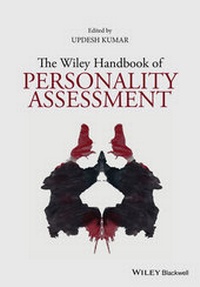
The Wiley Handbook of Personality Assessment
Description

More details
Other editions
Additional editions
Person
Content
About the Contributors xii
Foreword by Professor Irving B. Weiner xxxi
Preface xxxiii
Section I Emerging Conceptual Trends 1
1 Integrating Trait and Process Approaches to Personality: A Sketch of an Agenda 3
Robert R. McCrae
2 Personality Assessment and Theory 19
Philip J. Corr and Arthur E. Poropat
3 Situational Perception: Its Theoretical Foundation, Assessment, and Links to Personality 31
Kai T. Horstmann and Matthias Ziegler
4 Temperamental Components of the Developing Personality 44
James B. Victor, Mary K. Rothbart, Spencer R. Baker, and Jennifer L. Tackett
5 Integrity Tests: A Review of Alternate Conceptualizations and Some Measurement and Practical Issues 59
Chockalingam Viswesvaran and Deniz S. Ones
6 Network Analysis: A New Way to Think about Personality 74
Giulio Costantini and Marco Perugini
7 Theory and Measurement of Trait Emotional Intelligence 90
K.V. Petrides, Alexander B. Siegling, and Donald H. Saklofske
8 Beyond IQ and EQ: The Bar-On Multifactor Model of Performance 104
Reuven Bar-On
9 Measuring the Dark Side of Personality 119
Ashton C. Southard and Virgil Zeigler-Hill
10 Diversity and Assessment 134
Joyce P. Chu, Brian A. Maruyama, Ashley Elefant, and Bruce Bongar
11 Future Directions for Personality Assessment: An African Perspective 146
Sumaya Laher
12 Advances in the Use and Interpretation of the MMPI-2 158
Salazar-Schneiderman, Caroline S. Tonetti, Lacey M. Sommers, and Roger L. Greene
Section II Emerging Assessment Perspectives and Methodological Issues 173
13 Objective Personality Assessment with the MMPI-2: An Internationally Adaptable Measure 175
James N. Butcher
14 Precision Assessment: An Individualized and Temporally Dynamic Approach to Understanding Patients in their Daily Lives 192
Michael J. Roche and Aaron L. Pincus
15 Are Situational Judgment Tests Better Assessments of Personality than Traditional Personality Tests in High-Stakes Testing? 205
Deborah L. Whetzel and Michael A. McDaniel
16 Alternatives to Self-Reports: Conditional Reasoning Problems and Implicit Association Test (IAT) Based Tasks 215
Zvonimir Galic,¿ Andreja Bubic,¿ and Maja Parmac ¿Kovaci¿ c¿
17 Therapeutic Assessment in Clinical and Counseling Psychology Practice 228
Radhika Krishnamurthy, Stephen E. Finn, and Filippo Aschieri
18 Personality Assessment in Ecological Settings by Means of Virtual Reality 240
Pietro Cipresso and Giuseppe Riva
19 The Use of the Hare Psychopathy Checklist (PCL-R) and Rorschach Inkblot Method (RIM) in Forensic Psychological Assessment 249
Carl B. Gacono, Aaron J. Kivisto, Jason M. Smith, and Ted B. Cunliffe
20 Holtzman Inkblot Technique and Personality Assessment 268
C.R. Darolia
21 Integrative Treatments Come of Age: Systematic Treatment Selection (STS) 285
Christopher J. Edwards, Lori Holleran, and Larry E. Beutler
22 Personality Assessment Paradigms: Issues and Challenges 302
Vijay Parkash and Updesh Kumar
23 Identification and Assessment of the Correlates of Military Suicide 323
Kasie L. Hummel, James Sottile, Danielle Spangler, and Bruce Bongar
24 Integrative Clinical Assessment of Sexual and Gender Minority Clients 333
Whitney Bliss, Samantha Pflum, Matthew Skinta, Rylan J. Testa, Rebecca Floyd, and Peter Goldblum
25 Using the Johnson-Neyman Procedure to Detect Item Bias in Personality Tests: A Proposed New Method and
Practical Guidelines for Data Analysis 346
Burak Tunca
26 User Reactions to Personality Assessment: Implications for Assessment Credibility, Utility, and Practicality 361
Chris D. Fluckinger and Andrea F. Snell
27 Novel Approaches to Adjusting for Positive Response Distortion with the Personality Assessment Inventory 374
John E. Kurtz, Lindsey L. Bupp, and Corinne M. Henk
28 Applicant Faking Behavior: The Elephant in the Room 387
Richard L. Griffith, Patrick D. Converse, Yumiko Mochinushi, and Matthias Ziegler
29 Transforming Assessment: New Pedagogies for the Digital Age 399
Swati Johar and Updesh Kumar
30 Ethical Issues in Personality Assessment 415
Swati Mukherjee and Updesh Kumar
Index 427
About the Contributors
Filippo Aschieri, PhD, is Assistant Professor of Psychology at the Università Cattolica del Sacro Cuore (UCSC) of Milan, Italy. He works at the European Center for Therapeutic Assessment (ECTA) at UCSC as a clinician and supervisor, and serves on the ECTA's Board. He also is a member of the faculty and Executive Committee of the Therapeutic Assessment Institute, a non-profit transnational organization that coordinates training and certification in therapeutic assessment. His current research interests include therapeutic assessment, multicultural assessment, and psychotherapy process and outcome. In 2012 Dr Aschieri was awarded the Martin Mayman Award by the Society for Personality Assessment for distinguished contribution to the personality assessment literature.
Spencer R. Baker, PhD, is an Associate Professor in the Department of Counseling and a Research Scientist with the Behavioral Science Research Center, Hampton University. Dr Baker's primary research interests include adolescent cognitive development, adolescent behavior problems including development of psychopathologies, and the antecedents of adult personality within the context of family and neighborhood. As a methodologist and a psychometrician, he has been actively involved with the Behavioral Science Research Center since 1997. He has authored and co-authored several publications and book chapters and made presentations at international and national conferences on the development of personality and psychopathologies. In these endeavors, Dr. Baker is a co-author of an instrument, the Child Temperament and Personality Questionnaire (CTPQ), that will bridge the gap between measurement of temperament and personality. He is currently using this instrument as a self-report for children aged 10 to 16 years, along with the new NEO Personality Inventory 3 (NEO-PI 3), a more readable version. Currently, he is working on the psychometric properties of both instruments with adolescent and inmate populations.
Reuven Bar-On, PhD, has worked as a psychologist for both public and private organizations since 1972. One of his primary areas of scholarly involvement has been in emotional and social intelligence, and he is acknowledged as one of the leading theorists, researchers and practitioners in this field today. The "Bar-On model of emotional intelligence" is described in the Encyclopedia of Applied Psychology as one of the three main approaches to this concept, and the term "EQ" was coined by him in 1985 to describe his approach to assessing it. He began developing the precursor to the Emotional Quotient InventoryT in 1980, which is the first measure of this concept to be published by a psychological test publisher. He developed, co-developed or has acted as a consultant in developing eight other instruments since 1978. The most recent psychometric instrument that Dr Bar-On has developed is the Multifactor Measure of PerformanceT. He has examined the ability of these various instruments to predict different aspects of human behavior and performance. Dr Bar-On has contributed 50 publications in the area of emotional and social intelligence alone, which have been cited more than 7,000 times in articles, books, encyclopedias and doctoral dissertations.
Larry E. Beutler received his PhD from the University of Nebraska and subsequently served on the faculties of Duke University Medical Center, Stephen F. Austin State University, Baylor College of Medicine, the University of Arizona Health Sciences Center, and the University of California at Santa Barbara. He is the Past Director of the National Center for the Psychology of Terrorism and the continuing Director of the Institute for the Study of Equine Assisted Change at Palo Alto University (PAU). He is a Distinguished Professor Emeritus of Psychology, a previous Chair of the Faculty, and Director of Clinical Training at Palo Alto University. He is also Professor Emeritus at the University of California, a diplomate of the American Board of Professional Psychology (ABPP), a fellow of both the American Psychological Association (APA) and Association of Psychological Science (APS), a Past President of Divisions 29 (Psychotherapy) and 12 (Clinical) of APA, and a two-term Past President (international) of the Society for Psychotherapy Research (SPR). Among his citations and achievements, he is a recipient of the Distinguished Career award from SPR, and a Presidential citation for achievement from the APA. He has also been honored for his contributions by the States of Arizona and California. He has published over 40 scholarly articles and chapters and is the author or co-author of 26 books on psychotherapy, assessment, and psychopathology.
Whitney Bliss is a Doctoral Researcher in Clinical Psychology at Palo Alto University. Prior to her graduate school at Brandman University, Whitney worked for the Army as an active duty soldier and then as a civilian specializing in suicide prevention and substance abuse prevention and treatment. Her current research interests include sexual and gender minority service members and veterans, as well as effective ways to educate civilian clinicians in military culture to provide more comprehensive care to military personnel and veterans.
Bruce Bongar, PhD, ABPP, FAPM, is the Calvin Professor of Psychology at Palo Alto University, and Consulting Professor of Psychiatry and the Behavioral Sciences at Stanford University School of Medicine. He is past president of the Section on Clinical Crises and Emergencies of the Division of Clinical Psychology of the American Psychological Association, a diplomat of the American Board of Professional Psychology, and a distinguished fellow of numerous psychological organizations. Professor Bongar has won the Edwin Shneidman Award for outstanding early career contributions to suicide research, the Louis I. Dublin award for lifetime achievement in suicidology research, and the Florence Halpern award for distinguished contributions to the practice of clinical psychology. His research and published work reflect his interest in the wide-ranging complexities of therapeutic interventions with difficult patients in general, and in suicide and life-threatening behaviors in particular.
Andreja Bubic, PhD, is an Assistant Professor at the University of Split in Croatia. She received her PhD at the Max Planck Institute for Human Cognitive and Brain Sciences at the University of Leipzig, where she utilized neuroscientific methods for studying future-oriented cognitive processing. After spending a postdoc in the MGH/HMS Martinos Center for Biomedical Imaging in Boston, USA, she is now in Split where she lectures and does research in the field of cognitive and educational psychology. She has published her research in outlets such as Current Psychology, Frontiers in Human Neuroscience, Human Brain Mapping, Journal of Cognitive Neuroscience, and European Journal of Neuroscience.
Lindsey L. Bupp is currently a doctoral researcher in clinical and community psychology at Wichita State University. She received her Bachelor's degree in psychology from the University of Arizona in 2009.
James N. Butcher, PhD, is Professor Emeritus of Psychology at the University of Minnesota, serving on its faculty for over 40 years. He received his graduate training at the University of North Carolina. Much of his career focuses on the use of the MMPI, MMPI-2, and MMPI-A across a variety of settings. His achievements include over 250 peer-reviewed articles, 60 books, and 38 years of providing continuing education workshops on the use of the MMPI instruments. Butcher was instrumental in identifying the need for a revision of the original MMPI, which resulted in the MMPI-2 and MMPI-A. He developed a computerized interpretive system, the Minnesota Reports, to assist psychologists in their psychological evaluations with the MMPI-2 and MMPI-A. The Minnesota Reports were originally published in 1981. Currently available Minnesota Reports include the Adult Clinical System-Revised, Reports for Forensic Settings, Revised Personnel System, and Adolescent Interpretive Report (co-authored with Carolyn L. Williams). Several of Professor Butcher's recent books include interpretive recommendations and relevant research for psychologists to aid in their use of the MMPI-2, MMPI-A, and Minnesota Reports. These books include: A Beginner's Guide to the MMPI-2 (3rd ed.) (2011), A Beginner's Guide to the MMPI-A (with Carolyn L. Williams, 2011), Oxford Handbook of Personality Assessment (Editor, 2009), Personality Assessment in Treatment Planning: Use of the MMPI-2 and BTPI (with Julia Perry, 2008), Assessing Hispanic Clients Using the MMPI-2 and MMPI-A (with Jose Cabiya, Emilia Lucio, and Maria Garrido, 2007), and MMPI/MMPI-2/MMPI-A in Court (3rd ed.) (with Kenneth Pope and Joyce Seelen, 2006).
Joyce P. Chu, PhD, is an Associate Professor of Clinical Psychology at Palo Alto University (PAU). She co-leads the Multicultural Suicide and Ethnic Minority Mental Health Research Groups at PAU, and is also Director of the Diversity and Community Mental Health emphasis which trains future psychologists to work with underserved populations in the public mental health sector. Dr Chu's work is focused around depression and suicide in ethnic minority adult and geriatric populations, particularly in Asian Americans. Her work is community-collaborative and aims to understand...
