

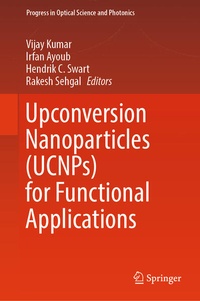
Upconversion Nanoparticles (UCNPs) for Functional Applications
Description

This book explores upconversion nanoparticles (UCNPs) at both, the fundamental as well as applied levels, for functional applications. It provides a broad perspective about the synthesis approaches of UCNPs with the preferred size, improved and tunable upconversion luminescence, along with the combined multifunctionality for various applications. It highlights the fundamentals and systematic developments in the tuning of UC emission and surface engineering of UCNPs that make UCNPs convenient for use in a large range of applications. Moreover, it gives an understanding of the imposed limitations and challenges associated with these methods to achieve the desired performance in targeted applications. It also includes the latest multifunctional lanthanide-based UCNPs, which efficiently convert low-energy photons into high-energy photons, and their applications in fluorescent microscopy, deep-tissue bioimaging, nanomedicine, optogenetics, solid-state lighting, solar cells, security labeling, and volumetric display.
More details
Other editions
Additional editions
Persons
Dr. Vijay Kumar is presently working as an assistant professor in the Department of Physics at the National Institute of Technology Srinagar (J&K), India. He received his Ph.D. in Physics from the SLIET Longowal. His research experience and interests lie in the synthesis, processing, and characterization of functional materials, solid-state luminescent materials, bio-based/biodegradable polymers, composite, drug delivery devices, wastewater treatment, polymer nanocomposites, and ion solid interaction.
Irfan Ayoub is a senior research fellow in the Department of Physics, National Institute of Technology, Srinagar. He is pursuing his Ph.D. in luminescence and optical properties of metal oxides.
Prof. Hendrik C Swart is an internationally acclaimed researcher and currently a senior professor in the Department of Physics at the University of the Free State, South Africa. He has led research in the area of degradation of phosphors forfield emission displays, as well as developing materials for nano-solid-state lighting. He has been key in the development of processes to synthesize and deposit thin films of various types of semiconductor nanoparticles that enhance the color, luminescent intensity, and lifetime of such displays. His research led to the establishment of a strong group working on luminescent materials and several smaller groups all over South Africa.
Prof. Rakesh Sehgal is a professor at the National Institute of Technology Hamirpur (H.P.), India. He is an outstanding leader with sustained international acclaim for his work on the synthesis and characterization (mechanical, metallurgical/metallographic, and tribological) of materials for aerospace, automobile, and biomedical applications. He served as the vice president of the Indian Society of Theoretical & Applied Mechanics (ISTAM) during 2001-2003, an executive member of the Tribology Society of India (TSI) for 02 terms, anda member of academic bodies of many other institutions. His research interests are in the areas of biomedical science and technology, including the synthesis of smart materials, nanomaterials, and tribological materials.
