

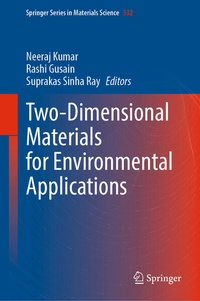
Two-Dimensional Materials for Environmental Applications
Description

This book focuses on recent developments in the field of two-dimensional nanomaterials for environmental applications. Due to their high surface area and tunable surface chemistry, two-dimensional nanomaterials are currently garnering great interest for environmental remediation applications. This book compiles contributed chapters from active international researchers dealing with the development of state-of-the-art two-dimensional nanomaterials in environmental applications such as water and wastewater treatment, adsorption, photocatalysis, membrane separation, desalination, deionization, environmental pollutants sensing/detection, carbon-dioxide capture and catalytic conversion, microbial treatment, and electrochemical remediation.
Each chapter provides an essential and comprehensive overview of the recent advances in material development and application, giving special attention to preparation methods, tunning of physiochemical properties, surface and interface chemistry, structural porosity, assemblies integration for fabrication of devices, and their relationship with overall efficiency. It offers a valuable reference guide for environmental and materials scientists, engineers, and policymakers working towards environmental sustainability.
More details
Other editions
Additional editions
Persons
Professor Suprakas Sinha Ray is a chief researcher in nanostructured materials at the Council for Scientific and Industrial Research (CSIR) with a Ph.D. in physical chemistry from the University of Calcutta in 2001 and director of the DST-CSIR Centre for Nanostructures and Advanced Materials. Ray's current research focuses on advanced nanostructured materials and their applications. He is oneof the most active and highly cited authors in the field of polymer nanocomposite materials, and he has recently, been rated by Thomson Reuters as being one of the Top 1% most impactful and influential scientists and Top50 high impact chemists (out of 2 mil Chemists worldwide).
Prof. Ray is the author of 5 books, co-author of 3 edited books, 32 book chapters on various aspects of polymer-based nanostructured materials & their applications, and author and co-author of 330 articles in high-impact international journals, 30 articles in national and international conference proceedings. He also has 6 patents and 7 new demonstrated technologies shared with colleagues, collaborators and industrial partners. So far, his team commercialized 19 different products. His honors and awards include South Africa's most Prestigious 2016 National Science and Technology Award (NSTF); Prestigious 2014 CSIR-wide Leadership award; Prestigious 2014 CSIR Human Capital development award; Prestigious 2013 Morand Lambla Awardee (top award in the field of polymer processing worldwide), International Polymer Processing Society, USA. He is also appointed as Extraordinary Professor, University of Pretoria and Distinguished Professor of Chemistry, University of Johannesburg.
