

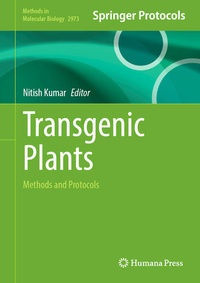
Transgenic Plants
Description

This detailed volume explores methods used in the development of transgenic plants. The book presents techniques for genetically altering plant tissues and cells as well as for obtaining entire transgenic plants from them. The creation of new vectors, the use of chloroplast engineering, and the most recent advances in this field, such as plant genome editing, are also covered. Written for the highly successful Methods in Molecular Biology format, chapters include introductions to their respective topics, lists of the necessary materials and reagents, step-by-step and readily reproducible laboratory protocols, and tips for troubleshooting and avoiding known pitfalls.
Timely and practical, Transgenic Plants: Methods and Protocols serves as an ideal guide for the development of transgenic crop plants and their application for improving agriculture, environment, ecology, and health.
More details
Other editions
Additional editions
Person
Content
Agrobacterium-Mediated Genetic Transformation of Indica Rice.- Agrobacterium-Mediated Genetic Transformation in Banana.- Agrobacterium-Mediated Genetic Transformation and Genome Editing Using CRISPR-Cas9 Constructs in Rice.- Characterization of Transgenic Plants by Southern Blotting in Rice.- Characterization of Transgenic Arabidopsis Plants by Western Blotting.- Agrobacterium-Mediated Genetic Transformation in Solanum torvum L. Using Leaf Explants.- Development of Fungal Resistant Transgenic Plants Using RNAi Approach in Apple.- Agrobacterium-Mediated Genetic Transformation in Wheat.- Development of Hairpin RNAi Tobacco Plants for Management of Insects and Pests.- Characterization of RNAi Tobacco Plants and Detection of siRNA.- Development of Transplastomic Tobacco Plants.- Development of Transgenic Cotton Plants for Insect Resistance.- Characterization of Transgenic Cotton Plants by GUS Histochemical Staining and GUS Fluorometric Assay.- Characterization of Transgenic Cotton Plants by PCR.- Characterization of Transgenic Cotton Plants by Southern Blotting.- Characterization of Transgenic Cotton Plants by Northern Blotting.- Development of Fungal Resistant Transgenic Fennel Plant.- Agrobacterium-Mediated Genetic Transformation in Ashwagandha (Withania somnifera).- Agrobacterium Infection in Cotton for the Development of Transgenic Cotton Plants.- Characterization of Transgenic Cotton Plant to Confirm Gene Integration.- Characterization of Transgenic Rice Plants by Non-Radioactive Southern Hybridization.- Characterization of Transgenic Rice Plants by Radioactive Northern Hybridization.- Isolation and Transfection of Nicotiana benthamiana Mesophyll Protoplasts.- Regeneration of Transgenic Nicotiana benthamiana Raised from the Genome Edited Protoplast.- Agrobacterium-Mediated Genetic Transformation in Crop Plants.- Characterization of Transformed Plants by GUS Assay.
