

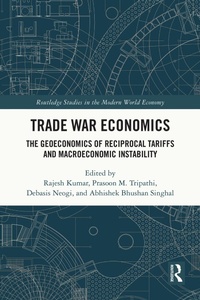
Trade War Economics
The Geoeconomics of Reciprocal Tariffs and Macroeconomic Instability
Will be published approx. on 24. June 2026
228 pages
978-1-040-81932-6 (ISBN)
Description

In an era marked by multipolar power rivalries, pandemic-era protectionism, and institutional fragmentation, global trade is undergoing a strategic shift. This book investigates the resurgence of reciprocal tariff wars in the 21st century and assesses their implications for global macroeconomic stability. It is premised on the argument that we have entered a "new geoeconomic paradigm" in which nations increasingly use tariffs and other economic tools as instruments of power, leading to heightened volatility in trade relations and economic performance.
By uniting perspectives from international economics and political economy, the book examines why these retaliatory trade conflicts have resurfaced, how they are unfolding across different regions, and what consequences they hold for the stability of the global economic order. It begins by grounding the reader in foundational theories of trade retaliation and geoeconomics. It then delves into institutional stress points, regional realignments, and systemic shifts-covering both developed and developing economies, including Asia, the West, Africa, and the Global South. Sectoral case studies on high-tech industries, digital trade conflicts, capital flows, and currency tensions illustrate how tariffs ripple through financial systems, reshape supply chains, and spark inflationary shocks. It concludes by offering forward-looking policy scenarios and institutional innovations, including bilateralism, minilateralism, and emerging digital governance frameworks. Further, it focuses on investor sentiment, financial market behaviour, and digital sovereignty conflicts, deepening the analysis beyond traditional trade balances.
By framing tariff wars within a broader geoeconomic paradigm, the book contributes a critical and future-oriented lens to one of the most urgent challenges facing global economic stability today. It will appeal to scholars of international trade, macroeconomic governance, and global politics, as well as policymakers navigating a fractured trade order.
By uniting perspectives from international economics and political economy, the book examines why these retaliatory trade conflicts have resurfaced, how they are unfolding across different regions, and what consequences they hold for the stability of the global economic order. It begins by grounding the reader in foundational theories of trade retaliation and geoeconomics. It then delves into institutional stress points, regional realignments, and systemic shifts-covering both developed and developing economies, including Asia, the West, Africa, and the Global South. Sectoral case studies on high-tech industries, digital trade conflicts, capital flows, and currency tensions illustrate how tariffs ripple through financial systems, reshape supply chains, and spark inflationary shocks. It concludes by offering forward-looking policy scenarios and institutional innovations, including bilateralism, minilateralism, and emerging digital governance frameworks. Further, it focuses on investor sentiment, financial market behaviour, and digital sovereignty conflicts, deepening the analysis beyond traditional trade balances.
By framing tariff wars within a broader geoeconomic paradigm, the book contributes a critical and future-oriented lens to one of the most urgent challenges facing global economic stability today. It will appeal to scholars of international trade, macroeconomic governance, and global politics, as well as policymakers navigating a fractured trade order.
More details
Series
Language
English
Place of publication
London
United Kingdom
Publishing group
Taylor & Francis Ltd
Target group
College/higher education
Professional and scholarly
Illustrations
21 Tables, black and white; 3 Line drawings, black and white; 3 Illustrations, black and white
File size
8,79 MB
ISBN-13
978-1-040-81932-6 (9781040819326)
Copyright in bibliographic data and cover images is held by Nielsen Book Services Limited or by the publishers or by their respective licensors: all rights reserved.
Schweitzer Classification
Other editions
Additional editions
Rajesh Kumar | Prasoon M. Tripathi | Debasis Neogi
Trade War Economics
The Geoeconomics of Reciprocal Tariffs and Macroeconomic Instability
Book
approx. 06/2026
1st Edition
Routledge
€191.50
Not yet published
Persons
Rajesh Kumar is an Assistant Professor in the School of Business, Galgotias University, India, and a Research Scholar at the National Institute of Technology, Agartala, India
Prasoon M. Tripathi is the Director of the Business School, Institute of Management Studies Ghaziabad, Uttar Pradesh, India.
Debasis Neogi is Professor and Dean of the Department of Management, Humanities and Social Sciences, National Institute of Technology, Agartala, India.
Abhishek Bhushan Singhal is Professor, at Institute of Management Studies Ghaziabad, Uttar Pradesh, India.
Prasoon M. Tripathi is the Director of the Business School, Institute of Management Studies Ghaziabad, Uttar Pradesh, India.
Debasis Neogi is Professor and Dean of the Department of Management, Humanities and Social Sciences, National Institute of Technology, Agartala, India.
Abhishek Bhushan Singhal is Professor, at Institute of Management Studies Ghaziabad, Uttar Pradesh, India.
Content
PART I: Theoretical and Historical Foundations General Introduction - Understanding Tariff Retaliation in a Multipolar World Chapter 1: The Age of Economic Retaliation Chapter 2: Trade War Economics - Theoretical Foundations and Evolution Chapter 3: Rise of Geo-economics- Power, Strategy and Trade as a Weapon PART II: Systemic Shocks and Institutional Erosion Chapter 4: Global Trade Governance under Stress - WTO, FTAs, and the Decline of Rule-Based Order Chapter 5: Asia's Strategic Calculus - China, India, ASEAN, and the Indo-Pacific Response Chapter 6: BRICS and the Global South - From Critique to Counter Coalitions Chapter 7: Africa and MENA in the Age of Trade Fragmentation Chapter 8: Towards Equality or Persistent Gaps? Investigating Income, Human Development, and Tariff Liberalization in the European Union and Its Newest Members Chapter 9: Technology Under Fire - Chips, Intellectual Property(IP), and Strategic Industries Chapter 10: Digital Trade Conflicts - Data Sovereignty, Platform Power, and the New Tech Tariffs Chapter 11: Digital Trade Conflicts - Data Sovereignty, Platform Power, and the New Tech Tariffs Chapter 12: Policy Responses and Institutional Innovation - From Bilateralism to Mini-laterals Conclusion
