

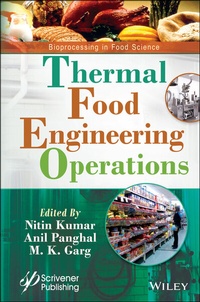
Thermal Food Engineering Operations
Description

Presenting cutting-edge information on new and emerging food engineering processes, Thermal Food Engineering Operations, the first volume in the new series, 'Bioprocessing in Food Science,' is an essential reference on the modeling, quality, safety, and technologies associated with food processing operations today.
As the demand for healthy food increases in the current global scenario, manufacturers are searching for new possibilities for occupying a greater share in the rapidly changing food market. Compiled reports and updated knowledge on thermal processing of food products are imperative for commercial enterprises and manufacturing units. In the current scenario, academia, researchers, and food industries are working in a scattered manner and different technologies developed at each level are not compiled to implement for the benefits of different stakeholders. However, advancements in bioprocesses are required at all levels for the betterment of food industries and consumers. This series of groundbreaking edited volumes will be a comprehensive compilation of all the research that has been carried out so far, their practical applications, and the future scope of research and development in the food bioprocessing industry.
This first volume includes all the conventional and novel thermal technologies based on conduction, convection, and radiation principles and covers the basics of microbial inactivation with heat treatments, aseptic processing, retorting, drying, dehydration, combined high-pressure thermal treatments, and safety and quality concerns in food processing. Before studying the novel non-thermal processes and the concept of minimal processing, comprehensive knowledge about the conventional thermal technologies is desired along with benefits, constraints, equipment, and implementation of these technologies. Whether for the engineer, scientist, or student, this series is a must-have for any library.
This outstanding new volume:
- Discusses food safety and quality and thermal processing, laying the groundwork for further study and research
- Provides case studies of solid-liquid and supercritical fluid extraction
- Explores pasteurization, ohmic heating, irradiation, and more
- Presents cutting-edge information on new and emerging food engineering processes
Audience: Process and chemical engineers, chemists, engineers in other disciplines, managers, researchers, scientists, students, and teachers working in the field of food engineering and processing
Nitin Kumar, PhD, is an assistant professor in the Department of Processing and Food Engineering at CCS Haryana Agricultural University. He obtained his doctorate in the discipline of processing and food engineering from Punjab Agricultural University, India, focusing on the preparation and characterization of novel bio-nano composite materials for food packaging. His area of expertise includes food packaging, biopolymers, shelf-life extension, and transformation and valorization of horticultural co-products. He is actively working on several research projects with the USA, UK, and Germany.
Anil Panghal, PhD, is an assistant scientist in the Department of Processing and Food Engineering at CCS Haryana Agricultural University. Previously, he worked with Nestle as a production manager for nine years. His areas of expertise include bioprocessing, manufacturing, food chemistry, food science, and technology, FSMS, and nutrition. He obtained his PhD in food technology, focusing on the molecular and physicochemical quality aspects of commercial wheat varieties. He has published various research papers in reputed journals and chapters for international publishers.
M.K. Garg, PhD, is very well-known and respected in the field of food process engineering. After completing his PhD in agricultural structures and process engineering from the Indian Agricultural Research Institute, New Delhi, he started his career at Haryana Agricultural University, Hisar as an assistant professor in 1985. He is the former Dean of the College of Agricultural Engineering and Technology, Hisar. He has been involved in the design, development, and field evaluation of various post-harvest machinery and processing equipment. He is a member of the Bureau of Indian Standards and has been a referee for several reputed research journals.
More details
Other editions
Additional editions
Content
- Intro
- Cover
- Half-Title Page
- Series Page
- Title Page
- Copyright Page
- Contents
- Preface
- 1. Novel Thermal Technologies: Trends and Prospects
- 1.1 Introduction
- 1.2 Novel Thermal Technologies: Current Status and Trends
- 1.2.1 Environmental Impact of Novel Thermal Technologies
- 1.2.2 The Objective of Thermal Processing
- 1.2.3 Preservation Process
- 1.3 Types of Thermal Technologies
- 1.3.1 Infrared Heating
- 1.3.1.1 Principal and Mechanism
- 1.3.1.2 Advantages of IR Heating
- 1.3.1.3 Applications of IR Heating
- 1.3.2 Microwave Heating
- 1.3.2.1 Principal and Mechanism
- 1.3.2.2 Advantages of Microwave in Food Industry
- 1.3.2.3 Application of Microwave in Food Processing Technologies
- 1.3.3 Radiofrequency (RF) Heating
- 1.3.3.1 Principal and Mechanism
- 1.3.3.2 Advantages and Disadvantages
- 1.3.3.3 Applications
- 1.3.4 Ohmic Heating
- 1.3.4.1 Principal and Mechanism
- 1.3.4.2 Advantages and Disadvantages
- 1.3.4.3 Applications
- 1.4 Future Perspective of Novel Thermal Technologies
- 1.5 Conclusion
- References
- 2. Microbial Inactivation with Heat Treatments
- 2.1 Introduction
- 2.2 Innovate Thermal Techniques for Food Reservation
- 2.3 Inactivation Mechanism of Targeted Microorganism
- 2.3.1 Action Approach and Inactivation Targets
- 2.4 Environmental Stress Adaption
- 2.4.1 Sublethal Injury
- 2.5 Resistance of Stress
- 2.5.1 Oxidative Stress
- 2.5.2 Osmotic Stress
- 2.5.3 Pressure
- 2.6 Various Techniques for Thermal Inactivation
- 2.6.1 Infrared Heating
- 2.6.1.1 Principle and Mechanism
- 2.6.1.2 Application for Inactivation in Food Sector
- 2.6.2 Microwave Heating
- 2.6.2.1 Principle and Mechanism
- 2.6.2.2 Application for Inactivation in Food Sector
- 2.6.3 Radiofrequency Heating
- 2.6.3.1 Principle and Mechanism
- 2.6.3.2 Application for Inactivation in Food Sector
- 2.6.4 Instant Controlled Pressure Drop Technology (DIC)
- 2.6.4.1 Principle and Mechanism
- 2.6.4.2 Application for Inactivation in Food Sector
- 2.6.5 Ohmic Heating
- 2.6.5.1 Principle and Mechanism
- 2.6.5.2 Application for Inactivation in Food Sector
- 2.7 Forthcoming Movements of Thermal Practices in Food Industry
- 2.8 Conclusion
- References
- 3. Blanching, Pasteurization and Sterilization: Principles and Applications
- 3.1 Introduction
- 3.2 Blanching: Principles & Mechanism
- 3.2.1 Types of Blanching
- 3.2.1.1 Hot Water Blanching
- 3.2.1.2 Steam Blanching
- 3.2.1.3 High Humidity Hot Air Impingement Blanching (HHAIB)
- 3.2.1.4 Microwave Blanching
- 3.2.1.5 Ohmic Blanching
- 3.2.1.6 Infrared Blanching
- 3.2.2 Application of Blanching
- 3.2.2.1 Inactivation of Enzymes
- 3.2.2.2 Enhancement of Product Quality and Dehydration
- 3.2.2.3 Toxic and Pesticides Residues Removal
- 3.2.2.4 Decreasing Microbial Load
- 3.2.2.5 Reducing Non-Enzymatic Browning Reaction
- 3.2.2.6 Peeling
- 3.2.2.7 Entrapped Air Removal
- 3.2.2.8 Enhancing Bioactive Extraction Efficiency
- 3.2.2.9 Other Applications
- 3.3 Pasteurization: Principles & Mechanism
- 3.3.1 Thermal Pasteurization
- 3.3.2 Traditional Thermal Pasteurization
- 3.3.3 Microwave and Radiofrequency Pasteurization
- 3.3.4 Ohmic Heating Pasteurization
- 3.3.5 Application of Pasteurization
- 3.4 Sterilization: Principles, Mechanism and Types of Sterilization
- 3.4.1 Conventional Sterilization Methods
- 3.4.2 Advanced Retorting
- 3.4.3 Microwave-Assisted Thermal Sterilization
- 3.4.4 Pressure-Assisted Thermal Sterilization
- 3.5 Conclusions
- References
- 4. Aseptic Processing
- 4.1 Introduction
- 4.2 Aseptic Processing
- 4.3 Principle of Thermal Sterilization
- 4.3.1 Effect of Thermal Treatment on Enzymes
- 4.3.2 Effect of Thermal Treatments on Nutrients and Quality
- 4.3.3 Effect of Thermal Treatments on the Cooking Index (C0)
- 4.3.4 Effect of Heat Treatments on Chemical Reactions in Food
- 4.4 Components of Aseptic Processing
- 4.4.1 Equipment Used in Aseptic/UHT Processing
- 4.4.1.1 Indirect Heat Exchanger
- 4.4.1.2 Direct Heat Exchanger
- 4.4.1.3 Ohmic Heating (OH)
- 4.5 Aseptic Packaging
- 4.5.1 Types of Packaging Materials Used in Aseptic Processing
- 4.5.2 Methods and Requirements of Decontamination of Packaging Materials
- 4.6 Applications of Aseptic Processing and Packaging
- 4.6.1 Milk Processing
- 4.6.2 Non-Milk Products Processing
- 4.7 Advantages of Aseptic Processing and Packaging
- 4.8 Challenges of Aseptic Processing and Packaging
- 4.9 Conclusion
- References
- 5. Spray Drying: Principles and Applications
- 5.1 Introduction
- 5.2 Concentration of Feed Solution
- 5.3 Atomization of Concentrated Feed
- 5.3.1 Principle of Atomization
- 5.3.2 Classification of Atomizers
- 5.3.2.1 Rotary Atomizers
- 5.3.2.2 Pressure Nozzle/Hydraulic Atomizer
- 5.3.2.3 Two-Fluid Nozzle Atomizer
- 5.4 Droplet-Hot Air Contact
- 5.5 Drying of Droplets
- 5.6 Particle Separation
- 5.7 Effect of Process Parameters on Product Quality
- 5.7.1 Process Parameters of Atomization
- 5.7.2 Parameters of Spray-Air Contact and Evaporation
- 5.7.2.1 Spray Angle
- 5.7.2.2 Aspirator Flow Rate
- 5.7.2.3 Inlet Air Temperature
- 5.7.2.4 Outlet Air Temperature
- 5.7.2.5 Glass Transition Temperature
- 5.7.2.6 Residence Time
- 5.8 Classification of Spray Dryer
- 5.8.1 Open-Cycle Spray Dryer
- 5.8.2 Closed-Cycle Spray Dryer
- 5.8.3 Semi-Closed Cycle Spray Dryer
- 5.8.4 Single-Stage Spray Dryer
- 5.8.5 Two-Stage Spray Dryer
- 5.8.6 Short-Form Spray Dryer
- 5.8.7 Tall-Form Spray Dryer
- 5.9 Morphological Characterization of Spray-Dried Particles
- 5.10 Application of Spray Drying for Foods
- 5.11 Wall Materials
- 5.11.1 Carbohydrate-Based Wall Materials
- 5.11.1.1 Starch
- 5.11.1.2 Modified Starch
- 5.11.1.3 Maltodextrins
- 5.11.2 Cyclodextrins
- 5.11.3 Gum Arabic
- 5.11.4 Inulin
- 5.11.5 Pectin
- 5.11.6 Chitin and Chitosan
- 5.11.7 Protein-Based Wall Materials
- 5.11.7.1 Whey Protein Isolate
- 5.11.7.2 Skim Milk Powder
- 5.11.7.3 Soy Protein Isolate (SPI)
- 5.12 Encapsulation of Probiotics
- 5.12.1 Choice of Bacterial Strain
- 5.12.2 Response to Cellular Stresses
- 5.12.3 Growth Conditions
- 5.12.4 Effect of pH
- 5.12.5 Harvesting Technique
- 5.12.6 Total Solid Content of the Feed Concentrate
- 5.13 Encapsulation of Vitamins
- 5.14 Encapsulation of Flavours and Volatile Compounds
- 5.14.1 Selective Diffusion Theory
- 5.15 Conclusion and Perspectives
- References
- 6. Solar Drying: Principles and Applications
- 6.1 Introduction
- 6.2 Principle of Solar Drying
- 6.3 Construction of Solar Dryer
- 6.4 Historical Classification of Solar Energy Drying Systems
- 6.5 Storing Solar Energy for Drying
- 6.6 Hybrid/Mixed Solar Drying System
- 6.7 Solar Greenhouse Dryer
- 6.8 Solar Drying Economy
- 6.9 New Applications Related to Solar Drying
- References
- 7. Fluidized Bed Drying: Recent Developments and Applications
- 7.1 Introduction
- 7.2 Principle and Design Considerations of Fluidized Bed Dryer
- 7.2.1 Spouted Bed Dryer
- 7.2.2 Spout Fluidized Bed Dryer
- 7.2.3 Hybrid Drying Techniques
- 7.2.3.1 Microwave-Assisted FBD
- 7.2.3.2 FIR-Assisted FBD
- 7.2.3.3 Heat Pump-Assisted FBD
- 7.2.3.4 Solar-Assisted FBD
- 7.3 Design Alterations for Improved Fluidization Capacity
- 7.3.1 Vibrated Fluidized Bed
- 7.3.2 Agitated Fluidized Bed
- 7.3.3 Centrifugal Fluidized Bed
- 7.4 Energy Consumption in Fluidized Bed Drying
- 7.5 Effect of Fluidized Bed Drying on the Quality
- 7.6 Applications of Fluidized Bed Drying
- 7.7 Concluding Remarks
- References
- 8. Dehumidifier Assisted Drying: Recent Developments
- 8.1 Introduction
- 8.2 Absorbent Air Dryer
- 8.2.1 Working Principle of Adsorption Air Dryer
- 8.2.2 Design Considerations and Components of the Absorbent Air Drier
- 8.2.2.1 Desiccant Drying System
- 8.2.3 Performance Indicators of Desiccant Air Dryer System
- 8.2.3.1 Low Temperature Drying With No Temperature Control and Air Circulation System
- 8.2.3.2 Low Temperature Drying With Air Circulation and Temperature Control
- 8.3 Heat Pump-Assisted Dehumidifier Dryer
- 8.3.1 Working Principles of a Heat Pump-Assisted Dehumidifier Dryer
- 8.3.2 Performance Indicators of Heat Pump-Assisted Dehumidifier Dryer
- 8.4 Applications of Dehumidifier-Assisted Dryers in Agriculture and Food Processing
- 8.5 Concluding Remarks
- References
- 9. Refractance Window Drying: Principles and Applications
- 9.1 Introduction
- 9.2 Refractance Window Drying System
- 9.2.1 History and Origin
- 9.2.2 Components and Working of the Dryer
- 9.2.3 Principle of Operation
- 9.3 Heat Transfer and Drying Kinetics
- 9.3.1 Drying Rate and Moisture Reduction Rate
- 9.4 Effect of Process Parameters on Drying
- 9.4.1 Effect of Temperature of the Hot Circulating Water
- 9.4.2 Effect of Product Inlet Temperature and Thickness
- 9.4.3 Effect of Residence Time
- 9.4.4 Effect of Ambient Air Temperature (Air Convection)
- 9.5 Comparison of Refractance Window Dryer with Other Types of Dryers
- 9.6 Effect of Refractance Window Drying on Quality of Food Products
- 9.6.1 Effects on Food Color
- 9.6.2 Effects on Bioactive Compounds
- 9.6.2.1 Carotene Retention
- 9.6.2.2 Ascorbic Acid Retention
- 9.6.2.3 Anthocyanin Retention
- 9.7 Applications of Refractance Window Drying in Food and Agriculture
- 9.7.1 Applications of Refractance Window Drying in Preservation of Heat-Sensitive and Bioactive Compounds
- 9.7.2 Applications of Refractance Window Drying on Food Safety
- 9.8 Advantages and Limitations of Refractance Window Dryer
- 9.9 Recent Developments in Refractance Window Drying
- 9.10 Conclusion and Future Prospects
- References
- 10. Ohmic Heating: Principles and Applications
- 10.1 Introduction
- 10.2 Basic Principles
- 10.3 Process Parameters
- 10.3.1 Electrical Conductivity
- 10.3.2 Electrical Field Strength
- 10.3.3 Frequency and Waveform
- 10.3.4 Product Size, Viscosity, and Heat Capacity
- 10.3.5 Particle Concentration
- 10.3.6 Ionic Concentration
- 10.3.7 Electrodes
- 10.4 Equipment Design
- 10.5 Application
- 10.5.1 Blanching
- 10.5.2 Pasteurisation/Sterilization
- 10.5.3 Extraction
- 10.5.4 Dehydration
- 10.5.5 Fermentation
- 10.5.6 Ohmic Thawing
- 10.6 Effect of Ohmic Heating on Quality Characteristics of Food Products
- 10.6.1 Starch and Flours
- 10.6.1.1 Water Absorption Index (WAI) and Water Solubility Index (WSI)
- 10.6.1.2 Pasting Properties
- 10.6.1.3 Thermal Properties
- 10.6.2 Meat Products
- 10.6.3 Fruits and Vegetable Products
- 10.6.3.1 Electrical Properties
- 10.6.3.2 Soluble Solids Content and Acidity
- 10.6.3.3 Vitamins
- 10.6.3.4 Flavor Compounds
- 10.6.3.5 Phenolic Compounds
- 10.6.3.6 Colour Properties
- 10.6.3.7 Change in Chlorophyll Content
- 10.6.3.8 Textural Properties
- 10.6.3.9 Sensory Properties
- 10.6.4 Dairy Products
- 10.6.5 Seafoods
- 10.7 Advantages of Ohmic Heating
- 10.8 Disadvantages of Ohmic Heating
- 10.9 Conclusions
- References
- 11. Microwave Food Processing: Principles and Applications
- 11.1 Introduction
- 11.2 Principles of Microwave Heating
- 11.2.1 Nature of Microwaves
- 11.2.1.1 Propagation of EM Waves in Free Space
- 11.2.1.2 Propagation of EM Waves in Matter
- 11.2.2 Mechanism of Microwave Heating
- 11.2.2.1 Dielectric Characteristic of a Material
- 11.2.2.2 Waves-Product Interactions
- 11.2.3 Transmission and Absorption of a Wave in a Material
- 11.2.3.1 Expression of Transmitted Power
- 11.2.3.2 Penetration Depths
- 11.2.3.3 Power Dissipation
- 11.3 Applications
- 11.3.1 Microwave Baking
- 11.3.2 Microwave Blanching
- 11.3.3 Microwave Tempering and Thawing
- 11.3.4 Microwave Drying
- 11.3.4.1 Microwave-Assisted Hot Air Drying
- 11.3.4.2 Microwave-Assisted Vacuum Drying
- 11.3.4.3 Microwave-Assisted Freeze-Drying
- 11.3.5 Microwave Pasteurization and Sterilization
- References
- 12. Infrared Radiation: Principles and Applications in Food Processing
- 12.1 Introduction
- 12.2 Mechanism of Heat Transfer
- 12.2.1 Principles of IR Heating
- 12.2.1.1 Planck's Law
- 12.2.1.2 Wien's Displacement Law
- 12.2.1.3 Stefan-Boltzmann's Law
- 12.2.2 Source of IR Radiations
- 12.2.2.1 Natural Source
- 12.2.2.2 Artificial Sources
- 12.3 Factors Affecting the Absorption of Energy
- 12.3.1 Characteristics of Food Materials
- 12.3.1.1 Composition
- 12.3.1.2 Layer Thickness
- 12.3.2 IR Parameters
- 12.3.2.1 Wavelength of IR Rays
- 12.3.2.2 IR Intensity
- 12.3.2.3 Depth of Penetration
- 12.3.3 Advantages of IR Heating Over Conventional Heating Methods
- 12.4 Applications of IR in Food Processing
- 12.4.1 Drying
- 12.4.2 Peeling
- 12.4.3 Blanching
- 12.4.4 Microbial Decontamination
- 12.5 IR-Assisted Hybrid Drying Technologies
- 12.5.1 IR-Freeze-Drying
- 12.5.2 Hot Air-Assisted IR Heating
- 12.5.3 Low-Pressure Superheated Steam Drying with IR
- 12.6 Conclusion
- References
- 13. Radiofrequency Heating
- 13.1 Introduction
- 13.2 History of RF Heating
- 13.3 Principles and Equipment
- 13.3.1 Basic Mechanism of Dielectric Heating
- 13.3.1.1 Basic Mechanism and Working of Radiofrequency Heating
- 13.3.1.2 Basic Mechanism and Working of Microwave Heating
- 13.3.2 Factors of Food Affecting the Performance of RF Processing
- 13.3.2.1 Permittivity and Loss Factor
- 13.3.2.2 Power Density and Penetration Depth
- 13.3.2.3 Wave Impedance and Power Reflection
- 13.3.3 Comparison of RF Heating With Other Methods
- 13.3.4 Lab Scale and Commercial Scale of RF Equipment
- 13.3.4.1 Radiofrequency Processing of Food at Lab Scale
- 13.3.4.2 Radiofrequency Processing of Food at Industrial Scale
- 13.4 Applications in Food Processing
- 13.4.1 Drying
- 13.4.2 Thawing
- 13.4.3 Roasting
- 13.4.4 Baking
- 13.4.5 Disinfestation
- 13.4.6 Blanching
- 13.4.7 Pasteurization/Sterilization
- 13.5 Technological Constraints, Health Hazards, and Safety Aspects
- 13.6 Commercialization Aspects and Future Trends
- 13.7 Conclusions
- References
- 14. Quality, Food Safety and Role of Technology in Food Industry
- 14.1 Introduction
- 14.1.1 Food Quality
- 14.1.1.1 Primary and Secondary Food Processing
- 14.1.1.2 Historical Trends in Food Quality
- 14.1.1.3 Food Quality Standards and its Requirements
- 14.1.1.4 Role of Technology in Building Food Quality Within the Industry
- 14.1.1.5 Regulations and Their Requirements
- 14.1.2 Food Safety
- 14.1.2.1 Primary and Secondary Food Production
- 14.1.2.2 Historical Trends in Food Safety
- 14.1.2.3 Food Safety Standards and its Requirements
- 14.1.2.4 Role of Technology in Building Food Safety Within Industry
- 14.2 Future Trends in Quality and Food Safety
- 14.3 Conclusion
- References
- Index
- Also of Interest
- Other Books in the series, "Bioprocessing in Food Science"
- Other related titles from Scrivener Publishing
- EULA
