

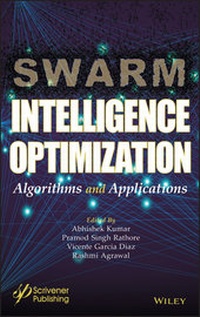
Swarm Intelligence Optimization
Description

Resource optimization has always been a thrust area of research, and as the Internet of Things (IoT) is the most talked about topic of the current era of technology, it has become the need of the hour. Therefore, the idea behind this book was to simplify the journey of those who aspire to understand resource optimization in the IoT. To this end, included in this book are various real-time/offline applications and algorithms/case studies in the fields of engineering, computer science, information security, and cloud computing, along with the modern tools and various technologies used in systems, leaving the reader with a high level of understanding of various techniques and algorithms used in resource optimization.
More details
Other editions
Additional editions
Persons
Abhishek Kumar gained his PhD in computer science from the University of Madras, India in 2019. He is assistant professor at Chitkara University and has more than 80 publications in peer-reviewed international and national journals, books & conferences His research interests include artificial intelligence, image processing, computer vision, data mining and machine learning.
Pramod Singh Rathore has a MTech in Computer Science & Engineering from the Government Engineering College Ajmer, Rajasthan Technical University, Kota India, where he is now an assistant professor. He has more than 60 papers, chapters, and a book to his credit and his research interests are in networking cloud and IoT.
Vicente García Díaz obtained his PhD in Computer Science in 2011 at the University of Oviedo, Spain where he is now an associate professor in the School of Computer Science. He has published more than 100 publications and his research interests include domain-specific languages, e-learning, decision support systems.
Rashmi Agrawal obtained her PhD in Computer Applications in 2016 from Manav Rachna International University Faridabad, India, where she is now a professor in the Department of Computer Applications. Her research area includes data mining and artificial intelligence and she has published more than 65 publications to her credit.
Content
Preface xv
1 A Fundamental Overview of Different Algorithms and Performance Optimization for Swarm Intelligence 1
Manju Payal, Abhishek Kumar and Vicente García Díaz
1.1 Introduction 1
1.2 Methodology of SI Framework 3
1.3 Composing With SI 7
1.4 Algorithms of the SI 7
1.5 Conclusion 18
References 18
2 Introduction to IoT With Swarm Intelligence 21
Anant Mishra and Jafar Tahir
2.1 Introduction 21
2.1.1 Literature Overview 22
2.2 Programming 22
2.2.1 Basic Programming 22
2.2.2 Prototyping 22
2.3 Data Generation 23
2.3.1 From Where the Data Comes? 23
2.3.2 Challenges of Excess Data 24
2.3.3 Where We Store Generated Data? 24
2.3.4 Cloud Computing and Fog Computing 25
2.4 Automation 26
2.4.1 What is Automation? 26
2.4.2 How Automation is Being Used? 26
2.5 Security of the Generated Data 30
2.5.1 Why We Need Security in Our Data? 30
2.5.2 What Types of Data is Being Generated? 31
2.5.3 Protecting Different Sector Working on the Principle of IoT 32
2.6 Swarm Intelligence 33
2.6.1 What is Swarm Intelligence? 33
2.6.2 Classification of Swarm Intelligence 33
2.6.3 Properties of a Swarm Intelligence System 34
2.7 Scope in Educational and Professional Sector 36
2.8 Conclusion 37
References 38
3 Perspectives and Foundations of Swarm Intelligence and its Application 41
Rashmi Agrawal
3.1 Introduction 41
3.2 Behavioral Phenomena of Living Beings and Inspired Algorithms 42
3.2.1 Bee Foraging 42
3.2.2 ABC Algorithm 43
3.2.3 Mating and Marriage 43
3.2.4 MBO Algorithm 44
3.2.5 Coakroach Behavior 44
3.3 Roach Infestation Optimization 45
3.3.1 Lampyridae Bioluminescence 45
3.3.2 GSO Algorithm 46
3.4 Conclusion 46
References 47
4 Implication of IoT Components and Energy Management Monitoring 49
Shweta Sharma, Praveen Kumar Kotturu and Prafful Chandra Narooka
4.1 Introduction 49
4.2 IoT Components 53
4.3 IoT Energy Management 56
4.4 Implication of Energy Measurement for Monitoring 57
4.5 Execution of Industrial Energy Monitoring 58
4.6 Information Collection 59
4.7 Vitality Profiles Analysis 59
4.8 IoT-Based Smart Energy Management System 61
4.9 Smart Energy Management System 61
4.10 IoT-Based System for Intelligent Energy Management in Buildings 62
4.11 Smart Home for Energy Management Using IoT 62
References 64
5 Distinct Algorithms for Swarm Intelligence in IoT 67
Trapty Agarwal, Gurjot Singh, Subham Pradhan and Vikash Verma
5.1 Introduction 67
5.2 Swarm Bird-Based Algorithms for IoT 68
5.2.1 Particle Swarm Optimization (PSO) 68
5.2.1.1 Statistical Analysis 68
5.2.1.2 Algorithm 68
5.2.1.3 Applications 69
5.2.2 Cuckoo Search Algorithm 69
5.2.2.1 Statistical Analysis 69
5.2.2.2 Algorithm 70
5.2.2.3 Applications 70
5.2.3 Bat Algorithm 71
5.2.3.1 Statistical Analysis 71
5.2.3.2 Algorithm 71
5.2.3.3 Applications 72
5.3 Swarm Insect-Based Algorithm for IoT 72
5.3.1 Ant Colony Optimization 72
5.3.1.1 Flowchart 73
5.3.1.2 Applications 73
5.3.2 Artificial Bee Colony 74
5.3.2.1 Flowchart 75
5.3.2.2 Applications 75
5.3.3 Honey-Bee Mating Optimization 75
5.3.3.1 Flowchart 76
5.3.3.2 Application 77
5.3.4 Firefly Algorithm 77
5.3.4.1 Flowchart 78
5.3.4.2 Application 78
5.3.5 Glowworm Swarm Optimization 78
5.3.5.1 Statistical Analysis 79
5.3.5.2 Flowchart 79
5.3.5.3 Application 80
References 80
6 Swarm Intelligence for Data Management and Mining Technologies to Manage and Analyze Data in IoT 83
Kashinath Chandelkar
6.1 Introduction 83
6.2 Content Management System 84
6.3 Data Management and Mining 85
6.3.1 Data Life Cycle 86
6.3.2 Knowledge Discovery in Database 87
6.3.3 Data Mining vs. Data Warehousing 88
6.3.4 Data Mining Techniques 88
6.3.5 Data Mining Technologies 92
6.3.6 Issues in Data Mining 93
6.4 Introduction to Internet of Things 94
6.5 Swarm Intelligence Techniques 94
6.5.1 Ant Colony Optimization 95
6.5.2 Particle Swarm Optimization 95
6.5.3 Differential Evolution 96
6.5.4 Standard Firefly Algorithm 96
6.5.5 Artificial Bee Colony 97
6.6 Chapter Summary 98
References 98
7 Healthcare Data Analytics Using Swarm Intelligence 101
Palvadi Srinivas Kumar, Pooja Dixit and N. Gayathri
7.1 Introduction 101
7.1.1 Definition 103
7.2 Intelligent Agent 103
7.3 Background and Usage of AI Over Healthcare Domain 104
7.4 Application of AI Techniques in Healthcare 105
7.5 Benefits of Artificial Intelligence 106
7.6 Swarm Intelligence Model 107
7.7 Swarm Intelligence Capabilities 108
7.8 How the Swarm AI Technology Works 109
7.9 Swarm Algorithm 110
7.10 Ant Colony Optimization Algorithm 110
7.11 Particle Swarm Optimization 112
7.12 Concepts for Swarm Intelligence Algorithms 113
7.13 How Swarm AI is Useful in Healthcare 114
7.14 Benefits of Swarm AI 115
7.15 Impact of Swarm-Based Medicine 116
7.16 SI Limitations 117
7.17 Future of Swarm AI 118
7.18 Issues and Challenges 119
7.19 Conclusion 120
References 120
8 Swarm Intelligence for Group Objects in Wireless Sensor Networks 123
Kapil Chauhan and Pramod Singh Rathore
8.1 Introduction 123
8.2 Algorithm 127
8.3 Mechanism and Rationale of the Work 130
8.3.1 Related Work 131
8.4 Network Energy Model 132
8.4.1 Network Model 132
8.5 PSO Grouping Issue 132
8.6 Proposed Method 133
8.6.1 Grouping Phase 133
8.6.2 Proposed Validation Record 133
8.6.3 Data Transmission Stage 133
8.7 Bunch Hub Refreshing Calculation Dependent on an Improved PSO 133
8.8 Other SI Models 134
8.9 An Automatic Clustering Algorithm Based on PSO 135
8.10 Steering Rule Based on Informed Algorithm 136
8.11 Routing Protocols Based on Meta-Heuristic Algorithm 137
8.12 Routing Protocols for Avoiding Energy Holes 138
8.13 System Model 138
8.13.1 Network Model 138
8.13.2 Power Model 139
References 139
9 Swam Intelligence-Based Resources Optimization and Analyses and Managing Data in IoT With Data Mining Technologies 143
Pooja Dixit, Palvadi Srinivas Kumar and N. Gayathri
9.1 Introduction 143
9.1.1 Swarm Intelligence 143
9.1.1.1 Swarm Biological Collective Behavior 145
9.1.1.2 Swarm With Artificial Intelligence Model 147
9.1.1.3 Birds in Nature 150
9.1.1.4 Swarm with IoT 153
9.2 IoT With Data Mining 153
9.2.1 Data from IoT 154
9.2.1.1 Data Mining for IoT 154
9.2.2 Data Mining With KDD 157
9.2.3 PSO With Data Mining 159
9.3 ACO and Data Mining 161
9.4 Challenges for ACO-Based Data Mining 162
References 162
10 Data Management and Mining Technologies to Manage and Analyze Data in IoT 165
Shweta Sharma, Satya Murthy Sasubilli and Kunal Bhargava
10.1 Introduction 165
10.2 Data Management 166
10.3 Data Lifecycle of IoT 167
10.4 Procedures to Implement IoT Data Management 171
10.5 Industrial Data Lifecycle 173
10.6 Industrial Data Management Framework of IoT 174
10.6.1 Physical Layer 174
10.6.2 Correspondence Layer 175
10.6.3 Middleware Layer 175
10.7 Data Mining 175
10.7.1 Functionalities of Data Mining 179
10.7.2 Classification 180
10.8 Clustering 182
10.9 Affiliation Analysis 182
10.10 Time Series Analysis 183
References 185
11 Swarm Intelligence for Data Management and Mining Technologies to Manage and Analyze Data in IoT 189
Kapil Chauhan and Vishal Dutt
11.1 Introduction 190
11.2 Information Mining Functionalities 192
11.2.1 Classification 192
11.2.2 Clustering 192
11.3 Data Mining Using Ant Colony Optimization 193
11.3.1 Enormous Information Investigation 194
11.3.2 Data Grouping 195
11.4 Computing With Ant-Based 196
11.4.1 Biological Background 196
11.5 Related Work 197
11.6 Contributions 198
11.7 SI in Enormous Information Examination 198
11.7.1 Handling Enormous Measure of Information 199
11.7.2 Handling Multidimensional Information 199
11.8 Requirements and Characteristics of IoT Data 200
11.8.1 IoT Quick and Gushing Information 200
11.8.2 IoT Big Information 200
11.9 Conclusion 201
References 202
12 Swarm Intelligence-Based Energy-Efficient Clustering Algorithms for WSN: Overview of Algorithms, Analysis, and Applications 207
Devika G., Ramesh D. and Asha Gowda Karegowda
12.1 Introduction 208
12.1.1 Scope of Work 209
12.1.2 Related Works 209
12.1.3 Challenges in WSNs 210
12.1.4 Major Highlights of the Chapter 213
12.2 SI-Based Clustering Techniques 213
12.2.1 Growth of SI Algorithms and Characteristics 214
12.2.2 Typical SI-Based Clustering Algorithms 219
12.2.3 Comparison of SI Algorithms and Applications 219
12.3 WSN SI Clustering Applications 219
12.3.1 WSN Services 233
12.3.2 Clustering Objectives for WSN Applications 233
12.3.3 SI Algorithms for WSN: Overview 234
12.3.4 The Commonly Applied SI-Based WSN Clusterings 235
12.3.4.1 ACO-Based WSN Clustering 235
12.3.4.2 PSO-Based WSN Clustering 237
12.3.4.3 ABC-Based WSN Clustering 240
12.3.4.4 CS Cuckoo-Based WSN Clustering 241
12.3.4.5 Other SI Technique-Based WSN Clustering 242
12.4 Challenges and Future Direction 246
12.5 Conclusions 247
References 253
13 Swarm Intelligence for Clustering in Wireless Sensor Networks 263
Preeti Sethi
13.1 Introduction 263
13.2 Clustering in Wireless Sensor Networks 264
13.3 Use of Swarm Intelligence for Clustering in WSN 266
13.3.1 Mobile Agents: Properties and Behavior 266
13.3.2 Benefits of Using Mobile Agents 267
13.3.3 Swarm Intelligence-Based Clustering Approach 268
13.4 Conclusion 272
References 272
14 Swarm Intelligence for Clustering in Wi-Fi Networks 275
Astha Parihar and Ramkishore Kuchana
14.1 Introduction 275
14.1.1 Wi-Fi Networks 275
14.1.2 Wi-Fi Networks Clustering 277
14.2 Power Conscious Fuzzy Clustering Algorithm (PCFCA) 278
14.2.1 Adequate Cluster Head Selection in PCFCA 278
14.2.2 Creation of Clusters 279
14.2.3 Execution Assessment of PCFCA 282
14.3 Vitality Collecting in Remote Sensor Systems 282
14.3.1 Power Utilization 283
14.3.2 Production of Energy 283
14.3.3 Power Cost 284
14.3.4 Performance Representation of EEHC 284
14.4 Adequate Power Circular Clustering Algorithm (APRC) 284
14.4.1 Case-Based Clustering in Wi-Fi Networks 284
14.4.2 Circular Clustering Outlook 284
14.4.3 Performance Representation of APRC 285
14.5 Modifying Scattered Clustering Algorithm (MSCA) 286
14.5.1 Equivalence Estimation in Data Sensing 286
14.5.2 Steps in Modifying Scattered Clustering Algorithm (MSCA) 286
14.5.3 Performance Evaluation of MSCA 287
14.6 Conclusion 288
References 288
15 Support Vector in Healthcare Using SVM/PSO in Various Domains: A Review 291
Vishal Dutt, Pramod Singh Rathore and Kapil Chauhan
15.1 Introduction 291
15.2 The Fundamental PSO 292
15.2.1 Algorithm for PSO 293
15.3 The Support Vector 293
15.3.1 SVM in Regression 299
15.3.2 SVM in Clustering 300
15.3.3 Partition Clustering 301
15.3.4 Hierarchical Clustering 301
15.3.5 Density-Based Clustering 302
15.3.6 PSO in Clustering 303
15.4 Conclusion 304
References 304
16 IoT-Based Healthcare System to Monitor the Sensor's Data of MWBAN 309
Rani Kumari and ParmaNand
16.1 Introduction 310
16.1.1 Combination of AI and IoT in Real Activities 310
16.2 Related Work 311
16.3 Proposed System 312
16.3.1 AI and IoT in Medical Field 312
16.3.2 IoT Features in Healthcare 313
16.3.2.1 Wearable Sensing Devices With Physical Interface for Real World 313
16.3.2.2 Input Through Organized Information to the Sensors 313
16.3.2.3 Small Sensor Devices for Input and Output 314
16.3.2.4 Interaction With Human Associated Devices 314
16.3.2.5 To Control Physical Activity and Decision 314
16.3.3 Approach for Sensor's Status of Patient 315
16.4 System Model 315
16.4.1 Solution Based on Heuristic Iterative Method 317
16.5 Challenges of Cyber Security in Healthcare With IoT 320
16.6 Conclusion 321
References 321
17 Effectiveness of Swarm Intelligence for Handling Fault-Tolerant Routing Problem in IoT 325
Arpit Kumar Sharma, Kishan Kanhaiya and Jaisika Talwar
17.1 Introduction 325
17.1.1 Meaning of Swarm and Swarm Intelligence 326
17.1.2 Stability 327
17.1.3 Technologies of Swarm 328
17.2 Applications of Swarm Intelligence 328
17.2.1 Flight of Birds Elaborations 329
17.2.2 Honey Bees Elaborations 329
17.3 Swarm Intelligence in IoT 330
17.3.1 Applications 331
17.3.2 Human Beings vs. Swarm 332
17.3.3 Use of Swarms in Engineering 332
17.4 Innovations Based on Swarm Intelligence 333
17.4.1 Fault Tolerance in IoT 334
17.5 Energy-Based Model 335
17.5.1 Basic Approach of Fault Tolerance With Its Network Architecture 335
17.5.2 Problem of Fault Tolerance Using Different Algorithms 337
17.6 Conclusion 340
References 340
18 Smart Epilepsy Detection System Using Hybrid ANN-PSO Network 343
Jagriti Saini and Maitreyee Dutta
18.1 Introduction 343
18.2 Materials and Methods 345
18.2.1 Experimental Data 345
18.2.2 Data Pre-Processing 345
18.2.3 Feature Extraction 346
18.2.4 Relevance of Extracted Features 346
18.3 Proposed Epilepsy Detection System 349
18.4 Experimental Results of ANN-Based System 350
18.5 MSE Reduction Using Optimization Techniques 351
18.6 Hybrid ANN-PSO System for Epilepsy Detection 353
18.7 Conclusion 355
References 356
Index 359
1
A Fundamental Overview of Different Algorithms and Performance Optimization for Swarm Intelligence
Manju Payal1*, Abhishek Kumar2┼ and Vicente García Díaz3
1Software Developer, Academic Hub, Ajmer, India Rajpura, Punjab, India
2Chitkara University Institute of Engineering and Technology, Chitkara University,
3Department of Computer Science, Universidad de Oviedo, Asturias, Spain
Abstract
Swarm Intelligence (SI), normally, is based on the problem-solving ability. It solves the problem using the interaction of simple information processing units. It contains some types of the terminologies which are the distribution, multiplicity, messiness, stochasticity, and randomness. The problem-solving approach is based on three terminologies which are suggested by the SI. These terminologies are the creativity, cognition capabilities, and learning. It contains some types of the methods which depend on the optimization techniques. These methods are the ABC, ACO, and PSO. Here, ABC is referred as the Artificial Bees Colony, ACO is referred as the Ant Colony Optimization, and PSO is referred as the Particle Swarm Optimization. It also depends on the scheduling optimization. It is the massive number of homogenous. These methods have grown as, of late, with a bunch of population-based algorithms, nature-driven equipped to quick, deliver least effort, and robust answers to few composite issues. Optimization is the term of the chosen best solution of the problems. It is chosen as the best solution from the set of the solutions. This solution is based on some types of features which are the highest achievable performance, cost effectiveness, and so on.
Keywords: Swarm intelligence, ant colony optimization, artificial bee colony, machine Learning, partical swarm optimization, population algorithms, agents, artificial intelligence
1.1 Introduction
SI is an essential section of the AI. Here, SI is referred as the Swarm Intelligence and AI is referred as the Artificial Intelligence. It is the bio-inspired computation [1]. Now, it has been recognized as a developing field. It was developed by the two professors. These professors are Gerardo Beni and Jing Wang. It was developed since 1989. It is the based on the cellular robotic systems. It consists of many types of algorithms. These algorithms depend on the bio-inspired
computation. Now, it has the most growing popularity because it consists many types of the SI algorithms. These algorithms consist of many types of the features such as versatility and flexibility. It consists of two most important features which are adaptability and self-learning capability [2]. This features the performance by the SI algorithms. It has identified different types of the application areas. Lately, SI has developed in prevalence with the expanding prominence quality of NP-hard issues where the discovery of a global ideals turns out to be practically inconceivable continuously situation [3]. The quantity of potential arrangements which may exist in such issues frequently will, in general, be unending. In such circumstances, finding a work capable arrangement inside time constraints gets significant. SI discovers its utility in taking care of nonlinear structure issues with real-based applications, thinking about practically all zones of sciences, designing and enterprises, from information mining to enhancement, computational insight, commercial arranging, in bioinformatics, and commercial modern applications. Some top applications contain incorporate route control, planetary motion sensing, interferometry, malignant tumor detection, micro-robot control, micro-robot control, and control [4].
There are some types of instances available in the SI which are the flock of birds, ant colonies, bacterial growth, schools of fish, and so on. It does not contain any type of the centralized control. It depends on the collection of the behavior in the nature [5].
The fundamental objective of the SI is to enhance the performance of the complex problems. It also enhances the solution of the complex problems. The incredible accomplishment of natural swarm systems has led many researchers to find out how to solve complex problems by the swarms in nature [6]. There are three types of the SI algorithms available, which provide the best solutions with the optimal issues. These algorithms are the BA, BCO, and ACO. Here, BA is referred as the Bat algorithms, BCO is referred as the Bee Colony Optimization, and ACO is referred as the Ant Colony Optimization [7].
SI, normally, is based on the problem-solving ability. It solves the problem using the interaction of simple information processing units [8]. It contains some types of the terminologies which are the distribution, multiplicity, messiness, stochasticity, and randomness. The problem-solving approach is based on three terminologies which are suggested by the SI. These terminologies are the creativity, cognition capabilities, and learning. It contains some types of the methods which depend on the optimization techniques. These methods are the ABC, ACO, and PSO. Here, ABC is referred as the Artificial Bees Colony, ACO is referred as the Ant Colony Optimization, and PSO is referred as the Particle Swarm Optimization. It also depends on the scheduling optimization [9].
It is the massive number of homogenous. These methods have grown, as of late, with a bunch of population-based algorithms, nature-driven equipped to quick, deliver least effort, and robust answers to few composite issues [10]. Optimization is the term of the chosen best solution of the problems. It is chosen as the best solution from the set of the solutions. This solution is based on some types of the features which are the highest achievable performance, cost effectiveness, and so on [11]. Finding an option with the most practical or most noteworthy feasible execution under the given requirements is by augmenting wanted factors and limiting undesired ones. In correlation, amplification implies attempting to achieve the most noteworthy or greatest outcome or result regardless of cost [12].
This term can be characterized as the joined mindset of decentralized or self-sifted through structures in normal or reproduced [13]. The inspiration begins from commonly natural structure. SI is a trademark computation since it is created by following the evolution and task behavior of basic animals and dreadful little creatures. The instance of the swarm of birds is the flock of birds. The second instance of the SI is the bee swarming. It is based on the agents that are bees. In case we are about watch a single insect or a bumble bee, we will appreciate that they are not all that sharp, yet, rather their settlements are. Multitude information can help individuals to understand complex systems, from truck controlling to military robots. A settlement can illuminate any issue, for instance, ACO calculation is utilized for finding the most limited way in the system directing issue, and Particle Swarm Intelligence is utilized in optical system improvement [14]. As an individual, the multitude might be little fakers; yet, as provinces, they respond quickly and enough to their condition. There are two kinds of social associations among swarm people, to be specific, direct communication and roundabout collaboration [15]. Direct collaborations are the undeniable cooperation through visual or sound contact, for instance, winged creatures communicate with one another with sound. Roundabout communication is known as the Stigmergy [16], where operators collaborate with the earth. A pheromone trail of ants is a case of backhanded association.
SI, an essential part in the field of AI, is continuously retrieving conspicuousness, as increasingly more high multifaceted nature issues require arrangements, which might be imperfect, yet feasible inside a sensible timeframe. For the most part motivated by natural frameworks, swarm knowledge embraces the aggregate conduct of a composed gathering of creatures, as they endeavor to endure [17]. This investigation plans to examine the overseeing thought, distinguish the potential application territories, and present a nitty gritty review of eight SI calculations [18]. The recently evolved calculations examined in the examination are the creepy crawly-based calculations and creature-based calculations in minute detail. All the more explicitly, we center around the calculations roused by ants, honey bees, fireflies, sparkle worms, bats, monkeys, lions, and wolves [19]. The motivation examinations on these calculations feature the manner in which these calculations work [20]. Variations of these calculations have been presented after the motivation examination. Explicit territories for the utilization of such calculations have likewise been featured for analysts inspired by the space. The investigation endeavors to give an underlying comprehension to the investigation of the specialized parts of the calculations and their future extension by the scholarly world and practice [20].
Moreover, SI is not just purposely utilized in multitudes of specialized gadgets. Additionally, in the plan of (advancement) calculations, swarm insight can be applied by taking motivation from multitudes of creatures. In numerous real-world optimization issues, the real target method is not known. For example, if numerous sets of 2D medical pictures, one from CT and one from MRT, must be enlisted, i.e., be adjusted so as to make their structures overlay in an important manner, the pictures must be changed to...
