

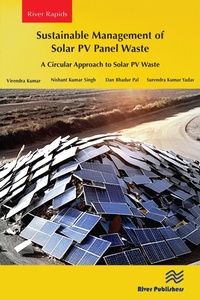
Sustainable Management of Solar PV Panel Waste
Description

The solar boom sweeping the world holds both promise and peril. Although solar PV panels provide a revolution in energy production, it is their end-of-life that poses a serious challenge. This book, Sustainable Management of Solar PV Panel Waste, addresses several aspects of this concern. It assesses the environmental degradation over the entire lifecycle of solar panels, from manufacturing to disposal. Readers will encounter new waste management approaches, explore key policy frameworks, and learn about urban technologies capable of resource recovery.
This book should be mandatory reading for researchers, policy-makers and industry professionals who want to reduce the environmental impacts of solar energy and create a truly sustainable solar future.
More details
Other editions
Additional editions
Persons
Dr. Virendra Kumar is an Associate Professor in the Department of Mechanical Engineering at MMUT, Gorakhpur, India. He has a Ph.D. in Thermal Engineering from the prestigious Indian Institute of Technology, Delhi, India and has over eight years of experience in teaching and research. He is an author of over 50 research articles and four books. E-mail address: virendar.k@hbtu.ac.in
Dr. Nishant Kumar Singh is an Associate Professor at Harcourt Butler Technical University, Kanpur, India. He holds a Ph.D. from the Indian Institute of Technology ( Dhanbad), India. Dr. Singh has published over 110 research articles in well-known international journals. He has also written five books with international publishers like CRC Press and Nova Publishers. His research interests include tribology, composites, micro-manufacturing, and non-conventional machining processes. Email: nsingh@hbtu.ac.in
Dr. Dan Bahadur Pal is currently working as an Assistant Professor in the Department of Chemical Engineering at Harcourt Butler Technical University, Kanpur, India. He completed his Ph.D. in 2017 in Chemical Engineering from the Indian Institute of Technology (BHU) Varanasi, Uttar Pradesh, India. He has published 82 papers in internationally refereed journals, six books, and thirty book chapters. Email: dbpal@hbtu.ac.in
Dr. Surendra Kumar Yadav is an Assistant Professor in the Department of Mechanical Engineering at K R Mangalam University in Gurugram, India. He earned his Master's (M.Tech) and doctoral (Ph.D.) degrees from the National Institute of Technology in Silchar, India. He has published more than 21 articles in reputed international peer-reviewed journals. Email: https://www.krmangalam.edu.in/
Content
Chapter 1 Introduction Chapter 2 Solar PV Panel Waste Projections Chapter 3 PV Panel Composition and Waste Classification Chapter 4 PV Panel Waste Management Options Chapter 5 National Approaches to PV Waste Management Chapter 6 Value Creation from End-of-life PV Panels Chapter 7 Conclusions: The Way Forward
