

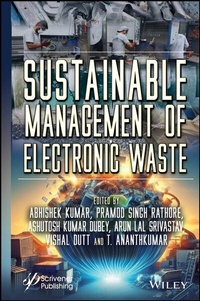
Sustainable Management of Electronic Waste
Description

Written and edited by a group of industry professionals, this new volume provides cutting-edge insights into how the sustainability of managing electronic waste can be achieved, for engineers, scientists, and students.
As a result of the rapid advancement of technology and the globalization of the economy, waste electrical and electronic equipment (WEEE) management has become increasingly important. Manufacturers are especially concerned about the proper disposal of their waste, and researchers need to identify the obstacles and enablers that stand in the way of implementing a long-term WEEE management system in order to develop a long-term WEEE management system. Further, the literature did not adequately capture the perspectives of multiple stakeholders while also identifying the enablers required for the development of sustainable WEEE management policies, which was particularly important in developing countries.
This volume fills a gap in the literature by considering the perspectives of multiple stakeholders to identify enablers of sustainable WEEE management in emerging economies which was previously unexplored. This book focuses on the most recent technological advancements for the twenty-first century, emphasizing the synergies that exist between computer science, bioinformatics, and other sciences. The research and development of artificial intelligence, machine learning, blockchain technologies, quantum computing with cryptography, nanotechnology, sensors based on biotechnology, Internet of Things devices, nature-inspired algorithms, computer vision techniques, computational biology, and other topics are covered in this book, along with their applications in the fields of science, engineering, physical science, and economics. Modern environmental techniques are among the most innovative innovations emerging as a result of the insatiable demand for health standards in the modern world.
More details
Other editions
Additional editions
Persons
Abhishek Kumar, PhD, is an assistant director and associate professor in the Computer Science and Engineering Department at Chandigarh University, Punjab, India. He is also a post-doctoral fellow at the Ingenium Research Group Lab, Universidad De Castilla-La Mancha, Ciudad Real, Spain. He has published over 150 publications in scientific journals and conferences and is a series E\editor for three books series. He is also working on numerous books for Scrivener Publishing.
Pramod Singh Rathore is an assistant professor in the Department of Computer and Communication Engineering at Manipal University Jaipur, India. He is pursuing his doctorate in computer science engineering from the University of Engineering and Management, Jaipur. With over 11 years of academic teaching experience, he has published more than 65 papers in scientific journals, books, and conferences. He has co-authored and edited numerous books and is working on numerous books for Scrivener Publishing.
Ashutosh Kumar Dubey, PhD, is an associate professor in the Department of Computer Science at Chitkara University School of Engineering and Technology, Himachal Pradesh, India. He is a postdoctoral fellow at the Ingenium Research Group Lab, Universidad de Castilla-La Mancha, Ciudad Real, Spain. He has more than 16 years of teaching experience and has authored or edited 15 books and has published over 65 articles in scientific journals and conference proceedings. He serves as an editor, editorial board member, and reviewer for numerous peer-reviewed journals.
Arun Lal Srivastav, PhD, is working as associate professor at the Chitkara University School of Engineering and Technology, Chitkara University, Baddi, Himachal Pradesh, India. He has published more than 80 research papers in various prestigious journals and is the editor of 17 books.
Vishal Dutt is currently working as a technical trainer at Chandigarh University, Mohali, Punjab, India with a strong background in academia and industry. With over seven years of teaching and research experience, he has authored over 50 scientific journals, conferences, and book chapters. He has contributed to the editorial process of many books and is currently working on three more publications.
T. Ananthkumar, PhD, is working as an assistant professor at the IFET College of Engineering affiliated with Anna University, Chennai. His fields of interest are networks on chips, computer architecture, and application-specific integrated circuit design. He is a life member of the International Society of Technology in Education and has many patents in various domains. He has written many book chapters and edited four books.
Content
Foreword xvii
Preface xix
1 Integration of Artificial Intelligence Techniques for Energy Management 1
Bhanu Chander and Kumaravelan Gopalakrishnan
2 Artificial Neural Network Process Optimization for Predicting the Thermal Properties of Biomass: Recent Advances and Future Challenges 47
S. Dayana Priyadharshini and M. Arvindhan
3 E-Waste Management and Bioethanol Production 67
Anshu Sibbal Chatli
4 A Novel-Based Smart Home Energy Management System for Energy Consumption Prediction Using a Machine Learning Algorithm 79
N. Deepa, Devi T., S. Rakesh Kumar and N. Gayathri
6 Comprehensive Review of IoT-Based Green Energy Monitoring Systems 113
Aishwarya V.
7 The Contribution of Renewable Energy with Artificial Intelligence to Accomplish Organizational Development Goals and Its Impacts 145
K. M. Baalamurugan and Aanchal Phutela
8 Current Trends in E-Waste Management 167
Anjali Sharma, Devkant Sharma, Deepshi Arora and Ajmer Singh Grewal
9 Current E-Waste Management: An Exploratory Study on Managing E-Waste for Environmental Sustainability 187
Shweta Solanki and Pramod Singh Rathore
10 Challenges in E-Waste Management 201
Himani Bajaj, Anjali Sharma, Deepshi Arora, Mayank Yadav, Devkant Sharma and Prabhjot Singh Bajwa
11 Recycling of Electronic Wastes: Practices, Recycling Methodologies, and Statistics 221
Suresh Chinnathampy M., Ancy Marzla A., Aruna T., Dhivya Priya E. L., Rindhiya S. and Varshini P.
12 Sustainable Development Through the Life Cycle of Electronic Waste Management 237
D. Magdalin Mary, S. Jaisiva, C. Kumar and P. Praveen Kumar
13 E-Waste Challenges & Solutions 255
K. Dhivya and G. Premalatha
14 Global Challenges of E-Waste: Its Management and Future Scenarios 277
Pranay Das and Swati Singh
15 Impact of E-Waste on Reproduction 293
Adrija Roy, Sayantika Mukherjee, Dipanwita Das and Amrita Saha
16 Challenges in Scale-Up of Bio-Hydrometallurgical Treatment of Electronic Waste: From Laboratory-Based Research to Practical Industrial Applications 301
Ana Cecilia Chaine Escobar, Andrew S. Hursthouse and Eric D. van Hullebusch
17 Current Advances in Recycling of Electronic Wastes 341
Kumar Sagar Maiti, Irin Khatun, Serma Rimil Hansda and Dipankar Ghosh
18 E-Waste: The Problem and the Solutions 375
Krati Taksali and Pramod Singh Rathore
19 Contribution of E-Waste Management in Green Computing 397
Shweta Sharma and Vishal Dutt
References 411
Index 413
Preface
This book is organized into nineteen chapters. In Chapter 1, a study explores the published works of AI with EMS, RES, and SG, their effects, and their reasons. AI technology has evolved quickly in the last several decades, and its applications have rapidly increased in modern industrial systems. Similarly, nature-inspired and biological systems denote an unlimited inspiration source for developing technical systems that lead human civilization's progress and shape our thinking style.
In Chapter 2, the author introduces the concept of the progress of artificial intelligence and blockchain technology unlocking prospects toward thermal marketing accuracy. The Artificial Neural Network (ANN) is crucial for improving biomass energy prediction research. This study emphasizes the steps in modeling and using ANN in forecasting biomass thermal values. Several research gaps in the present state of the investigation on ANN, in terms of biomass and guidance for additional research, are identified.
Chapter 3 will also go over growing environmental concerns over the use and depletion of non-renewable fuel sources, together with the increasing price of oil and instabilities in the oil markets, which have recently stimulated interest in producing sustainable energy sources in the form of biofuels derived from plants. Ethanol developed from lignocellulosic biomass has characteristic benefits of safety, economics, and being more environmentally friendly than fossil fuels. The lignocellulosic materials comprise 50% cellulose, 25% hemicellulose, and 25% lignin.
In Chapter 4, a novel approach for a Smart Home Energy Management System for Energy Consumption Prediction is proposed using an Enhanced Bayesian Linear Regression Machine Learning algorithm (EBLRML). The residual sum of squares shows the significant linear model difference from the existing application of ML techniques where the coefficient based on correlation is lower, and the energy consumption is calculated to achieve the best-fit model.
In Chapter 5, the author explains that using artificial intelligence today improves all the limitations outlined in the problem statements above. Machine learning algorithms have been used to predict crop cultivation, optimization metrics, irrigation levels, and so on, but very little has been done to predict weather and forecast agriculture. By using advanced sensors connected to a network, it is possible to identify bad weather that may threaten agriculture itself at an earlier stage. A live farm's features can improve crop exploitation earlier in the growing cycle.
In Chapter 6, the author explains that energy consumption has risen exponentially, putting pressure on the utilities to increase energy production. One of the significant concerns of the current day is that energy conservation and monitoring systems have been developed to optimize the increasing demand for energy and its consumption. Energy management systems help to decrease current consumption, prevent energy wastage, and enable the optimized utilization of available resources.
In Chapter 7, the author explains a significant impediment to the widespread adoption of these energy sources in their high integration costs. However, artificial intelligence (AI) explanations and data-intensive expertise are currently being deployed in various sectors of the electrical significance chain and, given the future smart grid's increasing complexity and data generation capacity, have the probability of adding substantial value to the system.
Chapter 8 provides detailed explanations of critical issues influencing India's entire e-waste value chain, including a lack of data inventorization, unlawful disposal, and treatment choices. As a result, this study focuses on strategic interventions that comply with existing legislation and are necessary for a long-term e-waste value chain, secure resources, social well-being, reduced environmental consequences, and overall sustainable development. Apart from these, other methods for recycling e-waste are also incorporated to maintain the environment's integrity.
Chapter 9 discusses the environmental concerns linked with discarded electronic equipment, sometimes known as "e-waste," in detail. In addition, the development of e-waste both now and in the future, as well as any environmental difficulties that may come from its management and disposal approaches, are investigated, and the existing programs for the management of e-waste are discussed.
Chapter 10 discusses electronic devices, such as televisions, smart-phones, and refrigerators, that have limited useful lives and must therefore be replaced frequently, creating e-waste. E-waste has the fastest growth rate among municipal solid garbage, producing 20 to 50 million tons annually globally. As a result, several nations are currently managing enormous amounts of e-waste. An essential issue in handling e-waste is environmental health. Worldwide, governments struggle to increase public awareness and make significant steps to protect the environment from rapid degradation. Because of the reasons above, effective e-waste management is required constantly.
Chapter 11 discusses the goals pertaining to the disposal of devices nearing the end of their "useful life." Increasing transboundary secondary resource movement and Asia's rapid economic growth will require both 3R initiatives (reduce, reuse, recycle) in every nation and effective management of the global material cycle. As a result, electrical and electronic garbage management, or "e-waste," has gained significant attention. For material processes from the national and international environmental and resource preservation perspectives, digital goods are at an all-time high in the developing digital world, and it is difficult to envision our everyday lives without them. Although they are most significant throughout their lifetime, they could endanger the environment if burned or disposed of in landfills.
Chapter 12 will include information on how the overall amount of trash managed locally and worldwide may be decreased by improving the lifecycle management of electronics by reducing the source of materials consumed, enhancing reuse, restoration, extending product life, and recycling electronics. The EPA's waste management hierarchy aligns with the life cycle approach. The hierarchy underlines that reducing, reusing, and recycling is essential components of sustainable materials management and grades the different management options from greenest to least green.
Chapter 13 discusses that e-waste is a significant problem in the technological world. To put it simply, e-waste refers to any unwanted or obsolete electronic equipment. Obsolete technology is inevitably phased out, reducing amounts of WEEE garbage. Large appliances and electronics such as refrigerators, air conditioners, computers, and mobile phones are all broken. This trash has the potential to kill humans. Humans and ecosystems alike are negatively affected by improper waste management. Polluting the environment by incinerating, burying, or dumping electronic waste is unacceptable. Rare earth elements used in reusable electronics are reusable.
Chapter 14 highlights modern developments in e-waste production and streams, current recycling technologies, human health, and environmental impacts of recycled materials and processes. The background, challenges, and problems of e-waste disposal and its proper management are also discussed, along with the implications of the analysis.
Chapter 15 shows associations between exposure to e-waste and physical health outcomes, including thyroid function, reproductive health, lung function, growth, and changes to cell functioning. Several researchers have investigated the consequences of pregnancies in communities exposed to e-waste. In most investigations, there have been consistent effects of exposure with increases in spontaneous abortions, stillbirths, premature deliveries, lower birthweights, and birth durations, despite diverse exposure settings and toxins being examined.
Chapter 16 will assess peer-reviewed data gathered to establish the technology readiness level of biohydrometallurgy for material recovery from e-waste at a pilot scale, concluding that bioleaching at a commercial scale currently faces diverse operational challenges that hamper its scale-up and industrial implementation.
Chapter 17 presents diverse e-waste recycling technologies, including conventional (physical and chemical treatments) and modern (biological or microbial treatments) approaches to combat environmental pollution and community health hazards. However, conventional and modern techniques suffer from multiple lacunae related to the efficacies of e-waste recycling techniques. To this end, the current literature review deals with a general outline of e-waste generation and categorization with special emphasis on e-waste recycling processes in great detail.
Chapter 18 discusses e-waste's addition to our ever-growing hazardous solid waste. Electronics and electrical equipment are part of e-waste. Many countries, especially developing countries like India, are facing infinite challenges in the management of e-waste which imported illegally or generated internally. India is also one of the countries fighting for e-waste management.
Chapter 19 discusses e-waste management as crucial to the development of green computing. We can lessen technology's adverse environmental effects and save resources...
