

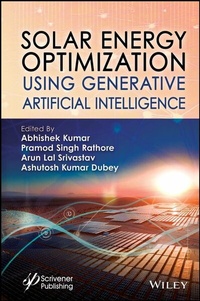
Solar Energy Optimization Using Generative Artificial Intelligence
Description

Lead the sustainable energy revolution with this guide to mastering the AI-driven algorithms and smart material innovations that are revolutionizing solar energy.
The integration of artificial intelligence into solar energy systems represents the next frontier in sustainable development, promising to improve efficiency, reduce costs, and increase the viability of solar energy as a mainstream energy source. This book will delve into the transformative role of artificial intelligence in enhancing various aspects of solar energy systems. It will begin by exploring how AI can significantly boost the energy efficiency of solar panels, showcasing innovative algorithms and techniques designed to optimize energy capture and conversion. The development of smart materials for enhanced energy storage will also be covered, emphasizing the latest advancements in material science driven by AI to improve the storage capabilities and longevity of solar panels. Further, it will address integrated waste management options for exhausted solar panels, providing insights into sustainable practices and AI-driven solutions for recycling and repurposing solar panel components. It will discuss the significance of AI in solar energy conservation and climate change management, illustrating how AI technologies are being harnessed to predict, monitor, and mitigate environmental impacts. Additionally, the book will explore the future scope of photovoltaic-based solar energy in a changing environment, highlighting AI's role in achieving sustainability and adapting to evolving climatic conditions. Using case studies and real-world applications, this book will demonstrate successful implementations of AI in the solar energy sector. Topics such as predictive maintenance, solar irradiance forecasting, optimal placement of solar panels, and AI-enhanced solar tracking systems will be featured to provide a comprehensive understanding of how AI is revolutionizing the solar energy landscape.
More details
Other editions
Additional editions

Persons
Abhishek Kumar, PhD is the Research and Design Coordinator and an Associate Professor in the Department of Computer Science at Chandigarh University. He has more than 100 publications in reputed, peer-reviewed national and international journals, books, and conferences. His research areas include artificial intelligence, image processing, computer vision, data mining, and machine learning.
Pramod Singh Rathore, PhD is an Assistant Professor in the Department of Computer and Communication Engineering at Manipal University. With more than 11 years of academic teaching experience, he has published more than 55 papers in reputable, peer-reviewed national and international journals, books, and conferences, and co-authored and edited numerous books. His research interests include NS2, computer networks, mining, and database management systems.
Arun Lal Srivastav, PhD is an Associate Professor at Chitkara University. He has published more than 90 research publications in prestigious journals, books, and conferences, edited 23 books, and filed 25 patents. His research interests include energy management, water quality surveillance, climate change, and water treatment.
Ashutosh Kumar Dubey, PhD is a Postdoctoral Fellow at the Ingenium Research Group Lab at the Universidad de Castilla-La Mancha with more than 14 years of teaching experience. He has authored one book and serves as an editor and editorial board member of many peer-reviewed journals. His research areas are machine learning, renewable energy, cloud computing, data mining, health informatics, optimization, and object-oriented programming.
Content
- Cover
- Series Page
- Title Page
- Copyright Page
- Contents
- Preface
- Chapter 1 Machine Learning Advancements in Solar Energy Forecasting: A Comprehensive Review
- 1.1 Introduction
- 1.2 Literature Review
- 1.3 Proposed Model
- 1.4 Conclusion and Future Work
- References
- Chapter 2 Development of Smart Materials for Enhanced Energy Storage in Solar Panels
- 2.1 Introduction
- 2.2 Literature Review
- 2.3 Smart Solar Photovoltaic (PV) Materials
- 2.4 Efficacy, Constancy, and Scalability of Sol-Gel Processed PV Materials
- 2.4.1 Commercial Practicability
- 2.4.2 Photovoltaic Device Efficiencies
- 2.4.3 Steadiness of Solar Cells
- 2.4.4 Scalability of Solar Cells
- 2.5 Environmental Influences of Solar PV
- 2.6 Future Directions
- 2.7 Conclusion
- Bibliography
- Chapter 3 Role of AI to Increase the Energy Efficiency of Solar Panels for Energy Conservation
- 3.1 The Immediate Nature of Energy Demand
- 3.2 Bibliography Study
- 3.3 Solar Energy: The Solution to the Current Energy Crisis
- 3.4 Artificial Intelligence (AI) - A Brief Account
- 3.5 The AI-Facilitated Future of Solar Cells
- 3.6 Artificial Intelligence Solutions in the Use of Solar Energy
- 3.7 Enabling Installs: Maximizing Value and Minimizing Cost with Machine Learning Techniques for Solar Panel Placement
- 3.8 Further Applications of AI-Powered Solar Cells
- 3.9 Conclusion
- References
- Chapter 4 Artificial Intelligence in Wind Energy Systems: Enhancing Efficiency and Optimizing Operations
- 4.1 Introduction
- 4.2 Comparison of Power Capacity Percentage of Various Renewable Energy Sources
- 4.3 Limitations of Traditional Wind Energy Prediction Methods (e.g., Statistical and Physical Models)
- 4.4 The Need for More Advanced Approaches to Handle the Complexity and Variability of Wind Patterns
- 4.5 Traditional Wind Energy Prediction Methods
- 4.6 Machine Learning Approaches
- 4.6.1 Regression Models
- 4.6.2 Classification Models
- 4.6.3 Neural Networks
- 4.6.4 Ensemble Methods
- 4.6.5 Hybrid Models
- 4.7 Wind Energy Prediction Methods vs. Machine Learning Approaches for Wind Farm Site Selection
- 4.8 Case Studies and Real-World Applications
- 4.9 AI-Driven Maintenance at General Electric (GE)
- 4.10 Future Trends in AI for Wind Energy
- 4.11 Conclusion
- References
- Chapter 5 Role of AI Generative in Renewable Energy and Conservation of the Environment
- Introduction
- Conclusion
- References
- Chapter 6 Ethical Consideration in the Use of AI for Solar Energy Optimization
- 6.1 Introduction
- 6.1.1 The Origin of Solar Energy
- 6.1.2 Factors for Using Solar Power
- 6.1.3 The Importance of Estimating the Quantity of Solar Power
- 6.1.4 Optimization Method
- 6.1.5 Machine Learning Models
- 6.1.5.1 K-Harmonic Mean-Based Attribute Weighting Method
- 6.1.5.2 Deep Neural Network (DNN)
- 6.1.5.3 K-Mean++ Technique
- 6.1.5.4 ABC-Based Detection Technique
- 6.1.5.5 Processed Data
- 6.1.5.6 LS-Support Vector Machine (LS-SVM)
- 6.2 Literature Survey
- 6.2.1 Introduction
- 6.3 An Efficient Machine Learning Based Optimization Framework
- 6.3.1 Solar Power Reduction
- 6.3.2 Evaluation Parameter
- 6.4 Conclusion
- References
- Chapter 7 Generative AI and Solar Energy: Shaping the Future of Sustainable Power
- Introduction
- 7.1 Current State of Generative AI in Solar Energy
- 7.1.1 AI Generative Design in Solar Energy
- 7.1.2 AI-Driven Optimization of Solar Panel Layout
- 7.1.3 AI-Driven Predictive Maintenance in Solar Farms
- 7.1.4 AI-Driven Optimization of Utility-Scale Solar Farms
- 7.1.5 Industry-Specific Applications of AI in Solar Energy
- 7.1.5.1 Smart Grid Integration
- 7.1.5.2 Solar Asset Management
- 7.1.5.3 Automated Energy Trading
- 7.1.5.4 Residential and Commercial Solar Optimization
- 7.1.5.5 Solar-Powered Microgrids
- 7.1.5.6 AI-Enhanced Battery Storage
- 7.1.5.7 AI-Powered Solar Forecasting
- 7.2 Emerging Trends in Generative AI in Solar Energy
- 7.2.1 AI-Powered Smart Grid Integration
- 7.2.2 AI-Enhanced Energy Storage Solutions
- 7.2.3 Decentralized Solar Energy Systems and Peer-to-Peer Energy Trading
- 7.2.4 AI-Driven Material Innovation for Solar Panels
- 7.2.5 AI-Enabled Autonomous Solar Installation and Maintenance
- 7.2.6 AI-Powered Hybrid Energy Systems
- 7.3 Challenges and Limitations
- 7.4 Future Research Directions in Context of Generative AI and Solar Energy
- Conclusion
- References
- Chapter 8 Leveraging AI for Sustainable Solar Energy Efficiency and Climate Change Mitigation
- 8.1 Introduction
- 8.1.1 Traditional Solar Conservation Techniques
- 8.1.2 Traditional Solar Energy Block Diagram
- 8.1.3 Passive Solar Heating
- 8.1.4 Heating Water Using Solar Energy
- 8.1.5 Solar Cookers
- 8.1.6 Trombe Walls
- 8.2 Literature Review
- 8.3 Role of AI
- 8.3.1 AI-Driven Solar Conservation Techniques
- 8.3.2 AI Home Solar Panel Optimization
- 8.3.3 Predictive Maintenance
- 8.3.4 Solar Energy Forecasting
- 8.3.5 Smart Energy Management Overview
- 8.3.6 The Art of Foresight
- 8.3.7 Energy Estimation
- 8.4 Benefits
- 8.5 Challenges
- 8.6 Future Work
- 8.7 Conclusion
- References
- Chapter 9 Market Analysis of Solar Energy through Generative AI Insights
- 9.1 Introduction
- 9.2 Overview of the Solar Energy Market
- 9.2.1 The Rise of Solar Energy
- 9.2.2 Where We Stand Today
- 9.2.3 The Economics of Solar Energy
- 9.2.4 Challenges to Solar Expansion
- 9.2.5 Why Policies are Driving Change
- 9.2.6 The Future of Solar Energy
- 9.3 Role of the Solar Energy Market
- 9.3.1 Optimizing the Solar Panel Design and Installation
- 9.3.2 Energy Production Forecasting
- 9.3.3 Improved Energy Storage and Grid Integration
- 9.3.4 Fault Detection and Predictive Maintenance
- 9.3.5 Cost Reduction and Efficiency Improvement
- 9.3.6 Speeding Up Research and Development
- 9.3.7 AI for Solar Energy in Smart Cities
- 9.3.8 Environmental and Sustainability Benefits
- 9.4 AI-Driven Market Forecasting and Investment Analysis
- 9.4.1 The Evolution of Solar Power Forecasting through AI Integration
- 9.4.2 Market Implications of Enhanced Solar Forecasting
- 9.4.3 Investment Landscape and Market Growth Projections
- 9.4.4 Key Investment Focus Areas
- 9.5 Challenges and Limitations of GenAI in Solar Energy
- 9.5.1 Energy Use & Environmental Dilemma
- 9.5.2 Data Dependence & Quality Constraints
- 9.5.3 Technical Integration & Infrastructure Obstacles
- 9.5.4 Regulatory & Market Dynamics
- 9.5.5 Scalability & Future Projections
- 9.6 Future Works and Recommendations
- 9.6.1 Improved Solar Forecasting
- 9.6.2 Optimized Renewable Energy Integration
- 9.6.3 Smart Energy Management Systems
- 9.6.4 AI-Driven Design of Solar Infrastructure
- 9.6.5 Market Growth and Investment
- 9.6.6 Policy Initiatives Fostering AI in Energy
- Conclusion
- References
- Chapter 10 Significance of AI in Solar Energy Conservation and Climate Change Management
- 10.1 Introduction
- 10.1.1 Solar Energy and the Global Energy Transition
- 10.1.2 Challenges in Solar Energy Adoption
- 10.1.3 The Emergence of AI in Solar Energy Systems
- 10.1.4 Significance of AI in Solar Energy Optimization
- 10.1.5 AI-Powered Predictive Maintenance in Solar Infrastructure
- 10.1.6 AI's Role in Grid Integration and Energy Storage
- 10.1.7 Land Use Management: AI-Driven Solar Project Mapping
- 10.1.8 The Importance of AI in Climate Change Mitigation
- 10.2 AI in Solar Energy Optimization
- 10.2.1 Real-Time Data Analysis
- 10.2.2 AI-Based Weather Conditions Forecasting for Predictive Adjustments
- 10.2.3 Optimizing Solar Panel Orientation and Reducing Energy Loss
- 10.2.4 Bad Cell Searching and Cure
- 10.2.5 Machine Learning for Long-Term System Efficiency
- 10.2.6 Strengthen the Economic Viability and Environmental Sustainability
- 10.3 Predictive Maintenance with AI in Solar Infrastructure
- 10.3.1 Early Fault Detection Through Predictive Analytics
- 10.3.2 Machine Learning Models and Historical Data
- 10.3.3 Durable Lifespan of Solar Installation
- 10.3.4 Minimizing Downtime and Maximizing Energy Production
- 10.3.5 Reducing Maintenance Costs through Early Intervention
- 10.3.6 Sustainability Benefits and Reduced CO2 Emissions
- 10.4 Artificial Intelligence in Grid Integration and Energy Storage
- 10.4.1 Predictive Algorithms for Solar Energy Output
- 10.4.2 Increased Grid Flexibility and Stability
- 10.4.3 Energy Storage Optimization by AI
- 10.4.4 Reducing Carbon Emissions and Fossil Fuel Dependency
- 10.5 AI-Driven Solar Project Mapping and Land Use Management
- 10.5.1 Application of AI in Geospatial Analysis
- 10.5.2 Identifying a Sustainable Location for Solar Development
- 10.5.3 Reducing Ecological and Social Impacts
- 10.5.4 Real-Time Monitoring and Decision Making
- 10.5.5 AI-Based Solutions for Conflicts Over Land Use
- 10.6 The Role of AI in Climate Change Mitigation
- 10.6.1 Efficient Energy Harvesting through Increased Efficiency of Solar Energy Systems and Reduced Carbon Emissions
- 10.6.2 Optimization of Energy Demand Management
- 10.6.3 AI in Sustainable Solar Project Development
- 10.6.4 Role of AI in Global Climate Policy
- 10.6.5 AI for a Circular Economy
- 10.7 Conclusion
- References
- Chapter 11 Navigating the Impacts of Photovoltaic Solar Energy: Socio-Economic and Environmental Perspectives with AI Solutions
- 11.1 Introduction
- 11.1.1 Background
- 11.1.2 Objectives
- 11.1.3 Scope
- 11.1.4 Environmental Background
- 11.1.5 AI in Overcoming the Challenges
- 11.2 Literature Review
- 11.3 Methodology
- 11.3.1 Data Collection
- 11.3.2 Training and Validation of an AI Model
- 11.3.3 Environmental Impacts
- 11.4 Results
- 11.4.1 Summary of Results
- 11.5 Conclusion
- References
- Chapter 12 Smart Materials for Enhanced Energy Storage in Solar Energy Systems: A Generative AI Approach
- 12.1 Introduction
- 12.1.1 Current Challenges in Solar Energy Storage
- 12.1.2 Role of Generative AI in Smart Materials Discovery
- 12.2 Literature Review
- 12.2.1 Evolution of Smart Materials for Energy Storage
- 12.2.2 Current State of AI Applications in Materials Science
- 12.2.3 Research Gaps and Opportunities
- 12.3 Generative AI Frameworks for Material Design
- 12.3.1 AI Techniques in Materials Science
- 12.3.2 Material Property Prediction and Optimization
- 12.4 AI-Enabled Smart Electrode Materials
- 12.4.1 Computational Discovery of Novel Compositions
- 12.4.2 Case Study: GAI-Optimized Battery Materials for Solar Storage
- 12.5 Advanced Phase-Change Materials
- 12.5.1 AI-Driven Design for Thermal Energy Storage
- 12.5.2 Performance Enhancement through Generative Design
- 12.6 Self-Healing Materials for Extended Lifespan
- 12.6.1 AI Prediction of Degradation and Self-Repair Mechanisms
- 12.6.2 Implementation in Solar Storage Systems
- 12.7 System Integration and Performance
- 12.7.1 Digital Twin Modeling of Smart Material Storage
- 12.7.2 Techno-Economic Analysis and Optimization
- 12.8 Future Directions and Challenges
- 12.8.1 Emerging Smart Materials for Next-Generation Storage
- 12.8.2 Commercial Implementation Roadmap
- 12.9 Conclusion
- References
- Chapter 13 Optimizing Wind Turbine Site Selection Using Machine Learning: Techniques, Applications, and Case Studies
- 13.1 Introduction
- 13.1.1 The Importance of Site Selection in Wind Energy
- 13.1.2 Limitations of Traditional Site Selection Approaches
- 13.1.3 AI as a Solution for Site Selection Optimization
- 13.2 Key AI Techniques in Wind Turbine Site Selection
- 13.2.1 Machine Learning Models for Predictive Analysis
- 13.2.2 Geographic Information Systems (GIS) and Data Layering
- 13.2.3 Optimization Algorithms for Site Selection
- 13.2.4 Hybrid Models and Ensemble Approaches
- 13.3 Data Sources and Processing for AI-Driven Site Selection
- 13.3.1 Key Data Sources
- 13.3.2 Data Cleaning and Preprocessing Techniques
- 13.3.3 Feature Engineering for Wind Site Selection
- 13.4 Applications and Case Studies
- 13.4.1 Case Study 1: Offshore Wind Farm Selection in Northern Europe
- 13.4.2 Case Study 2: AI-Powered Site Selection in Coastal India
- 13.4.3 Case Study 3: Hybrid Model for Wind Farm Development in the United States
- 13.5 Challenges and Limitations in AI-Driven Site Selection
- 13.5.1 Data Limitations and Quality Issues
- 13.6 Future Directions and Innovations in AI for Wind Site Selection
- 13.6.1 Advanced AI Techniques for Improved Prediction
- 13.6.2 Integration of Real-Time Data for Dynamic Site Assessment
- Conclusion
- References
- Chapter 14 AI-Driven Innovations in Solar Energy Systems and Climate Change Mitigation
- 14.1 Introduction
- 14.2 Solar Energy: Current Scenario and Challenges
- 14.2.1 Major Challenges of Solar Energy
- 14.3 Artificial Intelligence: A Transformational Technology
- 14.4 Role of AI in Solar Energy Conservation
- 14.4.1 Solar Power Forecasting
- 14.4.2 Smart Solar Panel Orientation and Sun Tracking
- 14.4.3 Predictive Maintenance of Solar Plants
- 14.4.4 Dust & Soiling Detection Using AI
- 14.4.5 Solar Energy Storage Optimization
- 14.4.6 Smart Grid Integration
- 14.5 Role of AI in Climate Change Management
- 14.5.1 Climate Modeling and Prediction
- 14.5.2 Carbon Emission Monitoring with AI
- 14.5.3 Renewable Energy Planning and Optimization
- 14.5.4 Disaster Management and Prediction
- 14.5.5 Smart City and Sustainable Environment Management
- 14.6 Integration of AI and IoT for Solar & Climate Efficiency
- 14.7 Case Studies and Real-World Applications
- 14.7.1 India's National Solar Mission and AI Integration
- 14.7.2 Google's AI for Climate Prediction
- 14.8 Benefits of AI in Solar and Climate Domains
- 14.8.1 Operational Benefits
- 14.8.2 Environmental Benefits
- 14.8.3 Economic Benefits
- 14.9 Challenges and Limitations of AI Integration
- 14.10 Future Directions
- 14.10.1 Autonomous Solar Plants
- 14.10.2 AI-Driven Climate Governance
- 14.10.3 Integration with General AI
- 14.11 Conclusion
- References
- Chapter 15 Smart Solar Energy Management through IoT and AI Integration: Architectures, Applications, and Future Trends
- 15.1 Introduction
- 15.1.1 Introduction to Solar Energy Management Issues
- 15.1.2 Significance of IoT and AI Implementation in Solar Systems
- 15.1.3 Issues and Capabilities of the Chapter
- 15.2 Literature Review
- 15.2.1 IoT Development in Renewable Energy Systems
- 15.2.2 AI Use in the Optimization of Solar Energy
- 15.2.3 Trends in the State of Research of IoT-AI Integration
- 15.3 IoT Architecture for Solar Energy Monitoring
- 15.3.1 Internet of Things Architecture in Solar Energy Monitoring
- 15.3.2 Edge Computing and Communication Protocols
- 15.3.3 Data Management Cloud-Based Solutions
- 15.4 Solar Energy Optimization AI Technologies
- 15.4.1 Predictive Maintenance Algorithms Based on Machine Learning
- 15.4.2 Deep Learning in Solar Panel Analysis
- 15.4.3 Solar Irradiance Forecasting Using Generative AI
- 15.4.4 Reinforcement Learning of Adaptive Energy Control
- 15.5 Solar Management IoT-AI Systems
- 15.5.1 Systems Components and Architecture Design
- 15.5.2 Integration of Real-Time Monitoring and Predictive Analytics
- 15.5.3 AI Energy Storage and Distribution Optimization
- 15.6 Applications and Case Studies
- 15.6.1 Residential Solar Energy Management Systems
- 15.6.2 Commercial and Industrial Implications
- 15.6.3 Solar Farms of Utility Scale with IoT-AI
- 15.7 Problems and Future Projections
- 15.7.1 Technical Challenges in IoT-AI Implementation
- 15.7.2 Transactions Secure Transactions Integrated with Blockchain
- 15.7.3 IoT-AI Solar Systems: Emerging Technologies
- 15.8 Conclusion
- 15.8.1 Conclusion of Findings and Reflections
- 15.8.2 Practice Implementation Recommendations
- Bibliography
- Index
- Also of Interest
- EULA
